 OPTIMUS DISTRIBUTOR
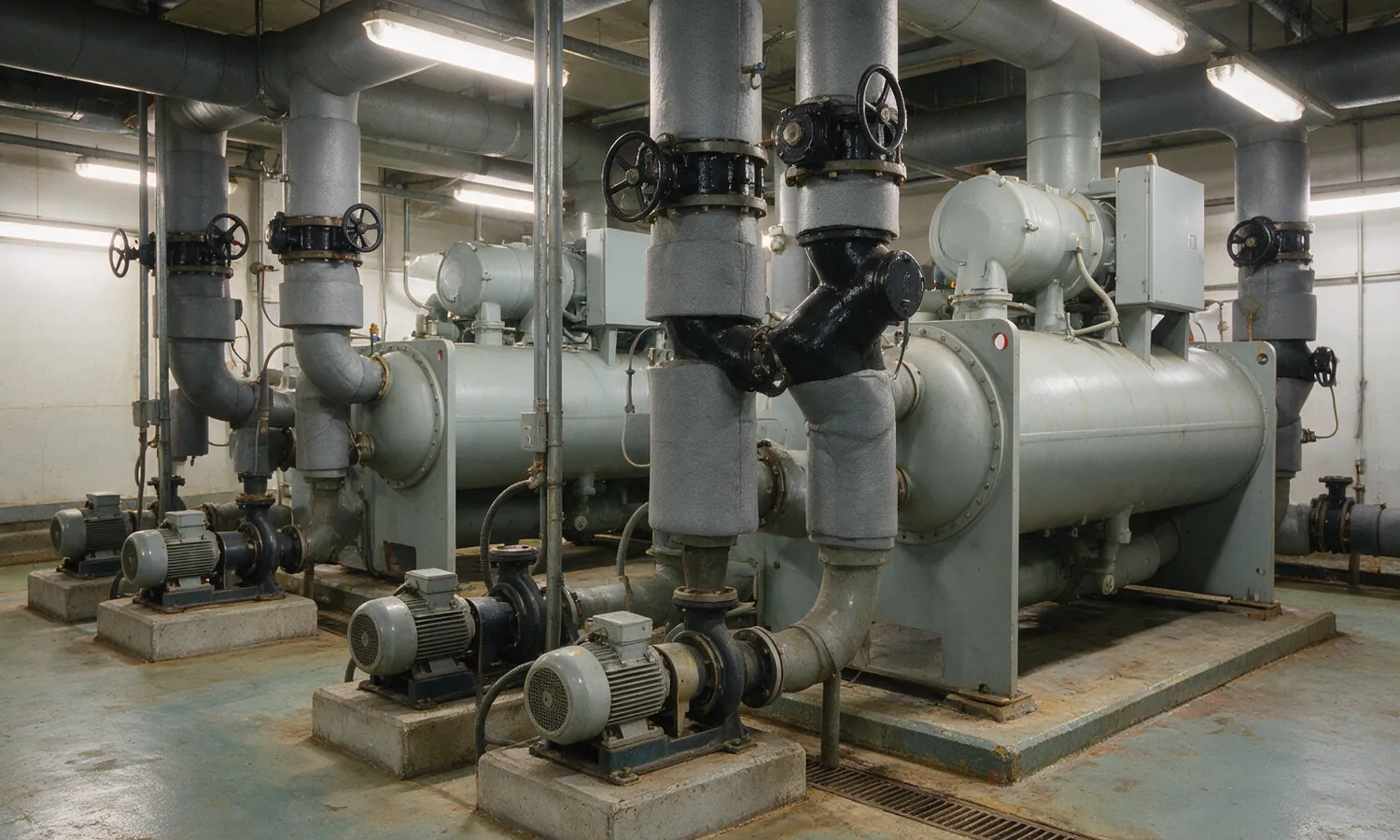
- A chiller is a machine that removes heat from water; a chilled-water system pumps that cold water through pipes to coils in air handlers, fan coils or data centre cooling units, then brings the warmed water back to be cooled again.
- Commonly the water leaves the chiller at about 7 °C and comes back at about 12 °C, a temperature difference (ΔT) of 5 K; the ΔT decides how much water the pumps move (section 05).
- Chillers are grouped by how they reject heat (air-cooled or water-cooled with a cooling tower) and by compressor (scroll, screw, centrifugal), with absorption chillers driven by heat instead.
- Capacity is quoted in refrigeration tons (1 RT = 3.517 kW) and efficiency in kW of electricity per ton, or as COP.
- The valves in the loop decide how well the plant performs: isolation at each chiller and pump, check valves on pump discharges, strainers, flexible joints, and balancing or pressure-independent control valves at every coil.
On this page15 sections
In Malaysian shops the word "chiller" is also used for a display fridge. This guide is about the other meaning, the chiller system and chilled water system of a building: the central cooling plant of an office tower, mall, hospital, factory or data centre, and the chilled-water system it feeds. It explains how the plant works from end to end, the types of chiller and how they are rated, and where each valve in the loop goes and why.
01What is a chiller, and what is a chilled-water system?
A chiller takes heat out of water and rejects it outside. The chilled-water system is everything around it: the pumps, pipes, valves and coils that carry the cold water to the rooms or equipment that need cooling and bring it back.
Wikipedia's article on chillers puts the purpose simply: "Chilled water is used to cool and dehumidify air in mid- to large-size commercial, industrial, and institutional facilities." The cold water itself never touches the room air. It flows through finned coils inside air handling units (AHUs), fan coil units (FCUs) or, in a data centre, computer room air handlers (CRAHs). A fan blows warm air across the coil, the air gives up its heat and moisture, and the water leaves the coil a few degrees warmer.
That is the main difference from a split or VRF air-conditioning system, where refrigerant runs all the way to each indoor unit. In a chilled-water system the refrigerant stays inside the chiller, and water, which is cheap, safe and easy to pipe over long distances, does the carrying.
A complete system has three loops that hand heat from one to the next:
- The chilled-water loop carries heat from the coils back to the chiller's evaporator.
- The refrigerant circuit inside the chiller moves that heat from the evaporator to the condenser.
- The heat rejection side gets rid of it: either fans blowing outdoor air across the condenser (air-cooled), or a condenser water loop that carries it to a cooling tower on the roof (water-cooled).
02How does a chiller make cold water?
Most chillers use the vapour-compression cycle: a refrigerant boils in the evaporator and takes heat from the water, a compressor raises its pressure, it gives the heat up and condenses in the condenser, and an expansion device drops its pressure so it can boil again.
The cycle has four parts, and each is worth knowing because each shows up on a chiller's datasheet:
- Evaporator. Return chilled water passes through a heat exchanger, shell-and-tube or plate type, where cold, low-pressure refrigerant boils and absorbs the water's heat. The water leaves colder.
- Compressor. The refrigerant vapour is compressed, which raises its pressure and temperature so that it is hotter than the air or water that will cool it.
- Condenser. The hot vapour gives up its heat, either to outdoor air blown across finned coils or to condenser water heading for the cooling tower, and condenses to liquid.
- Expansion device. The liquid passes through a metering device that drops its pressure, so it is cold again when it re-enters the evaporator.
The heat that leaves at the condenser is the heat taken from the building plus the energy the compressor put in. That is why a cooling tower or air-cooled condenser has to reject noticeably more heat than the building's cooling load, and why the condenser side is sized larger than the chilled-water side.
Absorption chillers are the exception. Instead of a compressor they use a heat source, usually steam, hot water or a gas burner, to drive the cycle. Wikipedia notes that an absorption chiller has "very low electrical power requirements" but large heat input, which is why they appear where waste heat is available.
03What are the main types of chiller?
Chillers are sorted two ways: by how they reject heat (air-cooled, water-cooled or evaporatively cooled) and by what drives the cycle (a scroll, screw or centrifugal compressor, or heat in an absorption machine). Put together, a buyer meets air-cooled and water-cooled machines with scroll, screw or centrifugal compressors, and absorption chillers.
Wikipedia lists the compressor types as reciprocating, scroll, screw and centrifugal, and says that "Most common today are the hermetic scroll, semi-hermetic screw, or centrifugal compressors." The table sets out the families a buyer meets.
| Type | How it rejects heat or is driven | Where it is usually found | What to know |
|---|---|---|---|
| Air-cooled | Fans blow outdoor air across the condenser coil | Rooftops | No cooling tower or condenser water to treat; less efficient than water-cooled because it rejects heat to the dry-bulb air temperature |
| Water-cooled | A condenser water loop takes the heat to a cooling tower | Plant rooms of large offices, malls, hospitals, district cooling | Higher efficiency; needs cooling towers, condenser pumps and water treatment |
| Evaporatively cooled | Water sprayed over the condenser coil | Outdoor packaged units | Efficiency between air-cooled and water-cooled |
| Scroll compressor | Electric, positive displacement | Simple and compact | |
| Screw compressor | Electric, positive displacement | Mid-size air-cooled and water-cooled chillers | |
| Centrifugal compressor | Electric, dynamic (impeller) | Large water-cooled plants | Highest full-load efficiency in the FEMP tables below |
| Absorption | Driven by steam, hot water or a burner | Sites with waste heat | Very low electricity use but a COP of about 0.5 to 1.0 |
The same chilled-water loop can be served by any of these. What changes for the valve and pipe side is mostly the condenser water: a water-cooled plant has a second set of pipes, pumps, strainers and isolation valves running to the cooling towers, and an air-cooled plant does not.
Which refrigerants do chillers use?
Wikipedia's chiller article groups the refrigerants by the pressure they run at: "R22, R134a, R1234ze(E), and R1234yf are positive pressure and R1233zd(E), R1224yd(Z), R514A and R123 are negative pressure." Positive pressure chillers "operate at internal pressures higher than ambient pressure, and negative pressure chillers operate under a partial vacuum internally", and the same article notes that negative pressure chillers "exhibit higher thermodynamic efficiency" but are heavier, being larger for the same cooling. The refrigerant stays sealed inside the chiller, so it changes nothing on the chilled-water side: the pipes, pumps and valves are the same whichever refrigerant the chiller uses.
04Air-cooled or water-cooled: which suits a building?
Water-cooled chillers are more efficient, because a cooling tower lets them reject heat close to the air's wet-bulb temperature. Air-cooled chillers are simpler to install and run, with no tower, condenser pumps or tower water to treat. Large, long-running plants usually go water-cooled; smaller or space-limited ones go air-cooled.
The reason for the efficiency gap is physics. Wikipedia explains that liquid-cooled chillers use cooling towers "which improve the chillers' thermodynamic effectiveness as compared to air-cooled chillers. This is due to heat rejection at or near the air's wet-bulb temperature rather than the higher, sometimes much higher, dry-bulb temperature." The wet-bulb temperature is always at or below the dry-bulb temperature; humid air narrows the gap but does not close it, and a lower condensing temperature means less work for the compressor.
The US Department of Energy's Federal Energy Management Program (FEMP) shows the size of the gap in its purchasing tables: for water-cooled chillers it states efficiency in kW per ton (lower is better), around 0.5 to 0.73 kW per ton depending on size and type, while it rates air-cooled chillers in EER (higher is better), around 10.9 to 11 at full load. Converted with kW per ton = 12 ÷ EER, an EER of 10.9 is about 1.1 kW per ton.
The trade-off is everything that comes with the tower. A water-cooled plant needs:
- cooling towers, with space and structure on the roof or at ground level;
- condenser water pumps, pipes, strainers and isolation valves;
- water treatment, because a cooling tower is open to the air and loses water by evaporation and drift, and Wikipedia's cooling tower article notes that bacteria including Legionella can thrive in the warm water if it is not treated.
So the choice usually comes down to the size of the load, the hours it runs and the space available. A small building, a single process line or a site with no room for towers often takes air-cooled chillers. A large tower or a 24-hour plant, where electricity is the biggest running cost, often justifies water-cooled ones.
05What temperatures does a chilled-water system run at?
Commonly the chiller receives water at about 12 °C and cools it to about 7 °C, a 5 K difference between supply and return. The leaving temperature can range from about 1 to 7 °C depending on the application, and the temperature difference (ΔT) is what decides how much water the pumps have to move.
Wikipedia gives both figures: chilled water leaving temperatures "usually range from 1 to 7 °C (34 to 45 °F), depending upon application requirements", and "Commonly, chillers receive water at 12°C (entering temperature), and cool it to 7°C (leaving temperature)." Supply temperatures close to freezing need glycol mixed into the water so it does not freeze inside the evaporator; Wikipedia notes that chilled coolant is often "chilled water mixed with ethylene glycol".
The supply temperature also decides how well the coils dehumidify. Colder water condenses more moisture out of the air, which matters in a humid climate where much of a coil's work is removing moisture rather than lowering temperature.
The ΔT is where many systems lose money. The cooling a coil delivers is the flow multiplied by the temperature rise. If the coil returns water at 9.5 °C instead of 12 °C, the ΔT is half the design value, and the pumps must push twice as much water to deliver the same cooling. This is the "low delta T" problem, and its usual causes are on the valve side: three-way valves bypassing cold water straight into the return, coils with too much flow because the system was never balanced, and dirty coils and strainers.
06How is chiller capacity measured, and how much water does it need?
Chiller capacity is quoted in refrigeration tons (RT) or kilowatts: one ton of refrigeration is exactly 12,000 Btu per hour, or 3.517 kW, so a 500 RT chiller is about 1,758 kW. The water flow it needs follows from that capacity and the design ΔT.
The ton comes from the cooling effect of melting one short ton of ice in 24 hours; Wikipedia gives its modern definition as "exactly 12,000 Btu IT /h ( 3.516853 kW )". Offers quote either unit, so it pays to convert before comparing two of them.
Worked example. An office tower needs a 500 RT water-cooled centrifugal chiller, designed for 12 °C return and 7 °C supply.
- Cooling capacity: 500 × 3.517 = about 1,758 kW.
- Chilled-water flow: capacity ÷ (specific heat of water × ΔT) = 1,758 ÷ (4.19 × 5) = about 84 kg/s, which is about 84 litres a second, or roughly 302 m³ an hour.
- If the system only manages a 2.5 K ΔT, the same 1,758 kW needs about 168 litres a second: twice the pump flow, and larger pipes and valves if it was designed that way.
- Electricity at full load: in FEMP's full-load table, a water-cooled centrifugal chiller of 400 to 599 tons must reach 0.541 kW per ton, so 500 × 0.541 = about 271 kW of electrical input for 1,758 kW of cooling.
Those flow figures are what size the chilled-water pumps, the main isolation valves at the chiller, the strainers and the balancing valve at the chiller branch. A supplier quoting the valves for a chiller connection will ask for the flow and the pipe size, not just the RT rating.
07How is chiller efficiency rated?
Efficiency is quoted as kW of electricity per ton of cooling (lower is better), as COP, the cooling output divided by the electrical input (higher is better), or as EER for air-cooled machines.
Wikipedia defines the coefficient of performance as "a ratio of the useful heating or cooling provided to the work (energy) required", and notes that "Most air conditioners have a COP of 3.5 to 5." The two common units convert directly: COP = 3.517 ÷ (kW per ton). The 500 RT chiller in the example above, at 0.541 kW per ton, has a full-load COP of about 6.5.
IPLV, the integrated part-load value, combines the chiller's efficiency at several part loads into one figure, measured under the AHRI 550/590 test procedures that FEMP names. FEMP publishes two tables: one for chillers that run mostly at full load and one for chillers that run mostly at part load. Its own requirement is set at the 25th percentile of the most efficient products, and the paired value comes from ASHRAE Standard 90.1-2022 (Path A IPLV, Path B full load). For a water-cooled centrifugal chiller of 400 to 599 tons, the full-load-optimised table asks for 0.541 kW per ton at full load and 0.500 IPLV; the part-load-optimised versions accept a slightly higher full-load figure in return for much better part-load efficiency.
| Water-cooled chiller (FEMP full-load table) | Capacity (tons) | Full load (kW/ton) | IPLV (kW/ton) |
|---|---|---|---|
| Positive displacement (scroll, screw) | Under 75 | 0.728 | 0.600 |
| Positive displacement | 150 to 299 | 0.611 | 0.540 |
| Positive displacement | 600 and over | 0.560 | 0.500 |
| Centrifugal | Under 150 | 0.610 | 0.550 |
| Centrifugal | 400 to 599 | 0.541 | 0.500 |
| Centrifugal | 600 and over | 0.501 | 0.500 |
These are US federal purchasing thresholds, not a Malaysian rule, but they are a useful published yardstick when comparing chiller offers. The chiller's rated efficiency is only reached if the water side delivers what the rating assumed: the design flow and ΔT through the evaporator and condenser.
08How is the chilled water distributed: constant or variable flow?
Older systems pump a constant flow and use three-way valves to bypass water around coils that need less cooling. Most new systems use two-port valves at the coils so the flow itself falls at part load, with variable-speed pumps controlled from a pressure sensor in the system.
In a constant-flow system every coil has a three-way valve. When a room needs less cooling, the valve sends some of the water around the coil instead of through it. The pumps always move the full design flow, and the bypassed cold water mixes into the return and drags the ΔT down.
In a variable-flow system the coils have two-port control valves that throttle the flow. CIBSE Journal's CPD module on pressure-independent control valves explains the benefit: by applying two-port control valves at the terminal loads, "and so not diverting flow around the loads", the main distribution flow rates modulate to meet the sum of the loads. Variable-speed pumps then slow down as the valves close, which saves pump energy. Our guide to choosing a two-way or three-way zone valve for a fan coil unit covers that choice at the terminal.
The plant itself is usually arranged one of two ways:
- Primary-secondary. Each chiller has its own constant-speed primary pump; a separate set of variable-speed secondary pumps serves the building. A short "decoupler" pipe between the two lets their flows differ.
- Variable primary. One set of variable-speed pumps moves water through both the chillers and the building, with a bypass that keeps each chiller above its minimum evaporator flow.
Variable flow has one catch: as valves open and close, the pressure across every other valve changes, and a conventional control valve's flow changes with it. That is the problem pressure-independent control valves (PICVs) solve: each one holds its set flow whatever the pressure around it. Our PICV guide explains how, and PICV start-up pressure and pump head shows how the PICV farthest from the pump helps set the pump's duty.
09Which valves does a chilled-water system need, and where do they go?
Every chiller, pump and coil needs isolation valves for maintenance; every pump needs a check valve on its discharge; strainers protect the pumps, chillers and control valves; flexible joints stop vibration travelling into the pipework; and every coil needs a way to control and balance its flow, a balancing valve with a control valve or a PICV.
The table follows the water round the loop. It lists what goes at each point and, for each, the Pettinaroli product line that Optimus Distributor supplies for that duty from the Pettinaroli HVAC catalogue and the Pettinaroli industrial valve flyer.
| Where in the loop | Valve or fitting | What it does | Pettinaroli line Optimus supplies |
|---|---|---|---|
| Chiller evaporator and condenser connections | Butterfly valves (isolation) | Let the chiller be shut off and drained for maintenance while the others run | BF3SE / BF4SE lug and wafer butterfly valves, 1¼" to 24", with gear or IP68 electric actuator options |
| Chiller and pump connections | Flexible joints | Absorb vibration and small movements so they do not pass into the pipework | GF1C / GF1CA single sphere flexible joint, 1¼" to 24" |
| Pump suction | Y-strainer | Catches debris before the pump and chiller | ST2D / ST2DA Y-strainer with test port, 2" to 24" |
| Pump discharge | Check valve | Stops reverse flow through a pump that is off | CK2WD dual plate wafer check valve, 2" to 24" |
| Chiller and riser branches | Static balancing valve | Sets and measures the design flow in a branch | SB2V / SB2VA static balancing valve with test port, 2½" to 16" |
| Riser and floor branches | Static balancing valve with flow measurement | Sets each branch's flow, with full shut-off | Terminator: quarter-turn ball, interchangeable Venturi for flow measurement, memory stop |
| Each AHU, FCU or CRAH coil | PICV, or a control valve with a balancing valve | Controls the coil's cooling and holds its design flow | EvoPICV (threaded, and flanged up to 10"); Dynasty 92 for dirty water |
| Terminal units | Prefabricated valve kit | Flushing, balancing, isolation and temperature control for one terminal unit in one factory-tested assembly | Pettinaroli Commissioning Solutions (PCS) kits |
| Plant and branches | Dirt separators and gauges | Remove dirt from the circulating water; read pressure and temperature | Filters and dirt separators (FilterBall, EvoMAGic) |
| Tenant branches | Energy meter | Measures each tenant's cooling for billing | Pettinaroli energy meters (see our metering guide) |
The flyer lists the industrial valves above in ductile iron for HVAC and water distribution, with flanges to ANSI Class 150 and EN 1092-2 PN16, and notes that the ST2D/ST2DA strainers are "Suitable for both horizontal and vertical installation". The Pettinaroli catalogue describes the EvoPICV as a combined constant flow limiter and full-stroke, full-authority control valve, available up to 500,000 l/h in the 10" flanged version. Each has its own guide on this site:
- Wafer, lug or double-flanged butterfly valve: how to choose
- Rubber flexible joints at pumps and chillers
- Y-strainer vs basket strainer
- Swing vs silent (axial) check valves
- Hydronic balancing and PICV for commercial buildings
- Chilled-water energy metering for tenant billing
The whole Pettinaroli HVAC range Optimus carries is on the Pettinaroli HVAC and data centre solutions page.
10Why does balancing matter so much?
Water takes the easiest path. Without balancing, coils near the pumps get more than their design flow and coils far away get less, so some rooms are too cold, others too warm, and the plant runs harder than it needs to. Balancing sets every coil to its design flow.
In a traditional system a commissioning engineer measures and adjusts each static balancing valve, branch by branch, until every coil gets its design flow. That works for the flows at the moment of balancing; when two-port valves start modulating, the pressures change and the balance drifts. PICVs build the balancing into the control valve: each one is set to its coil's design flow and holds it as the system changes. Pettinaroli's catalogue lists "pump head optimisation" and "easy flow-rate setting through the PICV" among the strengths of its data centre range.
The result shows in the ΔT (section 05): a coil that gets more water than it needs returns it barely warmed. Our guide to how a balancing valve measures flow explains the test points and readings used to check it.
11What goes wrong in chilled-water systems?
Five faults come up again and again: a low ΔT, dirt left from construction, reverse flow and water hammer at the pumps, vibration carried into the pipes, and valves bought on price alone or over-specified for the duty. Each one costs energy, comfort or equipment life, and each has a valve-side fix.
- Low ΔT. Three-way valves bypassing cold water, over-flowed coils and dirty coils all bring the return back too cold, so the pumps and chillers work harder for the same cooling (section 05).
- Dirt from construction. Weld slag, sand and scale left in new pipework end up in strainers, coils and control valves. Systems are flushed before handover, and our guide to flushing a chilled-water system without sending dirt through the control valves explains how bypasses keep the dirt away from the PICVs. For loops that stay dirty, the Dynasty 92 PICV is designed for heavily contaminated water, with internals that can be removed, cleaned and replaced.
- Reverse flow and water hammer. A missing or slow check valve on a pump discharge lets water flow back through a stopped pump; a fast-closing one can slam. Our water hammer guide covers the valve side of it.
- Vibration carried into the pipes. Rigid connections at pumps and chillers pass vibration and noise into the building; flexible joints break that path.
- Buying on price, or over-buying. Optimus Distributor's own view of the buyer mistake it sees most: "Customer either go too cheap and face costly downtime, or over-engineer without considering what their project actually needs." In a chilled-water system that is a cheap control valve that cannot hold its flow, or a valve rated far above the system's pressure and temperature that costs more and does no better.
12What is different in data centres, district cooling and process cooling?
Data centres need cooling all day, every day, with no shutdown for maintenance, so their loops have more isolation, more redundancy and kits built for the CRAH units. District cooling serves many buildings from one plant through a network. Process chillers cool machines or products, often with glycol and lower temperatures.
Data centres. IT equipment produces heat around the clock, so the chilled-water plant is built so that any chiller, pump or valve can be isolated without losing cooling. The CRAH units have their own valve sets. Pettinaroli's catalogue describes prefabricated kits for small and medium CRAH units (with PICVs, equal percentage PICVs, modulating actuators, insulation shells, flexible hoses, Venturi devices, non-return valves, unions and fittings) and for big CRAH units (with an equal percentage PICV, modulating actuators, a flushing three-way ball valve, the FilterBall ball valve with integrated strainer and an isolation ball valve with an integrated Venturi). Our guides on which valves a data centre chilled-water loop needs and valve kits for data centre CRAH units go into the detail.
District cooling. Instead of each building having its own chillers, a central plant produces chilled water and pipes it to many buildings; Wikipedia's article on district cooling describes it as delivering "chilled water to buildings like offices and factories". Each building's connection then needs its own isolation, control and metering.
Process cooling. Factories use chillers to cool moulding machines, food lines and other equipment. These often run with glycol mixtures and lower temperatures than comfort cooling, and the valve and seal materials have to suit the fluid.
13What should you send a supplier for chilled-water valves?
Send the flow and pipe size for each point, the system pressure and temperature, the connection standard, how each valve is controlled, and the water quality. With those, a supplier can match each valve to its duty instead of guessing.
- The schedule. A list of the chillers, pumps and terminal units, with the design flow (l/h or l/s) and pipe size at each.
- Pressure and temperature. The system's working pressure and the chilled-water temperatures, and glycol content if any.
- Connections. Threaded or flanged, and which flange standard (ANSI Class 150, EN 1092-2 PN16 or another).
- Control. On-off or modulating for each control valve, the signal (for example 0-10 V) and the supply voltage.
- Pumping. Constant or variable flow, and where the pump's pressure sensor sits, so the PICVs and the pump head can be checked together.
- Water quality. A new, flushed system or an older loop with dirt and scale.
- Documents and timing. The certificates or test reports your consultant needs, the quantities and the date the valves are needed on site.
Optimus Distributor, in Subang Jaya, supplies the Pettinaroli HVAC range listed above alongside its other valve principals. Send your schedule and we work through the selection with your engineers.
14Questions people ask about chillers and chilled-water systems
Is a chiller the same as an air-conditioner?
A chiller is one kind of air-conditioning plant. It cools water, and the water cools the air through coils in air handlers and fan coils; a split or VRF system cools the air directly with refrigerant.
What is the difference between a chiller and a cooling tower?
The chiller makes the cold water. The cooling tower, used only with water-cooled chillers, gets rid of the heat from the chiller's condenser by evaporating some of the condenser water into the outdoor air.
How many kW is one ton of refrigeration?
One ton of refrigeration is 3.517 kW, or exactly 12,000 Btu per hour. A 500 RT chiller is about 1,758 kW of cooling.
What is a good kW per ton for a chiller?
Lower is better. The US FEMP full-load tables range from about 0.50 kW per ton for large water-cooled centrifugal chillers to about 0.73 for small water-cooled positive displacement machines; air-cooled chillers use more.
Why does the chilled-water ΔT matter?
Because the flow needed for a given cooling load is inversely proportional to it. Halve the ΔT and the pumps must move twice the water, using more energy.
Do chilled-water pipes need insulation?
Yes. Pipes carrying water at around 7 °C are below the dew point of humid air, so uninsulated pipes and valves sweat, drip and corrode, and they gain heat. Valves on chilled-water lines often take insulation shells for the same reason.
15Sources
Read 21 November 2026. Product details are the manufacturer's published statements: confirm every detail against the current datasheet for the model you are buying.
- Wikipedia, Chiller, Ton of refrigeration, Coefficient of performance, Cooling tower and District cooling.
- US Department of Energy, Federal Energy Management Program, Purchasing energy-efficient water-cooled electric chillers.
- Tim Dwyer, CIBSE Journal, Module 140: Pressure-independent control valves in variable volume heating and cooling systems, January 2019.
- Pettinaroli, HVAC water distribution catalogue 2024, V1 March 2024 (held by Optimus Distributor): EvoPICV p13 and p20-21, Dynasty 92 p10-11, PCS kits p31-32, data centre solutions p45-46; and the Pettinaroli industrial valves flyer.