 OPTIMUS DISTRIBUTOR
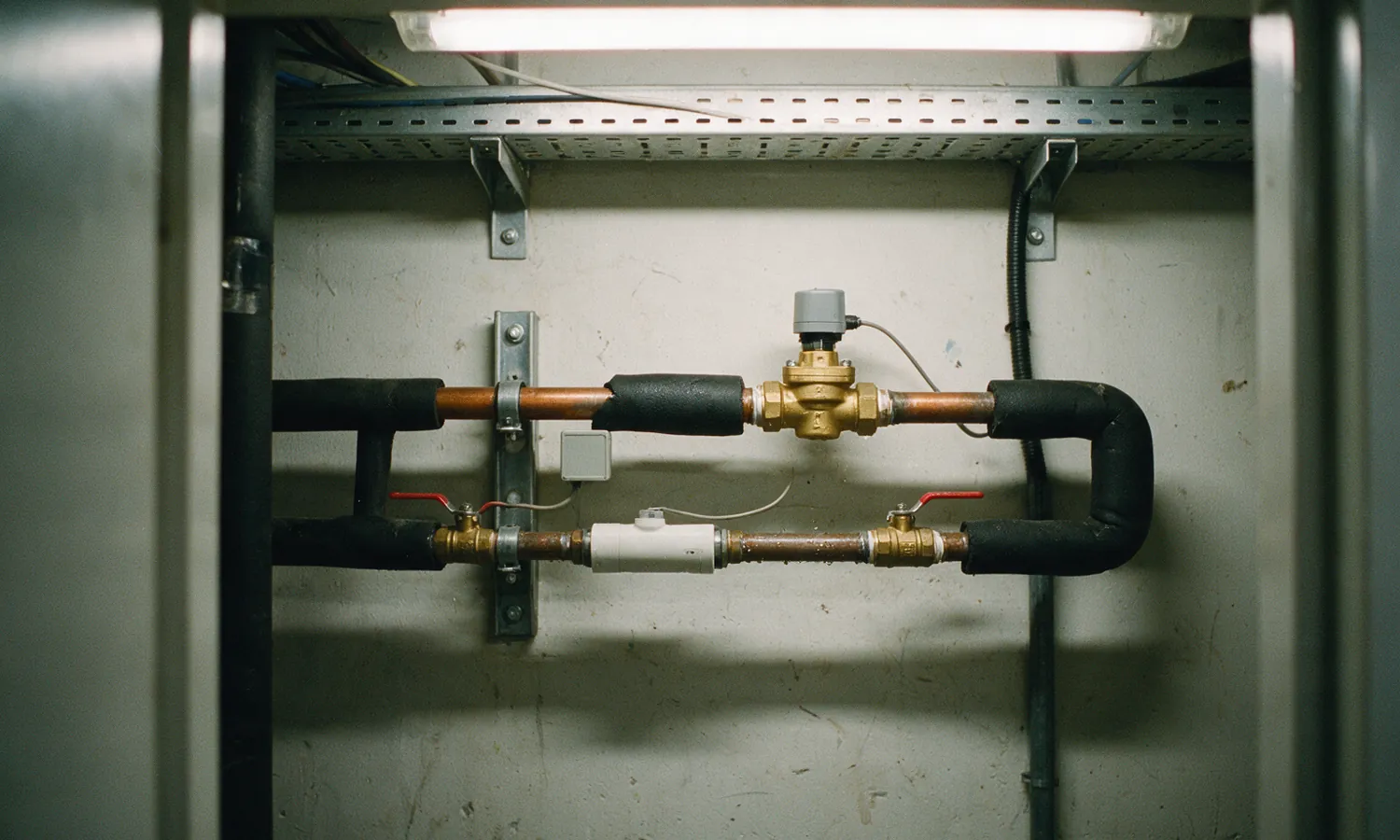
- A chilled-water energy meter (also called a thermal energy meter or BTU meter) works out the cooling a unit used from two readings: the water flow through its branch and the temperature difference between its supply and return pipes.
- It has three parts: a flow sensor, a matched pair of temperature sensors, and a calculator that adds the energy up over time.
- In a building on one central chilled-water plant, a meter on each tenant's branch lets the cooling bill follow what each unit actually used: consumption-based billing.
- The bill is the meter's reading at the end of the period minus the reading at the start, in kWh or ton-hours, multiplied by the rate the building owner sets.
- A hydronic metering kit mounts the meter on one assembly with valves for the branch; Pettinaroli's Switch Plus kit, for example, carries a double Dynasty PICV and an EvoSIX six-way valve.
- Choose the meter by the branch's flow rate, not only its pipe size, and agree with the building owner whether the meter must carry a metrology approval and which reading protocol the building system uses.
On this page11 sections
01What is a chilled-water energy meter?
A chilled-water energy meter measures how much cooling energy a unit takes from a central chilled-water system. It does this by measuring the flow of water through the unit's branch and the rise in temperature between the chilled water going in and the warmer water coming back.
The same device goes by several names. Wikipedia's entry on heat meters describes "a heat meter, thermal energy meter, or BTU meter" as a device that measures thermal energy "by measuring the flow rate of the heat transfer fluid and the change in its temperature (ΔT) between the outflow and return legs of the system". In cooling, the energy flows the other way, but the measurement is the same: more flow, or a wider gap between supply and return, means more cooling used.
These meters are typically called BTU meters in the United States and Canada.
02What is inside an energy meter, and where does each part go?
An energy meter has three parts: a flow sensor, a pair of temperature sensors, and a calculator. The flow sensor sits in one pipe of the branch, one temperature sensor sits in the supply pipe and the other in the return, and the calculator turns the two readings into a running energy total that the bill is made from.
- Flow sensor. Usually "a turbine flow meter or ultrasonic flow meter". Pettinaroli's own energy meters (EM303, EM403 and EM603) are ultrasonic.
- Temperature sensors. One measures the chilled water going into the unit, the other the water coming back. The meter works from the difference between them, so the two are supplied as a matched pair.
- Calculator. It combines flow and temperature difference continuously, "accumulating the total heat transfer in a given period". That running total is the figure the bill is made from.
The energy figure depends on the temperature difference, so an error in either sensor carries straight into the bill. Fit the sensors where the maker's installation instructions say, and do not swap or separate a matched pair.
03Why meter each tenant for chilled-water billing?
Metering each unit lets every tenant pay for the cooling they actually used. Wikipedia's entry says heat meters are used "to measure heat delivered to residential and commercial tenants, which enables consumption-based billing (submetering)", and that "multi-tenant commercial buildings with hydronic systems can also use heat meters to submeter tenant use of the system".
In practice that covers the buildings where one chiller plant serves many separately let spaces: office towers with tenant fan coil units or air handling units, shopping centres, mixed-use blocks and serviced apartments on central air conditioning. A meter on each tenant branch gives the building manager a reading per unit for each billing period.
The same meter has a second use at the plant: "a thermal energy meter can be used to measure the cooling output from a chiller unit", for example to monitor how well it works and how efficiently. A meter on the main header shows the cooling the plant delivers, which can be set against the chillers' power draw and against the total of the tenant meters.
04How does a meter reading become a tenant's cooling bill?
A tenant's cooling bill is the energy the meter recorded over the period multiplied by the building's rate. The building manager reads each meter at the start and end of the billing period, takes the difference as that unit's consumption, and charges it at the rate and terms set in the tenancy agreement.
- Read the meter's energy total at the end of the period (on site or over the meter's data connection).
- Subtract the reading taken at the start of the period: the difference is the unit's consumption.
- Multiply by the cooling rate the building owner sets, plus any fixed charge the tenancy agreement includes.
Meters report energy in kWh, MWh or BTU, and some cooling contracts use ton-hours. One ton of cooling is 12,000 Btu/h, or 3.52 kW, so one ton-hour is about 3.52 kWh. Check which unit the meter's display and the tenancy agreement use before the first bill goes out.
05What does a hydronic metering kit add to the meter?
A hydronic metering kit mounts the energy meter on one assembly with the valves the branch needs anyway. The contractor connects one package instead of assembling a meter, its sensors and several valves on site, and the meter arrives already placed where its maker intended, on a branch that is controlled as well as measured.
Pettinaroli calls its range for this job Energy SAVER, and its catalogue lists several versions under air conditioning metering:
| Kit | Service it covers | What the listing adds |
|---|---|---|
| Energy SAVER | Air conditioning | Sizes 1/2" (150 l/h) to 3/4" (1,500 l/h); insulating case available |
| Energy SAVER Compact | Air conditioning | A compact version of the kit |
| Energy SAVER Plus | Air conditioning and heating | Meters thermal energy in both services |
| Energy SAVER Switch | Centralised air conditioning and heating | For centralised systems |
| Energy SAVER Switch Plus | Centralised air conditioning and heating | Selects the heating or the cooling circuit: double Dynasty PICV, EvoSIX six-way valve, energy meter |
Flow control matters on a metered branch. A pressure independent control valve (PICV) holds a branch at its design flow whatever the pressure elsewhere in the loop; the Switch Plus kit, for example, carries a double Dynasty PICV. Our guide to what a PICV does explains why that matters: a branch that overflows takes more cooling than its design, and the meter will bill it. For how a whole loop is balanced, see our hydronic balancing guide.
06How do you meter a unit that takes both heating and cooling?
On a four-pipe system, a switching kit uses one six-way valve to connect the unit to either circuit, and one meter that reads both. Pettinaroli's Energy SAVER Switch Plus is built that way, so a unit served by both a chilled-water and a heating circuit needs one kit and one meter rather than two of each.
Pettinaroli lists what the Switch Plus kit includes: a double Dynasty PICV with its actuator (thermoelectric or electromechanical), an EvoSIX six-way valve with electromechanical actuator, an energy meter for heating and refrigeration, and a valve with a temperature probe. The EvoSIX valve carries out the changeover between the two circuits, as our guide to six-way valves or separate control valves explains.
Where a building runs cooling only, the plain air conditioning kits are the ones to look at. The switching kits matter where a building also runs a heating or reheat circuit.
07What should you check before choosing an energy meter for billing?
Check four things before ordering a billing meter: its flow rating, any approval it must carry, how it will be read, and how it is insulated. Each one decides whether the readings will be accurate, accepted by the tenants and collected without a site visit every month.
- Flow rating, not only pipe size. One pipe size can come in more than one flow rating. Pettinaroli lists its EM403 at 3/4" in both a 600 l/h and a 1,500 l/h version, and up to 2" at 10,000 l/h. Pick the rating that covers the branch's design flow, as worked out for the loop (see which valves a chilled-water loop needs).
- Approval. In the European Union heat meters "need to comply with the Measuring Instruments Directive (MID) Annex VI MI-004 if the meters are used for custody transfer", and the relevant US standard is ASTM E3137/E3137M-18. Pettinaroli states the EM403 is "Certified according to MID directive". Whether a Malaysian building needs a particular approval for tenant billing is a question for the building owner, so ask before you order.
- How it is read. Automatic meter reading of heat meters in the European Union uses the Meter-Bus standard. Pettinaroli lists the EM403 with M-bus via cable, M-bus wireless, Modbus RTU, Modbus TCP/IP, LoRaWAN, BACnet MS/TP and BACnet IP. Match the protocol to the building management system or billing software that will collect the readings.
- Insulation. Chilled-water pipe sweats where it is left bare. Ask for the kit's insulating case, or agree with the insulation contractor how the meter body and sensors are covered while the display stays readable.
08Where do Pettinaroli's metering kits fit in its HVAC range?
Pettinaroli's metering kits and energy meters sit in its HVAC range, which Optimus Distributor supplies as an authorised Pettinaroli distributor. Send the kit or meter you have in mind, the size and the design flow, and we confirm the model and what we can supply for your project.
The metering kits sit with the rest of Pettinaroli's hydronic range: the EvoPICV and Dynasty PICVs (Dynasty 92 is designed for heavily contaminated water), the EvoSIX six-way valve, and the prefabricated kits for fan coils, chilled beams, air handling units and data centre CRAH units. See our Pettinaroli HVAC and data centre page for the full range and our Pettinaroli hydronic balancing and PICV page for the brand. For kits that combine valves at each terminal unit, see prefabricated valve kits for fan coils, chilled beams and AHUs.
09What should a metering kit enquiry state?
A metering enquiry should state each unit's design flow and pipe size, whether it is cooling only, and how readings will be collected. Those decide the meter rating, the kit and the communication option. With these six lines, the kit and meter can be matched before anything is ordered:
- The building type and how many units or tenant branches are to be metered.
- Each unit's design flow rate (l/h) and pipe size.
- Cooling only, or heating and cooling (two-pipe or four-pipe).
- The control wanted on each branch (PICV with actuator, and the control signal).
- How readings are collected (M-bus, Modbus, BACnet, LoRaWAN or read on site) and any approval the meter must carry.
- Whether insulating cases are needed, and the date the kits are needed on site.
Send these six lines on WhatsApp, or browse more guides on our insights page.
10Questions engineers ask about chilled-water metering
Is a BTU meter the same as a chilled-water energy meter?
Yes. BTU meter, thermal energy meter, heat meter and energy meter all name the same kind of device: a flow sensor, a pair of temperature sensors and a calculator. On a cooling system it measures the energy taken from the chilled water.
Can one meter read both heating and cooling?
Yes, if it is made for both. Pettinaroli lists its EM303, EM403 and EM603 for heating and cooling, and its Energy SAVER Switch Plus kit carries one energy meter for heating and refrigeration behind a six-way valve, so a four-pipe unit is billed from a single meter for both services.
Should the meter size match the pipe size?
Not necessarily. Size it by the branch's design flow, because one pipe size can come in more than one flow rating: Pettinaroli lists its EM403 at 3/4" in both 600 l/h and 1,500 l/h versions. Check the rating on the datasheet for the model you are buying.
Does a metered branch still need a balancing valve?
Yes. The meter measures what flows; it does not limit it. A PICV or balancing valve keeps the branch at its design flow, so one tenant's unit does not take more than its share of the loop and starve the units further along it.
11Sources
Read 4 November 2026. Product features and ratings are the manufacturer's own published statements: confirm every detail against the current datasheet for the model you are buying.
- Wikipedia, Heat meter (definition, parts, tenant submetering, chiller output, MID, Meter-Bus, ASTM E3137) and British thermal unit (ton of cooling in kW).
- Pettinaroli, Air conditioning metering, Energy SAVER and Energy SAVER Switch Plus (kit range, sizes and contents).
- Pettinaroli, Energy meters and EM403 (ultrasonic meters, MID certification, protocols, sizes).
- Pettinaroli, HVAC water distribution catalogue 2024 (client document held by Optimus Distributor).