 OPTIMUS DISTRIBUTOR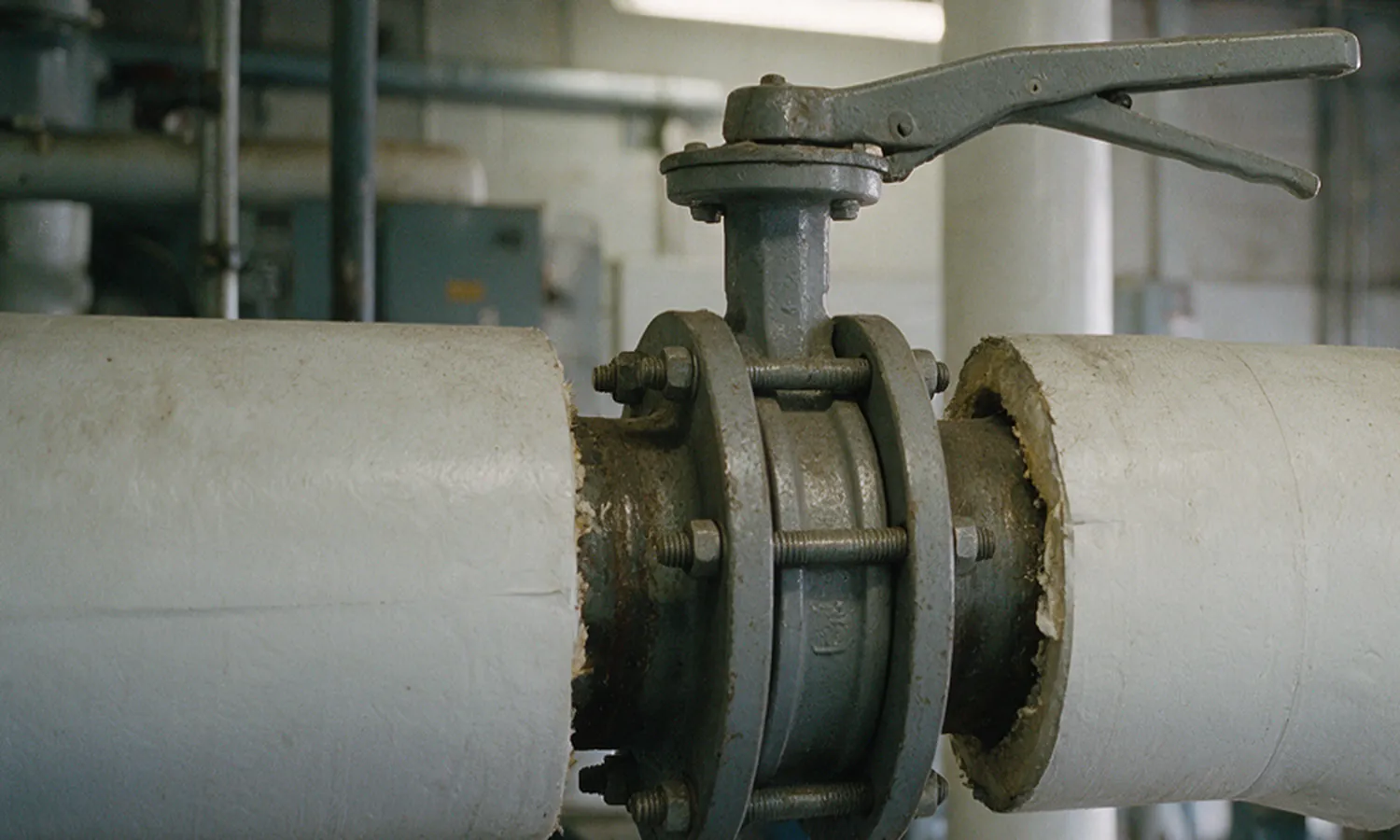
- Body style decides whether a butterfly valve can hold the line with one side opened.
- A wafer body is clamped between two flanges, so it cannot hold an end-of-line pipe alone.
- Bray's Series 30/31 lug valve (DN 50 to 300) drops from 12.0 bar to 5.2 bar dead-end.
- AWWA C504-23 covers wafer bodies up to 20 in. and flanged bodies up to 72 in.
- Seat design, concentric or double-offset, is a separate decision from body style.
01What separates wafer, lug and double-flanged butterfly valves?
Wafer, lug and double-flanged butterfly valves differ in one thing: how the body joins the pipe. A wafer body sits between two flanges, clamped by bolts that pass outside it. A lug body has threaded lugs, so each flange bolts to the valve on its own. A double-flanged body carries its own flanges and bolts in like a short spool.
Wafer bodies are lighter and cheaper than lug bodies, as Valve Magazine's butterfly valve overview notes. KITZ's US DJ catalogue lists a DN 100 wafer at 3.5 kg, against 8.1 kg for the lug. But open either side and a wafer has nothing left to resist line pressure.
In their words“These valves cannot be used for dead-end service, which requires additional isolation valves when shut down for maintenance.”
Mitchell Anderson and Haley Ferner of Bray International, on wafer valves, Valve Magazine
With a lug body, either pipe can be unbolted while the other stays attached. A lug body earns its premium wherever one side will be opened in service.
Double-flanged bodies suit large bores and water mains.
In the AWWA C504-23 scope, wafer bodies stop at 20 in. while flanged bodies reach 72 in. Penang's water utility specifies double-flanged short-pattern valves to BS EN 593 in its PBAPP butterfly valve specification. Large water mains are double-flanged territory; confirm the governing edition of each document.
Valve Magazine also names a fourth end style, the butt-weld end. A butt-weld body is welded in where dismantling is rare or flange joints risk leaks.
| Question | Wafer | Lug | Double-flanged |
|---|---|---|---|
| How it is held | Clamped between flanges by through-bolts | Cap screws into tapped lugs from each side | Own flanges, bolted to each pipe flange |
| One side removed | Not possible | Possible, at the published dead-end rating | Possible; some designs are de-rated |
| Weight and cost | Lighter and cheaper than lug | Heavier than wafer; costs more | Flanges on both ends; check the datasheet |
| Where it usually fits | Branch isolation between fixed flanges | Chillers, pumps and strainers removed for service | Water mains and large bores |
If the pattern itself is undecided, start with choosing the right industrial valve: duty first, budget second. Other isolation patterns are compared in gate, globe or ball.
02Which butterfly valve body suits dead-end (end-of-line) service?
Lug and double-flanged butterfly valves suit dead-end service; a wafer does not. Even then, the limit is the dead-end rating in the manufacturer's data, not the headline pressure. Read the dead-end line before anyone opens a pipe against a closed butterfly valve.
Bray's Series 30/31 specification sheet gives standard-disc ratings by size. At DN 50 to 300, the Bray Series 30/31 lug valve holds 12.0 bar (175 psi) bidirectional. In dead-end service, the same Bray Series 30/31 lug valve drops to 5.2 bar (75 psi). Bray's dead-end rating is less than half its in-line rating.
Milwaukee Valve's engineering specifications tie the dead-end rating to size and liner material. The same sheet keeps valves above 24 in. out of dead-end service altogether. KITZ Corporation of America's DJ catalogue rates its US lug valves at full pressure for dead-end service. KITZ's DJ manual sets conditions: non-shock water, a lever or gear operator, the valve locked closed and four days at most. No rule of thumb replaces the datasheet line for the exact valve on order.
Milwaukee still advises a downstream flange for safety, and KITZ's US catalogue recommends one beyond 96 hours. Fit a blind flange on the open side, whatever the rating says.
Where a chiller, pump or strainer will come out for service, fit a lug valve on each side. Each item can then come out while the header stays full. Match the body to the maintenance plan, not to the pipe size. Balancing those circuits is covered in our guide to hydronic balancing and PICV.
03Will a wafer or lug butterfly valve fit JIS 10K, PN16 or Class 150 flanges?
A wafer butterfly valve often fits JIS 10K, PN16 and Class 150 flanges alike. Its bolts pass outside the body, so the body is not tapped to one drilling. A lug or double-flanged body is drilled or tapped to one pattern only. That pattern must match the pipe flange exactly, or the bolts will not go in.
The KITZ DJ series page shows the difference in published data. The KITZ DJ wafer type lists four flange families: ASME, EN 1092, BS 10 and JIS. The KITZ DJ lugged type lists ASME Class 150 to 250 and EN 1092 drillings only. A wafer usually adapts to the pipe; a lug has to be ordered for it.
Penang's PBAPP butterfly valve specification cites BS EN 1092 flanges and calls for PN16. KITZ, a Japanese maker, lists JIS 10K to 20K flanges for its DJ wafer. KITZ also names API 609, MSS SP-67, EN 593 and JIS B 2032 as DJ design standards. State the flange standard and rating on every enquiry, and check it against the pipe already installed.
Valve Magazine notes that resilient-seated ratings are often cold working pressures, not ASME classes. So check the valve's pressure figure and its flange rating separately. Classes and PN numbers do not convert neatly; see PN and ASME Class ratings in the glossary. Treat any flange figure as reference data, and confirm it against the current edition and your purchase order.
04Concentric or double-offset: is the seat a separate decision?
Seat design is a separate decision from body style. A concentric, resilient-seated valve holds the disc on the pipe centreline, rubbing its seat through the stroke. A double-offset, or high-performance, valve sets the stem off centre to cut that rubbing. Body style settles the installation; seat design settles pressure, temperature and wear.
Valve Magazine lists HVAC and water among the main resilient-seated duties. Resilient-seated designs are often rated below ASME classes, which keeps them cost effective at low pressure. For building services water at moderate pressure, concentric is usually the right choice.
Valve Magazine adds that a double-offset disc cams away from the seat instead of across it. Bray's butterfly valve guide puts double-offset seat contact in only the final 5 to 7 per cent of closure. Double-offset valves suit higher-cycle duty and higher temperatures and pressures than resilient-seated designs. Pay for double-offset where heat, pressure or frequent cycling would wear out a rubber seat.
Water utilities can set a higher bar: PBAPP specifies a double-offset disc on its water mains. Valve Magazine places triple-offset valves, sealed metal to metal, in steam distribution, petrochemical and tank farm service. Seat design follows the duty, so name the fluid, pressure, temperature and cycling on the enquiry.
05What should you check before installing a wafer or lug butterfly valve?
Butterfly valve installation comes down to four checks: disc clearance, gaskets, bolts and welding. The open disc must clear the real pipe bore, and lug cap screws are sized per flange. A seat covering both body faces needs no extra gasket, and the valve comes out before full welding.
The open disc projects past the body faces into the adjoining pipe. Bray's installation manual requires the disc chord at full open to clear the adjacent flange bore. KITZ's DJ series operation manual lists a minimum pipe bore for each size for the same reason. Check the disc chord against the real pipe bore, not the nominal size.
KITZ's DJ manual says to fit or remove the valve with the disc about 10 degrees off closed. The bolts are then tightened evenly, in a star pattern.
Bray asks for at least six pipe diameters from elbows, pumps or other valves, where possible. Where a butterfly valve meets a check valve or pump, Bray calls for an expansion joint between them.
KITZ's DJ manual says not to add flange gaskets, because the rubber seat seals against the flanges. Bray's technical manual adds that valves without an integral seat gasket need gaskets supplied. Check whether the seat covers both flange faces before ordering gaskets.
Bray's flange bolting guide asks for thread engagement at least equal to the bolt diameter. Size lug cap screws for each flange separately, because lug threads may be tapped from both ends.
The BC Industry Training Authority's installation text says to tack the flanges, remove the valve, then finish welding. A resilient seat left between flanges during full welding will be damaged.
A US specification from Los Alamos National Laboratory cites UL 1091 for fire-protection butterfly valves. That LANL specification also calls for listed shutoff valves, supervised open. A general-service butterfly valve is not a fire valve, so confirm the listing with your fire engineer.
Run this checklist before the enquiry goes out.
- Will either side ever be opened while the other is live? Then specify lug or double-flanged.
- Which flange standard is the pipe? JIS, PN and ASME Class drillings do not interchange.
- Does the open disc clear the pipe and fittings? Fit it slightly open; check the disc chord against the actual bore.
- Gaskets and bolts? Confirm the seat replaces the gasket; size cap screws per side.
- Fire service? Then the valve must carry the listing your fire engineer specifies.
We see customers either go too cheap and face costly downtime, or over-engineer past the project's needs. Body style, flange drilling and seat design are where both mistakes are made or avoided.
Optimus Distributor was appointed authorised distributor for KITZ in 2019; see KITZ valves. Our catalogue covers butterfly valves, their accessories and butterfly valve actuators. We don't just sell parts; we sit down with your engineers to get the right solution. Send us the duty and the flange standard, not just a size.
06Questions buyers ask about butterfly valve body styles
Can a wafer butterfly valve be used at the end of a line?
A wafer butterfly valve cannot serve at the end of a line. Valve Magazine's overview rules wafer valves out of dead-end service. Removing one flange leaves nothing holding the valve against line pressure. Use a lug or double-flanged body, with a blind flange on the open side.
Is a lug butterfly valve rated for full pressure in dead-end service?
Not always, because makers rate dead-end service differently. KITZ Corporation of America rates its US DJ lug valves at full pressure, downstream flange removed, for non-shock water with a manual operator locked closed. Bray's Series 30/31 lug drops from 12.0 bar to 5.2 bar dead-end, at DN 50 to 300. Read the dead-end line for your exact valve.
Do butterfly valves need flange gaskets?
Resilient-seated butterfly valves usually do not, because the seat covers the body faces and seals against the flanges. KITZ's DJ manual warns that an added flange gasket can cause leakage. Valves whose seat stops short of the faces need gaskets, as can weak or uneven flanges.
When is a double-flanged butterfly valve the right choice?
Choose double-flanged for large bores and water mains. AWWA C504-23 covers flanged bodies up to 72 in., against 20 in. for wafers. Penang's PBAPP specification calls for double-flanged valves on its potable water mains. Where neither side is opened in service, a wafer body is usually enough.
07Sources
- Valve Magazine (Valve Manufacturers Association): An Overview of Butterfly Valves
- Bray International: Series 30, 31 Butterfly Valves Recommended Specification Sheet
- Milwaukee Valve: Butterfly Valve Engineering Specifications
- KITZ Corporation of America: DJ Series Butterfly Valves catalogue
- KITZ Corporation: Ductile cast iron Butterfly valves (DJ series)
- Perbadanan Bekalan Air Pulau Pinang: Specification for Butterfly Valve
- Nimonik: AWWA C504-23 Rubber-Seated Butterfly Valves
- Bray International: The Ultimate Guide to Butterfly Valve Selection
- Bray International: Resilient Seated Butterfly Valves Installation, Operation and Maintenance Manual
- KITZ: Operation Manual for DJ Type Butterfly Valve
- Bray International: Resilient Seated Butterfly Valves Technical Manual
- Bray International: Typical Flange Bolting Guide
- BC Industry Training Authority (TRU Pressbooks): D-2.2 Install Valves
- Los Alamos National Laboratory: Section 21 0523, General-Duty Valves for Water-Based Fire-Suppression Piping