 OPTIMUS DISTRIBUTOR
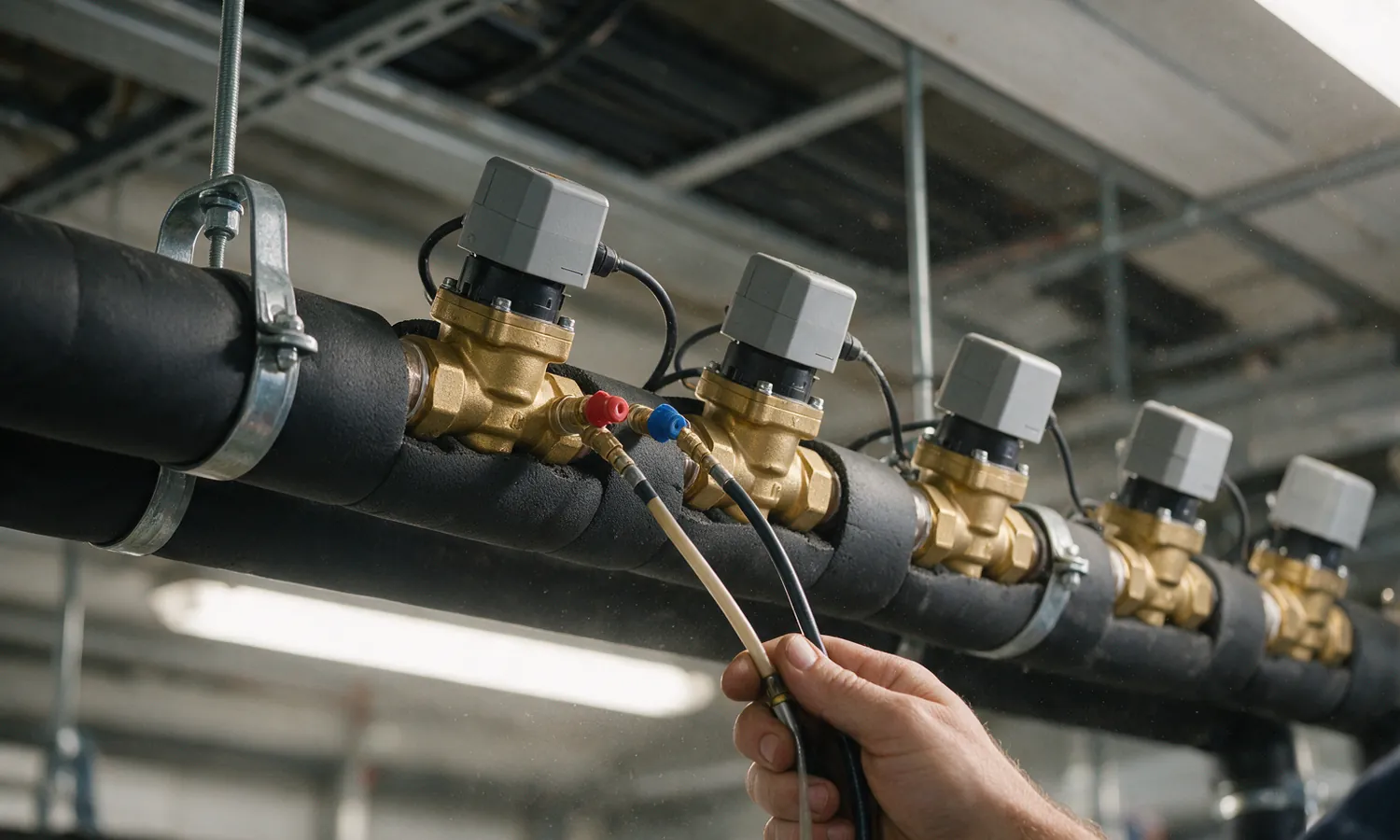
- A PICV's start-up pressure is the lowest differential pressure across the valve at which it starts holding its set flow; below it, the valve behaves like an ordinary control valve and flow falls.
- In a variable-speed system, the pump is controlled from a pressure sensor at the index, the least-favoured circuit (usually the one farthest from the pump), and the index PICV must still see at least its minimum differential pressure at full design flow.
- In the models listed in Pettinaroli's UK catalogue 2025, start-up pressures run from 20 kPa for the smallest ½" EvoPICV to 65 kPa for the 10" PE94FH at 500,000 l/h.
- The minimum differential pressure also depends on the preset: it generally drops as the preset flow is reduced, at the cost of higher flow deviation.
- At commissioning, the pressure at the test points of the index PICV is checked against the manufacturer's limits; if the index has enough, every other PICV in that sub-system has more.
On this page9 sections
01What is a PICV's start-up pressure?
A PICV's start-up pressure is the minimum differential pressure across the valve that it needs before its built-in regulator can hold the set flow. Above that value the flow stays constant as pressure changes; below it, the regulator's spring is not compressed and the valve passes less than its design flow.
A pressure-independent control valve combines a control valve with a differential pressure regulator: a spring-loaded diaphragm keeps the pressure drop across the control part constant, so the valve holds its set flow, as CSE Magazine's guide to specifying PICVs describes. That regulator needs some pressure to work with. In CIBSE Journal's CPD module on PICVs, Tim Dwyer explains that "If the operating differential pressure is too low, the differential pressure spring remains in an uncompressed state, and if it is too high, the spring will be fully compressed".
So every PICV has a minimum and a maximum differential pressure rating. Pettinaroli prints the minimum as "Start-up max" against each model in its catalogue.
02Why does the index PICV decide the pump head?
In a variable-speed chilled-water system, the pump is controlled to hold a differential pressure at the index, the least-favoured circuit, usually the one farthest from the pump. The index PICV has the least pressure available, so the pump setpoint must give it at least its start-up pressure at full design flow, plus the losses of the coil, pipes and fittings in that branch.
CIBSE Journal's module describes pump-speed control "using a differential pressure sensor across the sub-system feeding to the most remote group of terminal units (the 'index')". Siemens' application guide on PICVs says the same: the differential pressure sensor "at the critical coil or the one farthest from the pump" provides feedback to the variable frequency drive, so that the system gets "the necessary differential pressure to control adequate flow to that critical circuit."
Put as a sum, the setpoint the pump holds at the index sensor is at least: the index PICV's start-up pressure, plus the pressure loss of the index coil, plus the losses of the branch pipework and fittings between the sensor's tappings. As an illustration only, not a project figure: if the index fan coil has a PEB91XH ½" EvoPICV, with a start-up max of 30 kPa in Pettinaroli's catalogue, the setpoint is 30 kPa plus the coil and branch losses from your own design.
The start-up pressure of the index valve is therefore part of the head the pump makes at every load, all year. A PICV with a lower start-up pressure at the index lets the designer set a lower setpoint, so the pump makes less head at every load. Variable-speed pumping saves energy for a related reason: CIBSE Journal notes that, as two-port valves cut the flow, "the pump power is proportional to the cube of the flowrate". Pettinaroli's HVAC catalogue lists "low start-up pressure" and "pump head optimisation" among the strengths of its data centre range.
03What start-up pressure do PICVs need?
Start-up pressure differs by brand, model, size and flow range, so read it from the datasheet of the exact valve. In Pettinaroli's UK catalogue 2025, the models listed below run from 20 kPa for the smallest ½" EvoPICV to 65 kPa for the largest 10" flanged PE94FH, and the threaded ½" to 1¼" models listed run from 20 to 35 kPa.
| Model and size | Maximum flow | Start-up max |
|---|---|---|
| EvoPICV PEB91XVL ½" | 150 l/h | 20 kPa (0.20 bar) |
| EvoPICV PEB91XH ½" | 900 l/h | 30 kPa (0.30 bar) |
| EvoPICV PEB93L 1" | 2,200 l/h | 25 kPa (0.25 bar) |
| EvoPICV PEB93H 1¼" | 3,000 l/h | 35 kPa (0.35 bar) |
| EvoPICV PE94FL 8" flanged | 200,000 l/h | 40 kPa (0.40 bar) |
| EvoPICV PE94FL 10" flanged | 300,000 l/h | 40 kPa (0.40 bar) |
| EvoPICV PE94FH 10" flanged | 500,000 l/h | 65 kPa (0.65 bar) |
The Dynasty 92, Pettinaroli's PICV for heavily contaminated water, has start-up pressures of 25 to 40 kPa depending on size; our guide to choosing a PICV for dirty chilled-water loops covers it. Pettinaroli's PICV range runs from 150 l/h up to 500,000 l/h, so the same start-up check applies from a fan coil to the flanged valves on large air handlers and plant branches. Optimus Distributor is an authorised distributor for Pettinaroli in Malaysia. For how the valve itself works, see what a pressure-independent control valve does.
04Does the preset change the start-up pressure?
Yes. A PICV's minimum differential pressure depends on its preset as well as its model: generally, the lower the preset flow, the lower the pressure it needs. The trade is accuracy, because a valve run at a low preset holds its flow less tightly, so it is chosen with its maximum flow only a little above the design flow rather than oversized.
The Aircond Lounge guide states that "the minimum differential pressure of a PICV also depends on the preset flow", that "the minimum differential pressure drops as we reduce the preset flow", and that "While reducing the preset flow reduces the differential pressure requirement, it introduces higher flow deviation." The same guide warns that "oversizing is not desirable": for 500 L/hr it suggests a PICV with a maximum flow of "something around 600 L/hr". Pettinaroli prints the start-up figure as "Start-up max", so when the index valve is set well below its maximum, ask for the start-up pressure at that setting. Our guide to equal percentage or linear PICVs covers the other choice made at selection.
05Is there a maximum differential pressure as well?
Yes. Every PICV also has a maximum differential pressure. Above it, the regulator's spring is fully compressed and the valve stops holding its flow, and high water velocity can cause cavitation.
The Aircond Lounge guide says the maximum rating exists "to prevent cavitation and other issues due to high water velocity". Pettinaroli's UK catalogue gives its flanged EvoPICV range a maximum differential pressure of 600 kPa from 2" to 6" and 400 kPa for 8" and 10". In large systems with many sub-circuits, CIBSE Journal notes that differential pressure control valves on branches "may be needed to limit the maximum differential pressure across the PICVs", although "commercial PICVs are capable of maintaining control across a wide range of operating pressures."
06How is it checked at commissioning?
At commissioning, the differential pressure at the index PICV is read at its test points with all branches drawing design flow, and compared with the manufacturer's minimum. If the index valve has enough pressure, every other PICV in that sub-system has more.
CIBSE Journal describes this check: "the pressure at the test points (integrated into the PICV body) will be checked", at least in the index of each sub-system, "to ensure that the operating pressure differential is within the manufacturer's specified limits". It goes on: "If this pressure is available at the index PICV, then all other PICVs will have greater differential pressure available and so will be able to operate." The same module notes that the integral test points "cannot be used to determine the flowrate through the valve"; under the CIBSE Commissioning Code W, the flow at each load is normally checked with a separate orifice device. Our guide to fixed and variable orifice flow measurement explains how that reading is taken.
A PICV chosen so that the index valve's start-up pressure is low helps keep the pump setpoint down for the life of the building. In a data centre, where cooling runs all year, that setpoint is part of the energy bill every day; our guide to the valves a data centre chilled-water loop needs shows where the PICVs sit.
07What should you check, and send us, before ordering?
Before ordering PICVs, check the start-up pressure of the index valve at its actual preset, the maximum differential pressure of the valves nearest the pump, and the design flow of each terminal unit against the valve's range. Those three checks decide whether the pump setpoint and the valve sizes work together.
Send these six lines and we work through the selection with your engineers:
- Terminal units and design flow. Fan coils, AHUs or CRAH units, and the flow each one needs in l/h.
- Line sizes and connections. Threaded or flanged, and the size of each branch.
- Pump control. Where the differential pressure sensor sits and the setpoint, if known.
- Control signal. On-off or modulating, and the voltage your BMS supplies.
- Water quality. New clean system, or an older loop with dirt or magnetite.
- Quantity and date needed on site.
Send these six lines on WhatsApp, see our Pettinaroli HVAC and data centre solutions and the Pettinaroli balancing and PICV page, or read our main guide to balancing water systems in commercial buildings.
08Questions engineers ask about PICV start-up pressure
Is start-up pressure the same as minimum differential pressure?
In practice, yes. Both names describe the lowest pressure drop across the PICV at which its regulator starts holding the set flow. Pettinaroli's catalogue prints it as "Start-up max" for each model, from 20 kPa upwards in the models listed above.
What happens if the index PICV gets less than its start-up pressure?
The valve stops being pressure independent: its regulator spring stays uncompressed, it acts like an ordinary control valve, and the index terminal unit gets less than its design flow at peak load. The usual fixes are a higher pump setpoint or a valve with a lower start-up pressure.
Does a lower start-up pressure save pumping energy?
It lets the pump hold a lower differential pressure setpoint at the index, because the index valve needs less pressure to hold its flow, so the pump makes less head at every load. That is separate from the saving of variable-speed pumping itself, which comes from cutting the flow at part load.
Where is the start-up pressure measured?
Across the PICV, at the two measurement ports built into its body; the Aircond Lounge guide names a manometer for the reading. CIBSE Journal describes checking at least the index valve of each sub-system, with all branches drawing design flow at the time.
09Sources
Read 18 November 2026. Product figures are the manufacturer's own published statements: confirm every detail against the current datasheet for the model you are buying.
- Pettinaroli, UK catalogue 2025: EvoPICV, Dynasty 92 and flanged EvoPICV tables. Pettinaroli, HVAC water distribution catalogue 2024, V1 March 2024 (held by Optimus Distributor): Dynasty 92 p10-11, data centre solutions p45.
- Tim Dwyer, CIBSE Journal, Module 140: Pressure-independent control valves in variable volume heating and cooling systems, January 2019.
- Siemens, How to improve hydronic system performance with pressure independent control valves, application guide.
- CSE Magazine, Where and how to specify pressure-independent control valves in hydronics.
- Aircond Lounge, How PICV works.