 OPTIMUS DISTRIBUTOR
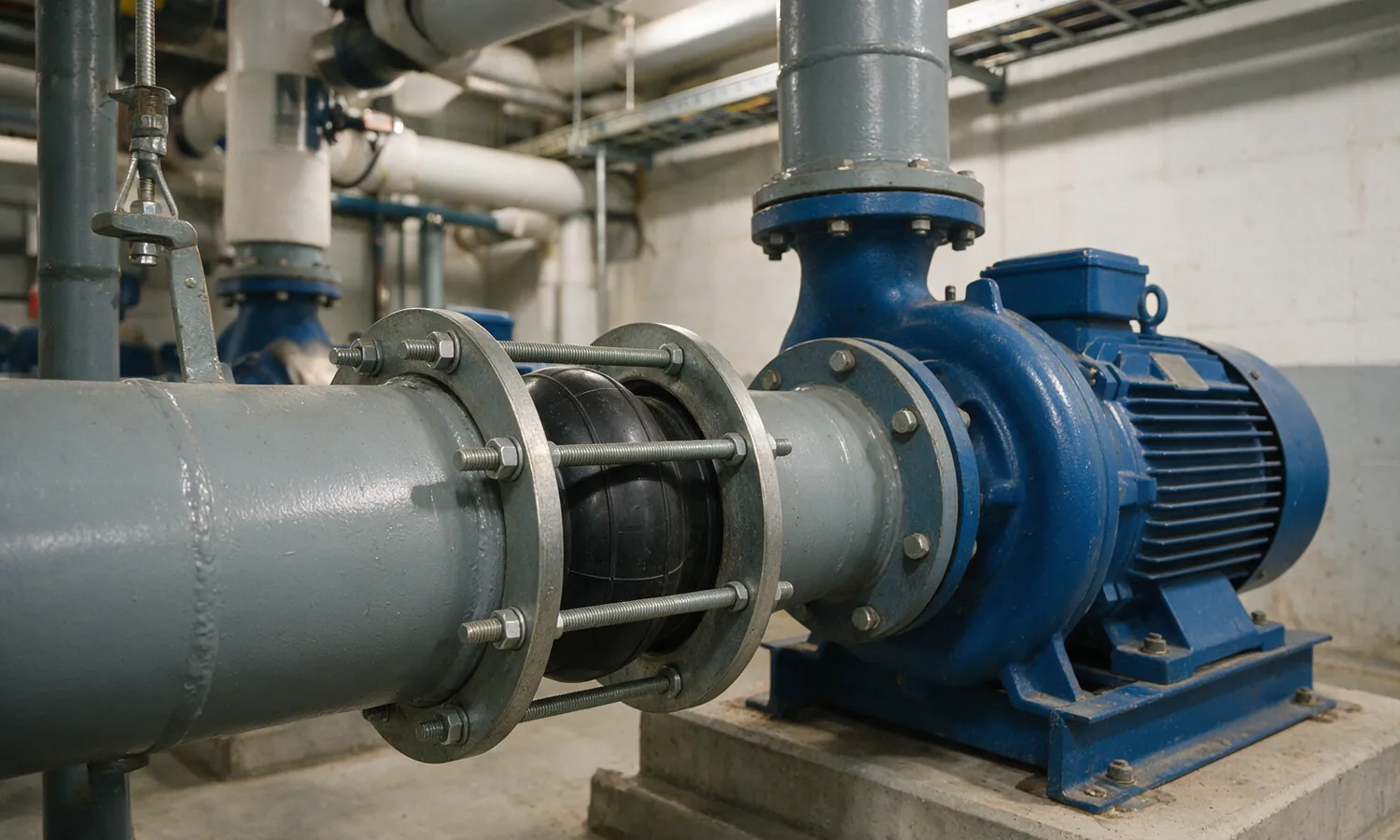
- A rubber flexible joint (a rubber expansion joint) sits between a pump or chiller and its pipework to absorb vibration, noise and small movements, so they are not passed along the pipe.
- The two common kinds are the spool type, with full-face rubber flanges, and the molded sphere type, with metal floating flanges; the sphere type comes as a single or double sphere.
- Under pressure an unrestrained joint pushes outwards like a balloon. Where the pipe is not anchored, control units (tie rods) must hold that pressure thrust.
- The pipe on both sides is anchored first and the joint fitted last. It should never carry the weight of the pipe, be twisted or be used to correct misalignment.
- Pettinaroli's ductile iron GF1C single sphere flexible joint runs from 1 1/4" to 24", with ANSI class 150 or EN 1092-2 PN16 flanges.
On this page9 sections
01What is a rubber expansion joint, and what does it do at a pump or chiller?
A rubber flexible joint absorbs the vibration, noise and small movements a pump or chiller makes, so they do not travel into the pipework. It also lets the pipe move slightly with temperature and pressure without loading the pump or chiller flange.
The Fluid Sealing Association's expansion joints piping division defines a rubber expansion joint in its Technical Handbook for Expansion Joints Piping. James M. Gannatal of Proco Products summarised that definition in Pumps & Systems in 2023: a flexible pipe connector made of elastomers and fabrics, with metal reinforcement where needed, "to provide stress relief in a piping system due to thermal and mechanical vibration and/or movements".
The same article names where they are most often seen: "on the inlet and discharge of pumps, in cooling water circulation and heat exchanger systems".
02Spool type or sphere type: what is the difference?
The two most common rubber expansion joints are the spool type and the molded sphere type. The spool type has full-face rubber flanges that seal against the mating flanges without gaskets; the sphere type is a compact rounded body with metal floating flanges and a beaded end seal.
Gannatal describes the sphere type as carrying the movement and vibration damping of a spool type "into a compact and robust device", made as a single sphere or a double sphere. Spool types come in more shapes, including single and multiple open arches, filled arches for slurry, and concentric and eccentric reducers.
Sure Flow Equipment, which makes sphere type connectors, lists these advantages for its own sphere joints: internal pressure spreads evenly over the rounded body, the loose flanges need no gasket, and the joint is light and compact. Its catalogue lists air conditioning systems, circulating water lines and pump suction and discharge among the uses.
| Point | Spool type | Molded sphere type |
|---|---|---|
| Ends | Full-face rubber flanges, part of the body | Metal floating flanges with a beaded end seal |
| Gaskets | Not needed: the rubber flange seals against the mating flange | Not needed: the beaded end seals (Sure Flow: no gasket or packing) |
| Shapes | Single and multiple open arch, filled arch, concentric and eccentric reducers | Single sphere and double sphere |
03What is pressure thrust, and when are control rods needed?
Pressure thrust is the force a rubber joint puts on the pipework when it is pressurised, because the flexible body tries to stretch. Where the pipe on either side is not anchored to hold that force, control units must be fitted to stop the joint stretching beyond its design limits.
Gannatal compares it to blowing up a balloon: as it is pressurised, an unrestrained joint pushes outwards on the system. "For unrestrained/unanchored systems, these control units will be required to restrain this pressure thrust load." Control units come in versions that limit extension only, limit extension and compression, or let the joint deflect only at an angle.
Sure Flow gives the same rule from the installer's side. Control rods prevent "an excessive extension or compression of the expansion joint", and should be used "when there are high pressure risks (starting a pump…) or when wide temperature fluctuations occur". For its own AMS single sphere range, Sure Flow says a control rod unit must be installed when the test, surge or operating pressure exceeds these ratings:
| Joint size | Rating (psig) |
|---|---|
| 1" to 4" | 150 |
| 5" to 10" | 135 |
| 12" to 14" | 90 |
| 16" to 24" | 45 |
The figures are one maker's limits for one range, not a general rule. They show why the joint's own datasheet matters: the larger the joint, the lower the pressure it can hold on its own. A pump start is also the moment of surge; more on that in our guide to water hammer and valve selection.
04How should a flexible joint be fitted?
Anchor the pipe on both sides first, then fit the rubber flexible joint last, aligned and carrying no load. The joint absorbs movement and vibration from the pump or chiller; it is not there to take up a misaligned pipe or to carry the pipe's weight. Sure Flow's mounting instructions set out the order and the checks:
- Fix the pipe as close as possible to each side of the joint, less than three times the pipe's nominal diameter away.
- Mount the upstream pipe and its anchor, then the downstream pipe and its anchor, and only then the expansion joint.
- Make sure the joint carries no compression or extension from the weight of the pipe on either side, and that it is not twisted.
- Check that the upstream and downstream pipes are aligned within 1/8" (3 mm).
- Insert the bolts from the arch side of the joint, so they do not touch the rubber.
- Cover or remove the joint if welding is done nearby, and do not paint it or coat it with insulation.
- Do not precompress it by more than 5 mm when fitting.
- Check bolt tightness daily in the first month of service and periodically after that.
On an insulated chilled-water line, the insulation rule matters most: agree with the insulation contractor how the joint is left uncoated and reachable, since its bolts are checked after start-up.
05Who decides the joint and where it goes?
The piping designer decides the type, size and control units of a rubber flexible joint, using the joint maker's data on pressure, temperature, movement and spring rate, and a pipe stress analysis where the loads on a pump or chiller flange matter. Gannatal puts the key question as whether the joint "will compensate for the required axial growth/contraction of the piping without exerting too much of a stress load on a nozzle, a pipe header or a pump flange".
The Fluid Sealing Association's handbook carries the design data for that check: maximum temperatures for the different elastomers, pressure characteristics of each style, and movement and spring rate capabilities. The fluid and temperature matter because each rubber has its own maximum temperature, which is why the enquiry list below asks for both.
06Which Pettinaroli flexible joint does Optimus supply?
Optimus Distributor supplies Pettinaroli's GF1C and GF1CA single sphere flexible joints, part of its ductile iron range for HVAC and water distribution, from 1 1/4" to 24", with flanges to ANSI class 150 or EN 1092-2 PN16. Tell us the size and flange standard and we confirm what we can supply. Confirm the sphere material and its temperature limit on the datasheet for your fluid.
On Optimus's own Pettinaroli industrial valve flyer the joint sits with the other ductile iron parts a pump or chiller connection uses, each with ANSI class 150 or EN 1092-2 PN16 flanges:
- BF3SE and BF4SE: lug and wafer butterfly valves for isolation, 1 1/4" to 24", with a stainless steel disc and EPDM seat.
- ST2D and ST2DA: Y strainers with a test port and stainless screen, 2" to 24".
- CK2WD: a dual plate wafer check valve, 2" to 24".
- SB2V and SB2VA: static balancing valves with a test port, 2 1/2" to 16".
The full range is on our Pettinaroli HVAC and data centre page, and the brand on our Pettinaroli hydronic balancing and PICV page. For the valves around a cooling loop, see which valves a data centre chilled-water loop needs.
07What should a flexible joint enquiry state?
A flexible joint enquiry should state the pipe size and flange standard, the fluid and temperature, the highest pressure the joint will see including the test pressure, and whether the pipe is anchored, because those decide the joint and whether it needs control rods. With these six lines, the joint can be matched before anything is ordered:
- Where it goes (pump suction, pump discharge or chiller connection) and how many.
- The pipe size and the flange standard (ANSI class 150 or EN 1092-2 PN16).
- The fluid (water or water and glycol) and the operating temperature.
- The operating pressure and the system test pressure.
- Whether the pipe on each side is anchored, and whether control rods are specified.
- Any other parts wanted at the same connection, such as the isolation valve, strainer or check valve.
Send these six lines on WhatsApp, or browse more guides on our insights page.
08Questions engineers ask about flexible joints
Can a flexible joint correct a misaligned pipe?
No. Sure Flow asks for the pipes either side to be aligned within 1/8" (3 mm) before the joint goes in, and for the joint to carry no compression or extension from the pipe's weight. Correct the pipe, then fit the joint.
Do I always need control rods?
Not always. Where the pipe on both sides is properly anchored, the anchors hold the pressure thrust. Where it is not, control units are required. Sure Flow also recommends them where a pump start brings pressure surges or the temperature swings widely, and requires them above its pressure ratings.
Single sphere or double sphere?
Both are molded sphere joints; the double sphere has two spheres in one body (Sure Flow sells it as a twin sphere connector). Which one a connection needs depends on the movement the designer expects there, so take it from the joint maker's movement data for the size in question.
Can the joint be insulated with the rest of the chilled-water pipe?
Not as a coating. Sure Flow's mounting instructions say not to paint the joint or coat it with insulation, and they ask for its bolts to be checked daily in the first month of service. On a chilled-water line, agree a removable or separate arrangement at the joint with the insulation contractor and the joint maker.
09Sources
Read 31 October 2026. Product features and ratings are the manufacturers' own published statements: confirm every detail against the current datasheet for the model you are buying.
- James M. Gannatal, Proco Products, Where to find technical information about rubber expansion joints, Pumps & Systems, 26 May 2023 (the Fluid Sealing Association's definition, types, pressure thrust, control units, design data).
- Sure Flow Equipment, Flexible expansion joints: control rods and mounting instructions (control rods, pressure ratings, mounting order and checks).
- Sure Flow Equipment, Expansion joints and flexible connectors catalogue (sphere type features and uses).
- Pettinaroli Industrial Valves, Optimus Distributor's product flyer for the Pettinaroli range (client document).