 OPTIMUS DISTRIBUTOR
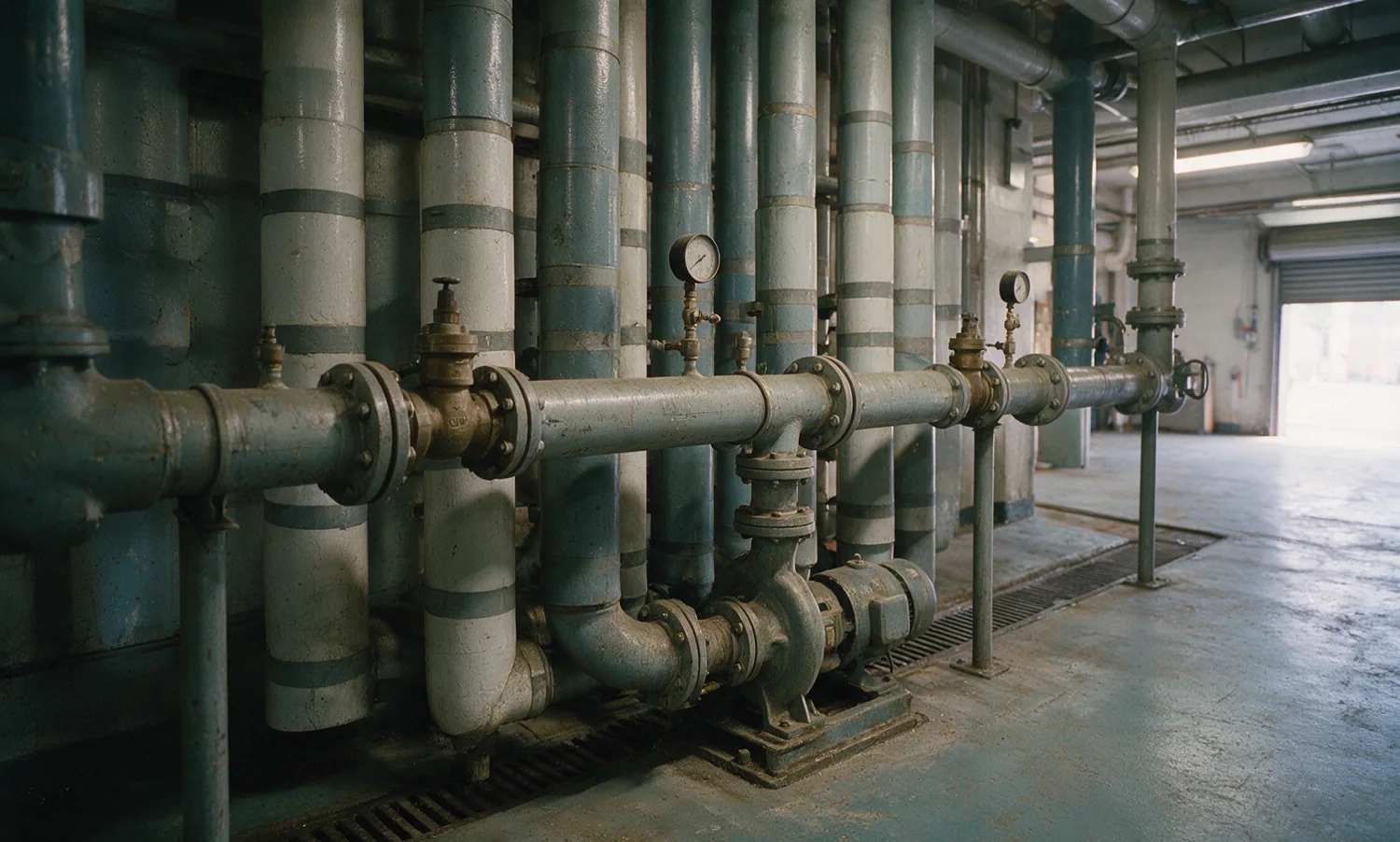
- Unbalanced water takes the easy path: units near the pump get too much flow, the far ones starve, and low delta-T makes chillers and pumps move more water for the same heat.
- A static balancing valve is simple and reliable, but its setting is only right at the condition it was commissioned at.
- A dynamic flow limiter caps flow across a pressure band; a separate control valve still does the modulating.
- A PICV holds design flow at every stroke position, full load and part load, and replaces the balancing valve, differential pressure controller and control valve at each terminal unit.
- Flushing before the PICV cartridges see water matters most: debris on the regulator diaphragm is the classic avoidable failure.
On this page8 sections
01Why do hydronic systems end up unbalanced?
Water is lazy. In any chilled- or hot-water circuit it takes the path of least resistance, which means the terminal units nearest the pump are drowned in flow while the far corners of the building starve. The symptoms are familiar to anyone who has run a commercial building: the third floor freezes while the ninth floor sweats, tenants wedge thermostats to extremes, and the plant runs flat out to satisfy the one zone that never gets there.
Unbalanced flow is also an energy problem, not just a comfort one. Overflowed coils return water that is barely cooler or hotter than it left, the low delta-T syndrome that forces chillers and pumps to move more water for the same heat transfer. Balancing exists to make the as-built system behave like the design: every terminal unit receiving its design flow, no more and no less, at every operating condition.
02What does a static balancing valve do, and where does it fall short?
The traditional answer is the static (manual) balancing valve: a calibrated orifice with a graduated handwheel and pressure test points, set once during commissioning to add resistance to the greedy short branches until the flows match design. Set correctly, a static valve is simple, cheap and utterly reliable. There is nothing in it to drift or fail.
Its weakness is the word static. The setting is only correct for the one system condition it was commissioned at. The moment control valves elsewhere modulate (which in a real building is every moment), the pressure field shifts and every branch's flow moves with it. Proportional balancing across dozens of risers is also slow, iterative work: adjust one valve and the others change, so the commissioning engineer walks the building more than once.
03What do dynamic balancing valves and flow limiters add?
Dynamic balancing valves attack that weakness with a moving element. A spring-loaded cartridge throttles itself as differential pressure rises, holding the branch at a set maximum flow across a working pressure band. Wherever the rest of the system is doing something unhelpful, the limiter simply refuses to pass more than its rating.
That makes commissioning almost trivial (the flow limit is built in, not dialled in) and it protects design flow at full load. What a plain flow limiter cannot do is control: it caps the maximum but plays no part in modulating the coil to meet the room's actual demand. The control valve is still a separate device, and the pairing of the two is where the next idea comes from.
04How does a PICV balance and control in one body?
A pressure independent control valve puts a differential pressure regulator and a modulating control valve in one body. The regulator holds a constant pressure drop across the control section, so whatever position the actuator commands corresponds to a definite flow, regardless of what the pumps and every other zone are doing. Balancing valve, differential pressure controller and control valve collapse into a single device per terminal unit; the mechanism is unpacked in PICV explained. A terminal whose single coil has to heat and cool is a different problem again: see six-way valve or separate control valves.
| Approach | How it works | Holds design flow when the system changes? | Watch out for |
|---|---|---|---|
| Static balancing valve | Fixed resistance set by hand against measured flow | No, correct only at the commissioned condition | Iterative commissioning; drifts out of truth as loads and settings change |
| Dynamic flow limiter | Spring cartridge self-throttles to cap flow across a pressure band | Yes, at maximum flow, but it does not modulate | Still needs a separate control valve; check the minimum ΔP is available |
| PICV | Built-in ΔP regulator keeps a constant drop across its own control section | Yes, at every stroke position, full load and part load | Higher unit price; needs the maker's minimum ΔP and clean water, so strainers matter |
The payoff shows at part load, where commercial buildings live. With a PICV on each fan coil or AHU coil there is no overflow to steal from neighbours, valve authority is effectively full at every position, and low delta-T stops being designed in. The premium over a plain control valve is real; what it buys is every balancing device and balancing man-hour it replaces. The arithmetic in why the cheapest valve usually costs the most applies here too.
05Mechanical or electronic PICV: which suits terminal units?
For terminal units, mechanical PICV is the better fit; electronic PICV earns its keep on a handful of large coils. The current fork in specification is between the mechanical PICV described above and the electronic version, where a flow or energy sensor and a smart actuator replace the mechanical regulator. E-PICV brings live flow data and remote re-ranging, and on large air handling units feeding an energy-metered plant that visibility can genuinely earn its keep.
That is Optimus Distributor's published position, and the reasoning is practical, not sentimental.
Mechanical PICV over electronic PICV for terminal units: E-PICV inflates valve budgets 2× to 4×, adds power and wiring failure points, suffers sensor drift in dirty closed-loop water, and needs electronics-literate maintenance. A spring and diaphragm need none of that. The full argument, criterion by criterion, is in mechanical PICV vs electronic PICV.
Multiply any of those E-PICV liabilities by the hundreds of fan coil units in a typical tower and the terminal-unit verdict writes itself. Reserve the electronics for the handful of large coils where the data is worth the wiring.
06How is a PICV system commissioned and verified?
PICV changes commissioning from an art into a checklist, but only if the checklist is actually run. Flushing matters most: a regulator diaphragm meeting construction debris on day one is the classic avoidable failure, which is why combined valve-and-strainer hardware exists at the terminal branch. Where the water itself is the problem rather than the commissioning, the selection changes: see choosing a PICV for a dirty chilled-water loop.
- Flush the system to the flushing specification before the PICV cartridges see water. Use flushing caps or bypasses where the maker provides them.
- Set each valve's design flow from the schedule: a preset on the dial, not a site calculation.
- Verify the pump can hold the maker's minimum differential pressure at the index (hydraulically most remote) valve at full load.
- Spot-check flows at the index and a sample of branches through the test points; record the presets in the O&M manual.
- Stroke each actuator from the BMS and confirm the coil responds across the range, not just at the ends.
That verification pass is short compared with proportionally balancing the same building. Unlike a static setting, the result still holds next year when the tenant fit-outs change the load map.
07Which PICVs do we supply, and what do we need to select one?
Our hydronic principal is Fratelli Pettinaroli of Italy, and the ranges we supply cover this whole page:
- EvoPICV: the pressure independent balancing and control valve
- Dynasty 92: a PICV for loops where the water is dirty
- FilterBall 51F: a ball valve with an integrated strainer, there precisely because of the flushing story above
The line, and where each series fits, is on our Pettinaroli hydronic balancing and PICV page. For data halls and chilled-water plant, see Pettinaroli for HVAC and data centre cooling, and the valve kit a data centre CRAH unit is fed from. The same package for fan coils, chilled beams and air handling units is in prefabricated valve kits and what off-site assembly changes.
Sizing a PICV is a selection, not a calculation (design flow, minimum available ΔP, connection size, actuation), but the selection still has to match your schedule and your water quality. Send us the terminal schedule and we sit down with your engineers to make sure the valve list is right before it becomes a purchase order; the process is described in how ordering and technical support work, and price, lead time and stock come back on the first reply.
08Questions buyers ask about hydronic balancing and PICV
Do I still need a separate balancing valve with a PICV?
Not at the terminal unit. A PICV puts the balancing valve, differential pressure controller and control valve in one body, so each fan coil or AHU coil holds its design flow at every stroke position.
Is a PICV worth its higher price?
The premium over a plain control valve is real. It buys back every balancing device and balancing man-hour the PICV replaces, and it keeps full valve authority and avoids low delta-T at part load, where commercial buildings spend most of their hours.
Mechanical or electronic PICV for fan coils?
Mechanical. Optimus Distributor's published position is that electronic PICV inflates valve budgets 2× to 4×, adds power and wiring failure points, suffers sensor drift in dirty closed-loop water and needs electronics-literate maintenance. Keep the electronics for the few large coils where the data is worth the wiring.
What causes most PICV problems at start-up?
Construction debris reaching the regulator diaphragm. Flush the system before the PICV cartridges see water, using flushing caps or bypasses where the maker provides them, and fit a strainer at the terminal branch, such as Pettinaroli's FilterBall 51F.
What do you need to select a PICV?
The terminal schedule: the design flow of each unit, the minimum available differential pressure, the connection size and the actuation, plus a note on water quality. We check the selection with your engineers before it becomes a purchase order.