 OPTIMUS DISTRIBUTOR
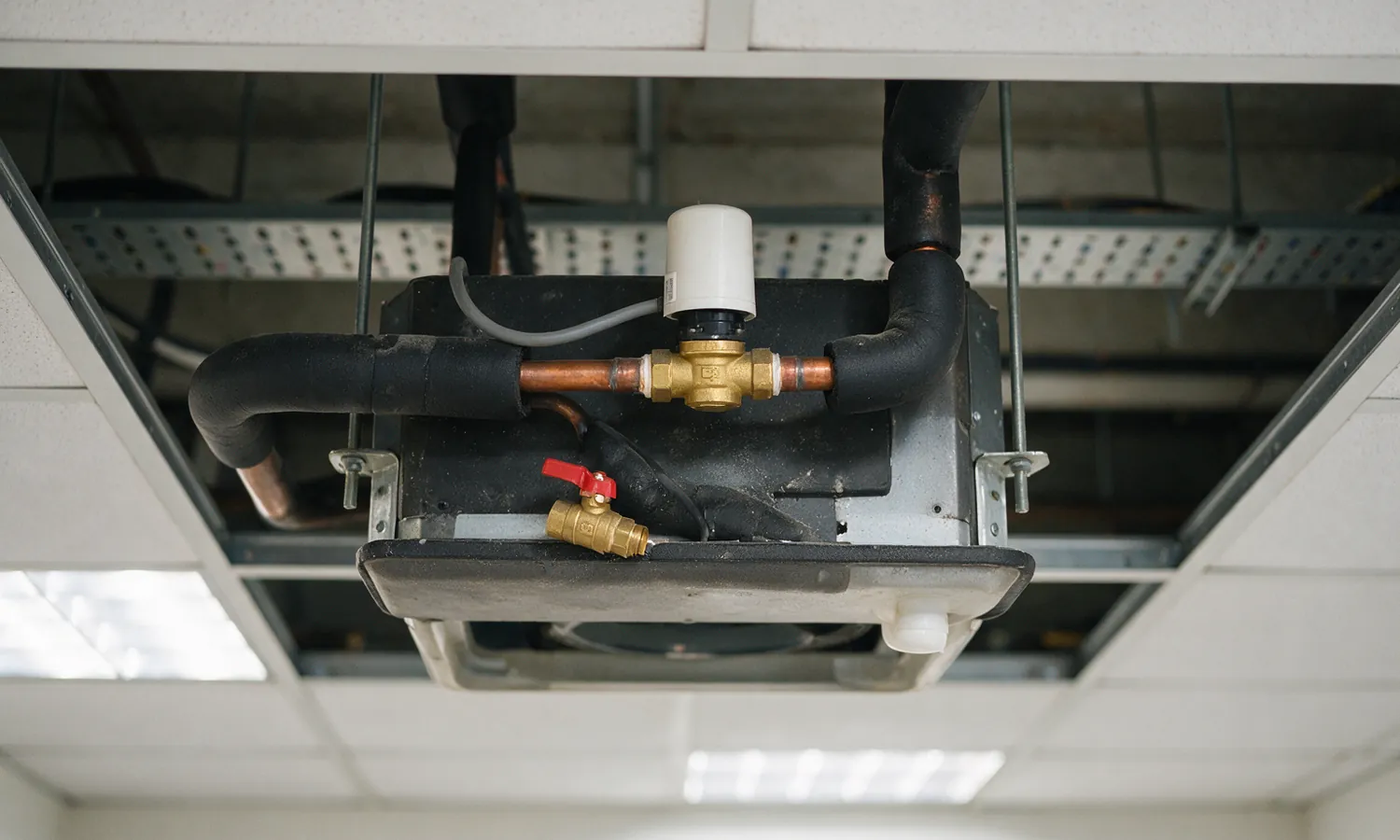
- A fan coil zone valve opens and closes the chilled or hot water to one fan coil unit when its room thermostat calls for it.
- A two-way valve holds back the water the coil does not need and bypasses nothing (an on/off valve shuts it, a modulating valve throttles it), so the system becomes variable flow and pump energy falls at part load.
- A three-way valve sends unused water around the coil, so the system flow stays constant whatever the load, and the return water comes back colder at part load.
- The fan coil zone valves Pettinaroli lists are driven by thermoelectric actuators: a small heater warms a wax element that moves the valve stem, so a stroke is slow (Caleffi gives 120 to 180 seconds for one of its actuators).
- Pettinaroli lists 2-way (662), 3-way (663) and 4-way (664) zone valves from 1/2" to 1", with Kv from 0.63 to 4.2, and a 24 V or 230 V on/off (PWM) actuator for them.
On this page11 sections
01What does a fan coil zone valve do?
A fan coil zone valve controls the chilled or hot water to one fan coil unit, opening when its room thermostat calls for cooling and closing when the room reaches its setpoint. One valve serves one unit, so each room or zone is controlled on its own while the building's water keeps flowing to the other units.
On a fan coil, the valve is usually small: 1/2" to 1" is the range Pettinaroli lists for its fan coil zone valves. The question that decides the whole system is not its size but how many ports it has.
02Two-way vs three-way valve: what changes in the system?
The coil cools the room the same way with either valve; the difference is what happens to the water the coil does not need. A two-way valve holds it back. A three-way valve sends it around the coil and back to the return pipe.
Trane's chiller system design manual puts it plainly: "The coil sees no difference between these two methods. The chilled-water system, however, sees a great difference." With a two-way valve, "all flow in the coil circuit is throttled. No water is bypassed. Consequently, a system using two-way valves is a variable-flow chilled-water system."
A three-way valve "bypasses unused water around the coil and requires a constant flow of water in the system, regardless of load". Trane names the cost: "the temperature of the water leaving the three-way valve is reduced at part-load conditions". The return water then comes back to the plant colder at part load, a problem engineers call low delta T syndrome.
Trane's lines describe modulating valves, which throttle the flow smoothly. An on/off zone valve has the same effect on the system, only in steps: a closed two-way valve stops its unit's flow, while a closed three-way valve sends all of it around the coil.
| Point | Two-way valve | Three-way valve |
|---|---|---|
| Unused water | Held back; nothing bypassed | Sent around the coil to the return |
| System flow | Varies with the load | Constant at all loads |
| Return water at part load | Stays about the same, or rises slightly | Colder, because bypass water mixes in |
| Part-load pump saving | Yes: flow falls with the load | No: flow is constant at all loads |
| Typical system | Variable-flow chilled water | Existing constant-volume systems |
03Why do most new chilled-water systems use two-way valves?
Two-way valves let the pumps move only the water the building needs at that moment. Trane's chilled-water system design manual lists what follows: "The water flow through each load terminal varies proportionately to the load, resulting in pump energy savings at part load," and "A variable-flow system is less sensitive to water balance than most constant-flow systems."
Trane notes that with two-way valves the return-water temperature "is constant (or increases) as the cooling load decreases", which makes options such as heat recovery and free cooling more effective.
A two-way system does need one more decision at the plant. Trane adds that a variable-flow system may need another way to keep a constant flow through the chillers, or chillers that can take a variable flow. Settle that with the system designer before every fan coil gets a two-way valve. Our guide to the valves a data centre chilled-water loop needs shows the same plant-side choices on a larger loop.
04When is a three-way zone valve still the right choice?
A three-way valve suits a system built for constant flow. Trane notes that three-way valves "are used in many existing systems, especially in those with constant-volume pumping." If the pumps and chillers were chosen for a steady flow, swapping every fan coil to two-way valves changes how the whole plant behaves, not just the room.
So on a replacement job, match what the system was designed for. On a new design, the choice belongs to the mechanical engineer's flow strategy, and the zone valve follows it.
05How does a thermoelectric actuator open a zone valve?
A thermoelectric actuator moves the valve by heating wax. Caleffi, describing its own thermo-electric actuator, explains that current from a 24 VAC supply passes through a resistor and "heats a small piston/cylinder assembly (2) containing a specially formulated wax. Heating causes the wax to expand, which moves the piston several millimeters." When power is removed, "the wax shrinks back to its original volume", and a spring helps close the valve.
That makes a thermoelectric actuator slow by design. Caleffi gives an operating time of "opening and closing from 120 s to 180 s" for one of its thermo-electric actuators. For a room on a fan coil, a stroke of two to three minutes is fine; for a process that needs a fast shut-off, it is not.
The actuator Pettinaroli lists for its fan coil zone valves is an electro-thermal on/off (PWM) actuator, normally closed (N.C.), with a 4 mm stroke, in a 24 V or 230 V version. Pettinaroli lists the valve bodies themselves as normally open, so confirm on the datasheet how the assembled valve sits when power is lost.
On/off or modulating?
The zone valve actuators Pettinaroli lists are on/off. Where a building management system needs proportional control, Pettinaroli's thermo-electric actuators for its PICV ranges also come in a 24 V, 0-10 V proportional version. Say which control you need on the enquiry.
06Two-pipe or four-pipe: how many zone valves does a fan coil need?
A two-pipe fan coil has one water circuit, so it takes one zone valve; a four-pipe unit has separate heating and cooling circuits. Wikipedia's entry on fan coil units explains that two-pipe units "have one supply and one return pipe", supplying either cold or hot water depending on the time of year, while four-pipe units "have two supply pipes and two return pipes", so either hot or cold water can enter at any time.
A four-pipe unit therefore needs control on both circuits: a zone valve on each, or one valve that switches between them. Pettinaroli's EvoSIX six-way valve does the second job; our guide to the six-way valve or separate control valves compares the two layouts.
07Which fan coil zone valves does Pettinaroli make?
Pettinaroli lists three fan coil zone valve series: the 662 two-way, the 663 three-way and the 664 four-way. All three have male-by-male threaded ends, axial movement and a normally open body, according to Pettinaroli's HVAC catalogue, and they share one electro-thermal actuator.
| Series | Type | Sizes | Kv |
|---|---|---|---|
| 662 | 2-way zone valve | 1/2" DN10, 3/4" DN15, 1" DN20 | 0.63, 1 and 1.6 (1/2"); 2.5 (3/4"); 4.2 (1") |
| 663 | 3-way zone valve | 1/2" DN10, 3/4" DN15, 1" DN20 | 0.63, 1 and 1.6 (1/2"); 2.5 (3/4"); 4.2 (1") |
| 664 | 4-way zone valve | 1/2" DN10, 3/4" DN15, 1" DN20 | 1.6 (1/2"); 2.5 (3/4"); 4.2 (1") |
The actuator for all three is the A54402S (24 V) or A54202S (230 V): electro-thermal, on/off (PWM), normally closed, 4 mm stroke, with its adapter and a 1 m cable.
Kv is the valve's flow factor, expressed in m³/h. The Wikipedia entry on flow coefficient gives it as the flow divided by the square root of the pressure drop in bar (for water), so a higher Kv passes more water at the same pressure drop.
A worked example, as arithmetic only: a fan coil designed for 0.5 m³/h (500 l/h), with 0.2 bar allowed across the valve, needs a Kv of 0.5 divided by the square root of 0.2, about 1.1. Pettinaroli's 1/2" valves come at Kv 1 and 1.6, so the designer picks between the two by the pressure drop the loop can take.
Optimus Distributor supplies Pettinaroli's HVAC range, from these zone valves to PICVs, six-way valves and prefabricated kits. Our page on Pettinaroli for HVAC and data centres shows the full line, and the Pettinaroli brand page covers its balancing valves.
08Why does the differential pressure limit matter?
A zone valve can only close against so much pressure, and that limit narrows the flow it can handle. Pettinaroli's catalogue says of all three series: "Use limited by the value of the maximum operating differential pressure, which reduces the flow range."
Makers give the limit on the datasheet. Caleffi, for example, rates its 676 two-way zone valve, which has a special obturator built for high differential pressures, at a maximum of 2.5 bar. Check the figure for the model you buy against the highest pressure the branch will see.
Where the pressure across a branch is too high or changes a lot, designers often move from a simple zone valve to a pressure independent control valve. Pettinaroli describes its EvoPICV as a combined constant flow limiter and full-authority control valve. Our PICV guide explains how one works, and the hydronic balancing guide shows where each valve sits in the loop.
09What should you check, and send us, before ordering?
Check the system first and the valve second: the flow strategy, the design flow and Kv, two-pipe or four-pipe, the actuator and the differential pressure settle most fan coil zone valve orders. Send these six lines and we work through the valves with your engineers:
- Units. Number of fan coil units, and two-pipe or four-pipe (one valve, two valves or a six-way valve per unit).
- Flow strategy. Two-way (variable flow) or three-way (constant flow), from the system design, or ask us to check it against the design.
- Design flow and connection. Flow per unit in l/h decides the Kv; the pipe size decides the connection.
- Actuator. 24 V or 230 V. On/off (PWM) is what Pettinaroli lists for these zone valves; ask if you need 0-10 V.
- Differential pressure. The highest pressure the valve must close against, if known.
- Quantity and date needed on site.
Send these six lines on WhatsApp, or browse more guides on our insights page. If the fan coils come as a set, a prefabricated kit can carry the zone valve, isolation and balancing in one assembly; our guide to prefabricated valve kits for fan coils covers what that changes.
10Questions engineers ask about fan coil zone valves
Can I replace a three-way zone valve with a two-way valve?
Only if the system can run on variable flow. A three-way valve keeps the system flow constant; a two-way valve does not, so the pumps and chillers must be able to handle a changing flow. Check with the system designer before changing any valves.
Why does a thermoelectric zone valve take minutes to open?
Because a thermoelectric actuator works by heating wax. The wax has to warm up and expand before the stem moves; Caleffi gives 120 to 180 seconds to open or close for one of its thermo-electric actuators. For room comfort that delay does not matter.
What size zone valve does a fan coil need?
Size it by the fan coil's design flow and the pressure drop allowed across the valve, which together give the Kv, not by the pipe alone. Pettinaroli's 1/2" two-way valve, for example, comes in three Kv values, 0.63, 1 and 1.6, so one connection size covers several flows.
Does a fan coil with a zone valve still need a balancing valve?
Usually. A zone valve opens and closes; it does not set how much water the branch takes. That is the job of a balancing valve or a PICV, which is why Pettinaroli's prefabricated kits for fan coils put flushing, balancing, isolation and temperature control for each unit in one package.
11Sources
Read 7 November 2026. Product features and ratings are the manufacturer's own published statements: confirm every detail against the current datasheet for the model you are buying.
- Trane, Chiller System Design and Control, SYS-APM001-EN, copy hosted on manualsonline.com (three-way and two-way valve load control).
- Trane, Chilled-Water System Design, TRG-TRC016-EN, copy hosted on manualsonline.com (two-way valve control and variable flow).
- Caleffi, Zoning with thermostatic valves and zone valve and thermo-electric actuator datasheet 01343 (how a thermo-electric actuator works, operating time, the 676 valve's differential pressure).
- Wikipedia, Fan coil unit (two-pipe and four-pipe units) and Flow coefficient (Kv).
- Pettinaroli, Zone valves for fan coil, and HVAC water distribution catalogue 2024, V1 March 2024 (client document held by Optimus Distributor): zone valves p56, actuators p24-25.