 OPTIMUS DISTRIBUTOR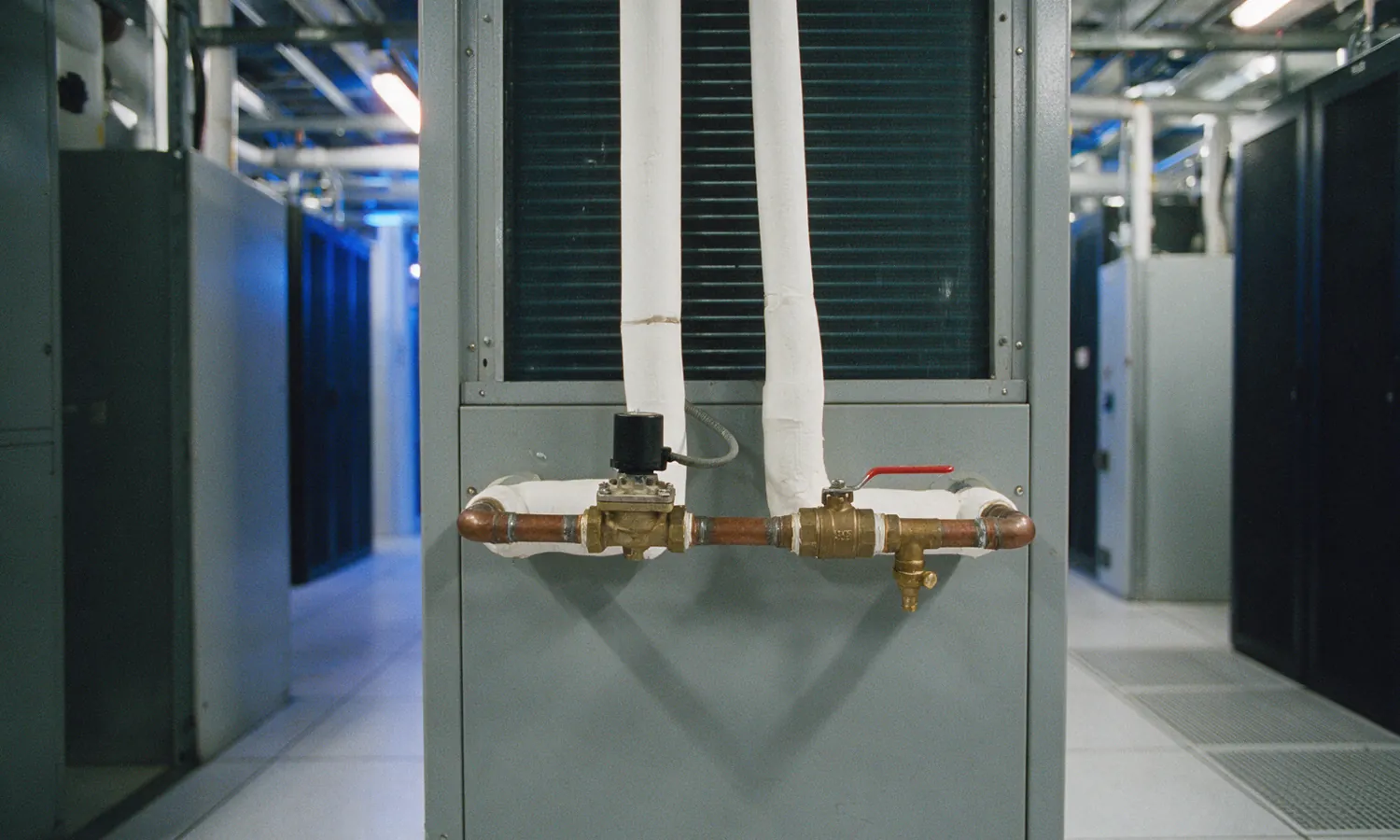
- A CRAH valve kit is one pre-assembled package carrying isolation, a strainer, a flushing by-pass, a flow measurement point and a pressure independent control valve with a modulating actuator.
- The control valve is pressure independent because the flow at one unit has to hold while the units around it modulate.
- Pettinaroli catalogues the EvoPICV 91 Series with an equal percentage characteristic and the Dynasty 92 Series with a linear one, and the Dynasty is the range it describes for heavily contaminated water.
- Kits are identified by the centre to centre spacing of their two legs, 40 mm to 279 mm across the listed PCS range, so flow is only half of what picks the kit.
- On chilled water the insulating case is the cooling one, which is a separate catalogue item from the heating case for the same valve.
01What is a valve kit for a CRAH unit?
A valve kit for a computer room air handling unit is a single pre-assembled assembly that connects one cooling coil to the chilled-water branch. It carries the isolation, the strainer, the flushing route, the flow measurement point and the control valve in one body of pipework, assembled and tested before it reaches site. One package does what five loose fittings would otherwise do, and it arrives with its joints already made.
The reason a data hall gets a kit rather than a set of loose valves is that every one of those jobs has to be done at every unit, and the cost of getting one of them wrong is not a complaint about a warm room. Each CRAH unit is fed from a shared loop. When the unit next to it modulates, the differential pressure across this one moves, and if nothing holds the flow, the aisle in front of the starved unit runs hot.
What is the difference between a CRAH and a CRAC unit?
A CRAH unit cools the air with a chilled-water coil fed from a central plant. A CRAC unit cools it with a refrigeration circuit of its own. Only the CRAH has water to isolate, strain, flush, balance and control, so only the CRAH needs a valve kit. If the unit on your drawing has a compressor in it rather than a flow and return connection, nothing on this page applies to it.
Pettinaroli groups these water-side assemblies under the name PCS and lists them in its own catalogue as preassembled valve kits, most of them described as a flushing by-pass with a pressure independent control valve and a FilterBall strainer and shut-off valve. Optimus Distributor is an authorised distributor for Pettinaroli in Malaysia and supplies that range: the overview is on our Pettinaroli HVAC and data centre page, and the brand page is Pettinaroli hydronic balancing and PICV.
02What parts are in a CRAH valve kit?
A CRAH valve kit normally carries eight things: a pressure independent control valve, a modulating actuator, an isolation valve on each leg, a strainer, a flushing by-pass, a flow measurement point, a drain-off valve and an insulating case. Read the kit as a list of jobs rather than a list of products. Each item answers a question somebody will ask on site, usually at the worst moment.
| Part | What it does | What goes wrong without it |
|---|---|---|
| Pressure independent control valve | Limits the flow to the design figure and controls the coil at the same time | Flow follows whatever pressure the loop happens to offer that minute |
| Modulating actuator | Takes the signal from the building management system and strokes the valve | The coil is either on or off, and the room temperature hunts |
| Isolation valve, each leg | Shuts the unit off without draining the branch | A coil cannot be worked on while the hall is running |
| Strainer | Catches debris before it reaches the control valve and the coil | Dirt lands in the seat of the valve that is holding your flow |
| Flushing by-pass | Lets the pipework be cleaned without the water passing through the control valve | Commissioning pushes building debris through the one component that must stay clean |
| Flow measurement point | Gives the commissioning engineer a reading at the unit | Nobody can prove the unit got its design flow |
| Drain-off valve | Empties the kit for service | Water on the floor of a data hall |
| Insulating case | Stops condensation forming on cold metal | Dripping onto whatever is underneath the unit |
The strainer and the shut-off are often the same fitting. Pettinaroli's kit listings name a FilterBall, a ball valve with the strainer built into it, so one item does the isolation and the straining. Several listings add a drain-off valve to that. Not every kit carries the full set: the X4 compact terminal valve assembly, at 40 mm centres, is listed as a by-pass and an axial EvoPICV only.
03How does a kit for a big CRAH unit differ from a small one?
Pettinaroli's HVAC catalogue splits its data centre kits in two. For small and medium size CRAHU it lists pre-fabricated kits with a PICV, an EQM (equal percentage) PICV, modulating actuators, insulation shells, flexible hoses, Venturi devices, non-return valves, and unions and fittings. For big size CRAHU it lists an equal percentage PICV, modulating actuators, a flushing 3-way ball valve, a DZR ball valve with an integrated FilterBall strainer, an isolation ball valve with an integrated Venturi, insulation shells, PT gauges, and unions and fittings.
In ordinary HVAC the same idea covers fan coils, chilled beams and air handling units, which is where most of the PCS range sits. Pettinaroli's own description of the EvoPICV says its intrinsic equal percentage characteristic makes it suitable for water-to-air terminal units such as fan coil units, chilled beams, and air handling units. A CRAH coil is a water-to-air terminal unit too, which is why the kit looks familiar to anyone who has commissioned a fan coil.
The catalogue also records something a specifier will want before the model is fixed: BIM files and technical support are available for the data centre kits, and insulation shells, flexible hoses and unions are listed as options rather than as standard content. Ask for the BIM object and the submittal sheet at enquiry stage, not after the order.
04Equal percentage or linear: which PICV does a cooling coil need?
Pettinaroli catalogues the 91 Series EvoPICV as a pressure independent balancing and control valve with an equal percentage characteristic, and the 92 Series Dynasty as one with a linear characteristic. The equal percentage valve is the one it describes for water-to-air terminal units, and the Dynasty is the one it describes for heavily contaminated water. That is the whole choice, and it is a trade, not a ranking.
Behind both sits the same principle. Pettinaroli states that a pressure independent control valve is designed to maintain a constant and accurate flow rate regardless of pressure variations within the system, by automatically compensating for fluctuating differential pressure. Our own guides set it out at length: what a PICV does and hydronic balancing and PICV.
| Point | EvoPICV 91 Series | Dynasty 92 Series |
|---|---|---|
| Characteristic | Equal percentage | Linear |
| Described for | Water-to-air terminal units: fan coils, chilled beams, air handling units | Systems where the water is heavily contaminated |
| Threaded flow range listed | 150 l/h at 1/2 inch to 1,500 l/h, reached at both 3/4 inch and 1 inch | 150 l/h at 1/2 inch to 14,000 l/h at 2 inch |
| Start-up pressure listed | 20 to 35 kPa across the threaded range | 25 to 40 kPa across the threaded range |
| Servicing | A maintenance kit is catalogued for the 91 and 93 Series | Internals can be removed, cleaned and replaced |
| Diaphragm | Differential pressure regulator diaphragm is a catalogue item | Dirt-resistant diaphragm is a listed feature |
| Connections listed | F x F threaded | F x F threaded |
| Temperature and pressure limits published on the range page | Not stated on the range page | Minus 10 to 120 degrees C, 25 bar maximum working pressure |
The practical reading: an equal percentage valve is the one described for a coil, and a dirty loop is the reason to look at the other one. Pettinaroli says the Dynasty range is engineered to operate reliably even in systems with heavily contaminated water, and that its internal components can be removed, cleaned and replaced without compromising overall performance. On a retrofit into an existing loop, where nobody can tell you what is in the water, that can matter more than the characteristic.
Pettinaroli also says the EvoPICV combines constant flow limitation with full-stroke, full-authority equal percentage temperature control in one valve, and that it can work as a constant flow limiter in a constant volume system without an actuator, or as a true PICV in a variable volume system. Both arrangements appear in data halls, and they are not the same purchase: one of them has no actuator on it. On the actuation itself our published position has not changed, and the reasoning is in mechanical PICV against electronic PICV, with the actuator types themselves covered in valve actuators and automation.
05How is a CRAH valve kit sized?
A PICV holds its flow only inside its own working range, so sizing starts from the flow schedule and not from the pipe. Three figures decide the kit: the design flow of the unit in l/h, the differential pressure available across the branch at its worst and its best, and the centre to centre spacing the coil connections expect. Pipe size is an output of that, not an input to it.
Smaller units stay in the threaded range. Pettinaroli lists the 91 Series EvoPICV from 150 l/h on the smallest 1/2 inch body up to 1,500 l/h, and the same 1,500 l/h figure appears against both the 3/4 inch and the 1 inch body, so going up a size there buys connection size rather than flow. The Dynasty 92 Series runs from 150 l/h at 1/2 inch to 14,000 l/h at 2 inch.
Where a large CRAH unit needs a flanged valve, Pettinaroli publishes the range on its own 94F catalogue page, with a smart actuator included and an insulating case available. Its table runs from 2 inch DN50 at 20,000 l/h to 10 inch DN250 at 500,000 l/h.
The figure in that table that catches people out is the start-up pressure, because it is not constant across the range. Pettinaroli lists 30 kPa against several of the mid sizes, including 4 inch DN100 at 55,000 l/h, and 65 kPa against the 94FH at 10 inch DN250 and 500,000 l/h, the largest flow in the table. A valve chosen on flow alone can still be the wrong valve if the circuit cannot give it the differential it needs to start regulating.
There is a dimension that sits outside the hydraulics and still decides which kit is ordered. Pettinaroli identifies its PCS kits by the centre to centre spacing of the two legs, from 40 mm on the compact terminal assembly to 279 mm on the largest kit it lists. Flow and spacing both have to match the coil, and only one of them is on the schedule.
Pettinaroli names data centers among the projects its flanged HVAC range is designed for, alongside commercial complexes, healthcare facilities and industrial plants. For the plant side of the same system, see our guides to choosing a butterfly valve pattern and choosing a pipeline strainer.
06Why does a CRAH valve kit include a flushing by-pass?
The by-pass exists so that the pipework can be cleaned before the system is commissioned without the dirty water passing through the control valve. It is the component whose purpose is least obvious from its name, and it is the one item in the kit that earns its place entirely during a fortnight nobody will remember a year later.
The reason is not theoretical. BSRIA, in its own announcement of the new edition of BG 29 republished on Designing Buildings, writes that system contaminants "such as mill scale, jointing compound and building debris will inevitably be found in newly fabricated heating and cooling pipework systems", and that if allowed to remain, "these contaminants will make the system prone to blockages at strainers, control valves and small-bore heat exchangers". BSRIA adds that they may also initiate further corrosion and encourage the growth of microorganisms.
Read that list again and notice the second item. The published guidance names control valves as one of the three places a dirty system blocks. A by-pass that routes the flush around the control valve, and a strainer upstream of it, are both answers to the same sentence. BSRIA describes pre-commission cleaning as bringing a closed heating or cooling system to a satisfactory state for commissioning and ongoing maintenance of water quality, which is the standard the kit has to let a contractor reach.
Check the edition before quoting it in a specification. The NBS Publication Index lists BG 29/2021, the amended 6th edition, Version A, as the current document and BG 29/2020 as withdrawn. Buy the current edition from BSRIA for the procedure itself.
The design conversation sits one level above all of this. ASHRAE's Standard 90.4 establishes the minimum energy efficiency requirements of data centers for design, construction, and operation and maintenance, and references Standard 90.1 for building envelope, service water heating, lighting and other equipment criteria. ASHRAE describes the 2025 edition as newly revised. The valves at the coils do not meet that standard on their own, but a loop whose units never reach their design flow makes every efficiency figure above them harder to achieve.
The valve choice follows from the same thinking. Where the water in a loop is known to be poor, Pettinaroli's answer is the Dynasty range with its dirt-resistant diaphragm and serviceable internals, rather than a cleaner valve and the hope that the loop improves. Pettinaroli's own summary of why a data centre kit is built this way lists the flushing by-pass for pipe cleaning, easy flow rate setting through the PICV and dry strainer cleaning of the FilterBall under the heading of easy commissioning and maintenance.
07What gets left off a CRAH valve kit enquiry?
Three items in a kit are easy to leave off an enquiry: the insulating case, the drain-off valve with its option port, and the maintenance parts. None of them changes the hydraulic selection, and all three change what arrives on site. Settle them at enquiry stage, because each is a catalogue line of its own rather than something a kit carries by default.
The insulating case, and which one. Pettinaroli catalogues a cooling insulating case and a heating insulating case for the same valve series as separate items. A chilled-water kit needs the cooling one. Getting that wrong is not a performance problem, it is condensation dripping inside a data hall.
The drain-off valve and the option port. They are not on every kit. Pettinaroli's own page for the XT704 kit describes it as a coil connection set with a drain-off valve and an option port, with an insulating case available, and lists it in sizes to 3/4 inch at up to 1,850 l/h. A neighbouring kit in the same family may not carry either.
The maintenance parts. Pettinaroli catalogues a maintenance kit for the EvoPICV 91 and 93 Series, and a differential pressure regulator diaphragm as its own item. A data hall that cannot be shut down is exactly the place to decide, at order stage, whether spares sit on the shelf.
One more item is worth naming because it is the kit's only lasting evidence. The flow measurement point, a Venturi device on the smaller kits and an isolation ball valve with an integrated Venturi on the big ones, is what the commissioning engineer reads to show each unit reached its design flow. No measurement point, no commissioning record for that unit.
08What should a CRAH valve kit enquiry say?
Six lines are enough for a kit to be matched to each unit on paper. Send the cooling schedule with them, and the selection can be checked before anything is ordered. The first three are hydraulic, the second three decide what physically arrives.
- Design flow per unit in l/h, unit by unit, not a single figure for the hall.
- Differential pressure available across the branch, worst case and best case.
- Whether the circuit is variable volume or constant volume, and the control signal the building management system sends.
- Coil connection size and the centre to centre spacing the unit expects.
- New pipework or an existing loop, and anything known about the water.
- Chilled water, so the insulating case is the cooling one, and whether a drain-off valve and test points are wanted at each unit.
Optimus Distributor's sales desk sits down with the customer's engineers on a selection like this rather than quoting from a pipe size. Where the design is still open, start from the duty-first approach to choosing a valve, and the terms used above are defined in our valve glossary.
09Questions engineers ask about CRAH valve kits
Four questions decide most of the specification.
Can a CRAH unit be fed by a control valve and a separate balancing valve instead of a kit?
It can be piped that way, and plenty of older halls are. What it gives up is the pressure independence: a two-port control valve with a fixed orifice beside it is balanced for one set of conditions, and a data hall does not stay in one set of conditions. Pettinaroli's case for the PICV is that it maintains a constant and accurate flow rate regardless of pressure variations within the system. The kit also makes one assembly out of parts that would otherwise be joined on site.
Does the kit need an actuator on every unit?
Not in every arrangement. Pettinaroli says the EvoPICV can be used as a constant flow limiter in a constant volume system without an actuator, or as a true PICV in a variable volume system. A modulating actuator is what lets the building management system control the coil, so a variable volume data hall normally has one at every unit. Confirm it against the control philosophy rather than assuming.
Our loop is an existing one and the water is dirty. Does that change the valve?
It can. Pettinaroli's Dynasty range is the one it describes as engineered to operate reliably even in systems with heavily contaminated water, with a dirt-resistant diaphragm and internals that can be removed, cleaned and replaced. The catalogue gives it a linear characteristic rather than the equal percentage of the EvoPICV, so it is a trade to make with your eyes open. Tell us what the loop is.
Why is the flushing by-pass worth paying for if the system will be cleaned anyway?
Because the cleaning is what the by-pass protects the valve from. BSRIA's published guidance on pre-commission cleaning names control valves among the places a contaminated system blocks, and the by-pass is how the flush avoids them. It is also the cheapest part of the argument: the alternative is a control valve that has had building debris through its seat before the hall was ever handed over.
10Sources
Read 14 October 2026. Product descriptions, sizes and flow figures come from Fratelli Pettinaroli's own public catalogue pages and from its HVAC catalogue, which Optimus Distributor holds as the manufacturer's own document. They are catalogue data, not a selection: confirm every figure against the current datasheet for the model you are buying, and your purchase order governs. This page names BSRIA BG 29 and ANSI/ASHRAE Standard 90.4 and summarises what the publishers themselves say about each. It reproduces no table or clause from either document and states no acceptance value from either; buy the current editions from BSRIA and ASHRAE for the requirements themselves.
- Fratelli Pettinaroli, HVAC Water distribution 2024 catalogue, printed pages 45 and 46 (the manufacturer's own document, held by Optimus Distributor; the data centre kit contents, the strengths list, and the BIM and technical support note)
- Fratelli Pettinaroli, Hydronic kits PCS (the manufacturer's own catalogue listing, for the kit contents and the centre to centre spacings)
- Fratelli Pettinaroli, XT704 PCS kit (the coil connection set, drain-off valve, option port and listed flow rates)
- Fratelli Pettinaroli, PICV Range (the PICV operating principle, EvoPICV and Dynasty descriptions and features)
- Fratelli Pettinaroli, Dynamic balancing Valves (PICV) catalogue index (which series carries which characteristic)
- Fratelli Pettinaroli, 94F EvoPICV (flanged sizes, flow rates and start-up pressures)
- Fratelli Pettinaroli, 91 Series EvoPICV (threaded sizes and flow rates)
- Fratelli Pettinaroli, 92 Series Dynasty (threaded sizes, flow rates and limits)
- Fratelli Pettinaroli, HVAC Accessories (cooling and heating insulating cases, maintenance kit, regulator diaphragm)
- Fratelli Pettinaroli, Flanged HVAC Solutions (the project types the flanged range is designed for)
- BSRIA, BSRIA publishes new edition of BG29 (BSRIA's own announcement, republished on Designing Buildings, for pre-commission cleaning and what contaminants do)
- NBS Publication Index, BSRIA Guide BG 29 (which edition of BG 29 is current and which are withdrawn)
- ASHRAE, ANSI/ASHRAE Standard 90.4, Energy Standard for Data Centers (ASHRAE's own page, for the standard's scope and its current edition)