 OPTIMUS DISTRIBUTOR
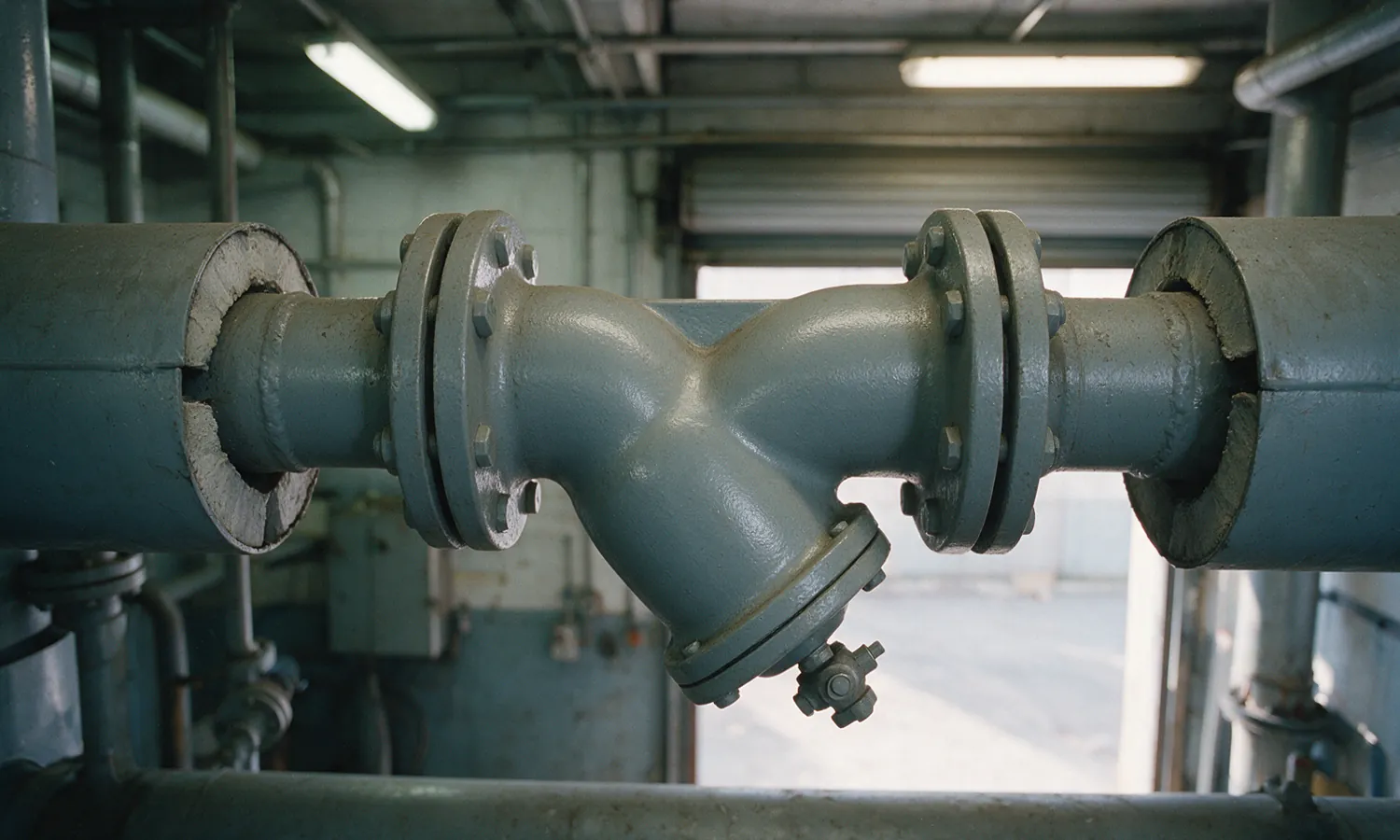
For pipework carrying water, chilled water, steam, gas or oil. Which body, which screen, where it goes and when to clean it, using the makers' own figures and the industry's strainer specification guide.
- Y-strainers are readily available for working pressures of 6,000 psi (about 414 bar) and higher. Basket strainers are not normally built above 1,500 psi (about 103 bar), says the Fluid Controls Institute (FCI).
- Debris capacity comes from open area: FCI says the open area ratio sets how long a strainer runs between cleanings, and heavy debris or viscous fluid needs a larger one.
- The same mesh number is not the same hole: KITZ's 40 mesh opens 0.47 mm, while Pettinaroli rates its FM40 screen's filtering capacity at 300 µm. Specify the opening in mm or µm.
- KITZ recommends cleaning a strainer screen when the differential pressure across it approaches 0.1 MPa (1 bar).
- On the index branch of a chilled-water loop pumping 100 m³/h round the clock, a standard 1" Y-strainer in place of a FilterBall valve costs about RM1,670 a year in pump power at TNB's medium voltage general tariff, at an assumed 60% pump efficiency.
On this page17 sections
01What is a pipeline strainer and what does it protect?
A pipeline strainer is a fitting in process or HVAC pipework that removes solids from the flowing fluid with a screen. The screen is perforated metal, mesh or wedge wire, and the most common retention range is 1" (25.4 mm) down to 40 µm.
That is the definition of the Fluid Controls Institute (FCI), whose Pipeline Strainer Section writes the industry's strainer specification guide. A strainer protects the equipment downstream from sediment, rust and pipe scale: pumps, compressors, meters, control valves, steam traps, heat exchangers and condensers. FCI calls it a relatively low cost item whose protection, when specified properly, "is invaluable". Its guide names two specified bodies: the Y-strainer and the basket strainer.
02What is the difference between a Y-strainer and a basket strainer?
A Y-strainer carries its screen in a short leg angled off the pipe; a basket strainer holds a basket in an upright pot. The body shape sets the pressure range, the pressure drop, the debris it holds and which way it can be fitted.
KITZ describes its Y-type as compact with relatively low fluid drag, and its U-type, whose screen lifts out from above, as one that can be piped directly to equipment. FCI notes there is primarily one type of Y-strainer but several variations of basket.
| Factor | Y-strainer | Basket strainer |
|---|---|---|
| Body | Screen in an angled leg; compact, relatively low fluid drag (KITZ) | Basket in an upright pot, cover on top |
| Pressure range | Readily available for 6,000 psi and higher (FCI) | Not normally built above 1,500 psi (FCI) |
| Pressure drop | Higher than a basket in large sizes | Above 4", generally less than a Y (FCI) |
| Debris capacity (open area) | Compact body; the less open area the screen leaves, the sooner it needs cleaning (FCI) | High-capacity versions pair fine straining with "a large basket which will not clog for extended periods" (FCI) |
| Orientation | Horizontal, or vertical with the flow running down | Most are for horizontal or slightly inclined pipe; a tee-type basket suits vertical pipe (FCI) |
| Cleaning | Remove the cap, or fit a blowdown valve to flush the screen without stopping the flow (FCI) | Lift the cover and basket out, generally with no draining; most basket types can also take a blowdown valve, with a modified basket (FCI) |
| Usual duties | Steam, gas, high pressure, tight spaces, vertical lines | Liquid lines with heavy debris, viscous fluids, large lines, continuous service as a duplex |
03When is a Y-strainer the right choice?
A Y-strainer suits steam, gas and high-pressure lines, tight spaces, and vertical pipe with the flow running down. It takes high pressure in a small body, and its cap can carry a blowdown valve so line pressure flushes the screen while the plant runs.
The makers' ratings show the range. KITZ rates its bronze Y-strainers to 2.07 MPa non-shock on water, oil and gas, and 1.03 MPa on saturated steam up to 2", and says not to use them on flammable or toxic gas. Its JIS 10K ductile iron Y-strainers take 1.0 MPa of steam, air, gas or oil at 220 °C; the 16K versions take 2.0 MPa.
On steam, FCI calls it a misconception that only one type works: baskets and Ys often perform comparably. What matters is telling the maker it is steam service. The hazard is condensate: FCI notes steam velocities of 70 to 350 ft/s (about 21 to 107 m/s), and a water slug hitting the strainer's change of direction can damage it. Proper trapping upstream prevents it; see our steam trap selection guide.
Which way should a Y-strainer face?
Screen down, says KITZ: cap or cover facing down on horizontal pipe, and on vertical pipe with the flow descending. With the flow rising, add a horizontal section and fit the strainer there; fitted the wrong way, it lets debris fall back upstream. In steam service, FCI notes that turning the debris chamber 90 degrees (on its side) "will minimize condensate collection". Follow the instructions for the model you fit.
04When is a basket strainer the right choice?
A basket strainer is the right choice on liquid lines carrying heavy debris, and on large lines. Its basket can give the large open area FCI recommends for flow "in which much debris is expected to be strained", so it runs longer between cleanings. Above 4", a single basket generally creates less pressure drop than a Y, and the basket lifts out from the top, usually without draining the line.
It needs a horizontal run, headroom to lift the basket and a rating check, since baskets are not normally built above 1,500 psi. KITZ's cast iron U-strainer is cleaned from above once the top cover is off, so it suits floor-level piping where a Y's screen could not be pulled out; it is for horizontal pipe only.
| Type | Use it when | Watch |
|---|---|---|
| Duplex basket | The line cannot stop: flow switches to the clean basket while the other is cleaned | More pressure drop than a single or twin basket of the same size |
| Twin basket | Same duty, built from two single baskets in parallel with their own valves | Takes more space than a duplex |
| Temporary (cone, truncated cone, flat) | Start-up of new pipework, where cost matters most | Lower open area than a basket; the pipe must be opened to clean or remove it |
| Automatic self-cleaning | Cleaning is frequent, hard to reach or unpredictable | The flush water has to go somewhere |
| Magnetic | Fine iron particles wear pump seals and wear rings | Magnets come out for cleaning |
05Which holds more debris between cleanings, a Y or a basket?
The strainer with more open area holds more: FCI says the open area ratio sets how long it runs between cleanings. FCI defines the open area ratio (OAR) as the screen's open flow area against the pipe's internal cross-section.
At 1 to 1, a clean screen matches the pipe, but flow is held back as it clogs. At 2 to 1, it still gives full flow when half clogged. Where much debris is expected, FCI calls for a larger ratio, and the high-capacity type it describes is a basket: fine straining combined with "a large basket which will not clog for extended periods".
Neither body comes with a fixed cleaning interval. FCI's advice is to measure how fast the screen clogs and set the schedule from that; see when a strainer needs cleaning.
Does fluid viscosity change the choice?
Yes. FCI says larger open area ratios suit "very viscous fluids", and names viscous fluids, gasoline and fuel oil as the service its high-capacity baskets are designed for. A viscous fluid in laminar flow also needs a different pressure-drop analysis from turbulent flow, so get the drop at your viscosity from the maker. FCI's list of what to tell a supplier includes the liquid's viscosity.
06What mesh or screen size should a strainer have?
The right screen is the coarsest one that still stops the particles the downstream equipment cannot pass. Start from what the pump, trap, valve or meter can tolerate and work back to an opening in mm or µm. A finer screen than the duty needs only adds pressure drop and cleaning.
"A tendency exists to select smaller holes than those actually needed, leading to too-frequent cleaning, excessive pressure drop, and screens constructed of thinner metal which will withstand less pressure differential."
Fluid Controls Institute, Pipeline Strainer Section: Engineering Specification for the Selection, Installation and Maintenance of Pipeline Strainers
Screens are perforated stainless plate, woven wire mesh, or mesh backed by perforated plate, which is how large strainers strain fine. KITZ fits perforated plate as standard on its bronze, cast iron and ductile iron Y-strainers (1.4 mm holes on 1/4" to 2" sizes), and 40 mesh as standard on its 20K, stainless and carbon steel ones.
Mesh is the number of openings per inch. KITZ warns that the opening varies with wire diameter even at the same mesh number, and the two makers' own figures show it:
| Mesh | KITZ opening | KITZ open area | Pettinaroli FilterBall screen, rated filtering capacity |
|---|---|---|---|
| 10 | 2.14 mm | 71.0% | Not listed |
| 20 | 1.01 mm | 63.2% | Not listed |
| 28 | Not listed | Not listed | FM28: 700 µm, the standard screen |
| 30 | 0.62 mm | 59.4% | Not listed |
| 40 | 0.47 mm | 55.7% | FM40: 300 µm |
| 60 | 0.27 mm | 41.3% | FM60: 230 µm |
| 80 | 0.20 mm | 39.1% | FM80: 180 µm |
| 100 | 0.15 mm | 36.0% | FM100: 150 µm |
At 40 mesh, KITZ's 0.47 mm opening and Pettinaroli's 300 µm (0.30 mm) rating differ by more than a third. Write the opening on the order, not just the mesh number. KITZ also lists Dutch weave wire mesh among its Y-strainer screens; confirm any weave with the maker against the equipment it protects.
07How do open area and pressure drop decide the strainer size?
Check the open area by a stated method, then the clean pressure drop. Two things cut open area: a finer screen, and the backing plate behind it. FCI describes two accepted ways to combine them. The "line of sight" method multiplies them: a 60% open material behind a 40% one leaves 24%. The other counts only the more restrictive layer: 40%. Ask which method a maker used before comparing two quotes.
For pumps, FCI notes most installations designed for reasonable velocities allow about 2 psi (about 14 kPa) across the strainer. Makers publish a strainer's capacity as Kv (m³/h at 1 bar) or Cv, and the standard flow-coefficient formula makes the drop rise with the square of the flow: double the flow and the drop is four times as large.
08How much pressure drop does the strainer choice cost?
On a 1" chilled-water branch, a FilterBall valve loses about a quarter of the pressure of a standard Y-strainer. On the index branch of a loop pumping 100 m³/h, that difference costs about RM1,670 a year in pump power. On a 2" Y-strainer, 100 mesh catches particles about nine times smaller than the standard plate but, counted line of sight, leaves about a third less open area.
Case 1: a 1" branch at 2.5 m³/h
2.5 m³/h (2,500 l/h) is a flow Pettinaroli lists for its 1" prefabricated terminal-unit kits. Pettinaroli's FilterBall leaflet gives a Kv for its 1" valve and, for comparison, for a standard 1" Y-strainer. That second figure is Pettinaroli's for a generic Y, not a KITZ rating.
| Step | Standard 1" Y-strainer (Pettinaroli's generic figure) | Pettinaroli FilterBall 1" |
|---|---|---|
| Kv at 1 bar (Pettinaroli leaflet) | 7.0 m³/h | 14.5 m³/h |
| Flow | 2.5 m³/h | 2.5 m³/h |
| Δp in bar | (2.5 ÷ 7.0)² = 0.128 | (2.5 ÷ 14.5)² = 0.030 |
| Δp in kPa and metres of water | 12.8 kPa, about 1.3 m | 3.0 kPa, about 0.3 m |
At its published Kv, the Y-strainer alone takes almost the whole 2 psi (about 14 kPa) FCI says pump installations usually allow across a strainer, before any dirt and before its separate isolating valve is counted. On the index circuit, the branch that sets the pump head, that drop is added straight to the head the pump must deliver every hour the plant runs.
Here is that extra 9.8 kPa priced for a loop whose pump moves 100 m³/h (forty such branches), running round the clock, on TNB's Non-Domestic Medium Voltage General tariff:
| Step | Figure |
|---|---|
| Extra drop on the index branch | 12.8 - 3.0 = 9.8 kPa |
| Pump flow (example) | 100 m³/h = 0.0278 m³/s |
| Extra power at the water | 0.0278 × 9,800 Pa = 272 W |
| Power drawn, at an assumed 60% pump-and-motor efficiency | 272 ÷ 0.6 = 454 W |
| Energy over 8,760 hours a year | 0.454 kW × 8,760 h = 3,974 kWh |
| Energy charge at 29.83 sen/kWh | about RM1,186 |
| Capacity and network charges, RM29.43 + RM59.84 per kW of monthly maximum demand | 0.454 kW × RM89.27 × 12 = about RM486 |
| Total a year | about RM1,670 |
That is before the monthly fuel adjustment and tax; rerun it with your own flow, pump efficiency and tariff. Our guide to a ball valve with an integrated strainer or a separate Y-strainer covers that choice in full.
Case 2: a 2" KITZ Y-strainer, three screens
| Screen | Opening | Open area of the screen | Combined, line of sight |
|---|---|---|---|
| Standard perforated plate | 1.4 mm holes | 28.5% | 28.5% |
| 40 mesh on backing plate | 0.47 mm | 55.7% | 55.7% × 51.0% = 28.4% |
| 100 mesh on backing plate | 0.15 mm | 36.0% | 36.0% × 51.0% = 18.4% |
Going from plate to 100 mesh makes the opening about nine times smaller (1.4 mm to 0.15 mm) and cuts the free area from 28.5% to 18.4%, so the screen blinds sooner and the drop climbs faster. Counted by FCI's other method, the same 100 mesh screen scores 36.0%, which is why the method belongs on the datasheet. 40 mesh costs almost nothing in open area against the plate: that choice is about particle size.
09Which costs more, a Y-strainer or a basket strainer?
FCI ties a strainer's cost to its pressure rating, cleaning method and testing. It gives no general price ranking between the two bodies. The running cost is the pressure drop, which Case 1 above puts in RM.
| If you need | What FCI says |
|---|---|
| High pressure | Baskets need thick walls, "and subsequent high cost", so are not normally built above 1,500 psi; Ys are readily available to 6,000 psi and above |
| A line that cannot stop | In smaller sizes, the plug-type or ball-type duplex basket is "less costly to construct" than other duplex types |
| Frequent or hard-to-reach cleaning | Automatic self-cleaning strainers are "normally more expensive" than manual ones; the cleaning frequency and its labour cost can justify them |
| Stricter testing | "The more stringent the test requirements, the more costly the ultimate strainer becomes" |
FCI's own conclusion is that the correct strainer can save money twice: by protecting equipment, and by keeping operating and maintenance costs down. For a price on your duty, send us the details.
10Where should a strainer be installed?
Install a strainer upstream of the equipment it protects, with room to pull the screen. Fit gauges either side, and orient the body for the fluid.
In a pressure reducing station the strainer comes first, because dirt under the seat stops a PRV holding its set pressure; see how to size a pressure reducing valve. Ahead of a check valve, it keeps debris from holding the disc off its seat, as our water hammer guide explains. On a vertical pump inlet, use a Y or a tee-type basket and keep the drop low.
Check the clearance before the line is fixed. KITZ's dimension tables give H1, the height needed to remove the screen: 173 mm on a 2" 10FCY cast iron Y-strainer and 497 mm on a 6" one. Insulation, a floor or a cable tray in that space means the screen never comes out.
11Which strainers does a chilled-water or data-centre cooling loop need?
A chilled-water loop needs strainers at two levels: the plant and main lines, and each terminal unit. Main-line strainers protect pumps and chillers; terminal strainers protect the control valve. In its fan-coil and AHU kits, and its kits for big data-centre CRAH units, Pettinaroli builds the terminal strainer into the isolating ball valve.
"System contaminants such as mill scale, jointing compound and building debris will inevitably be found in newly fabricated heating and cooling pipework systems."
BSRIA, announcing BG 29/2020, its guide to pre-commission cleaning of pipework systems
BSRIA adds that, left in, these contaminants make the system prone to blockages at strainers, control valves and small-bore heat exchangers.
- Main lines. Pettinaroli's ST2D and ST2DA are ductile iron Y-strainers for HVAC and water distribution, 2" to 24", flanged to EN 1092-2 PN16 or ANSI Class 150, with a test port and a stainless screen. They suit horizontal and vertical installation, and other meshes are available on request.
- Terminal units. Pettinaroli's 2024 HVAC catalogue lists its pre-assembled kits for fan coils, chilled beams and AHUs with a FilterBall strainer and shut-off valve, at a filtering capacity of 700 µm.
- Data centres. The same catalogue has a section titled "Pettinaroli Data Center Solutions". Its kits for big CRAH units carry a DZR ball valve with an integrated FilterBall strainer, and it lists "dry strainer cleaning" of the FilterBall among the range's strengths.
A strainer does not catch the fine particles that foul a PICV; clean flushing does. See flushing a chilled-water system and PICVs for dirty chilled-water loops. Where each valve sits in the loop is in which valves a data-centre cooling loop needs and valve kits for CRAH units; the range is on our Pettinaroli HVAC and data centre page.
12When does a strainer need cleaning?
Clean a strainer when the pressure drop across it rises well above its clean reading, and before it nears the maker's limit. KITZ recommends cleaning when the differential pressure approaches 0.1 MPa (1 bar). Gauges either side turn the decision into a number; a differential pressure switch can raise an alarm.
The rise is not steady. FCI explains that once a clogging screen's open area approaches the pipe's cross-section, the drop rises very rapidly and unpredictably, and that is the point to clean. Never let it approach the screen's burst pressure.
- Record the clean differential pressure at design flow when the system is commissioned.
- Check often in the first weeks of a new system, when construction debris is still moving.
- Time how fast the drop climbs; FCI's advice is to set the cleaning schedule from that clogging rate.
- Use a blowdown valve, on a Y or a basket built for one, to flush the screen without stopping the flow; on a FilterBall 51FS, 52FS or 56F/2, the system water back-flushes the screen through the drain outlet.
- Keep a spare screen: KITZ sells strainer screens as maintenance parts.
13What mistakes do buyers make with strainers?
Buyers go wrong both ways: too cheap, or over-engineered. In Optimus's own words, customers "go too cheap and face costly downtime, or over-engineer without considering what their project actually needs." With strainers, the first means leaving one out or under-rating it. The second means a screen far finer than the duty, which clogs and costs pressure drop.
- Choosing by mesh number alone. 40 mesh is a 0.47 mm opening from KITZ, while Pettinaroli rates its FM40 screen's filtering capacity at 300 µm.
- A finer screen than the equipment needs. FCI's warning above; Case 2 shows the open area it costs.
- Fitting it backwards, or with the flow rising. Debris falls back upstream (KITZ).
- Reading the flange class as the strainer's rating. FCI's example: a carbon steel strainer with Class 150 flanges, designed for 100 psig at 650 °F (6.9 bar at 343 °C), is limited to 100 psig, even though the flange is rated 170 psig (11.7 bar) at 500 °F.
- Not saying it is for steam. FCI says the maker must be told.
- Ignoring water hammer. FCI's rule of thumb is 54 psi for each ft/s of flow stopped, about 12 bar per m/s: 12 ft/s (3.7 m/s) can produce a 648 psi (about 45 bar) peak. Check the shock rating.
- Leaving the start-up strainer in by default. FCI notes temporary strainers are now often left in, with less open area and no way to clean them without opening the pipe.
14Which strainers and flange standards are available in Malaysia?
Order to the flange drilling on the drawing. One Malaysian catalogue, Optimus's own, carries Japanese, American and European standards side by side: KITZ in JIS 10K, 16K and 20K and ASME Class 125, Pettinaroli in EN 1092-2 PN16 and ANSI Class 150.
| Family | Body and screen | Ends | From the maker |
|---|---|---|---|
| KITZ bronze Y (Y, AKY, CY) | Cast bronze; 304 stainless screen | Threaded (BS21 or NPT) or solder | 2.07 MPa water, oil, gas; 1.03 MPa saturated steam up to 2" |
| KITZ cast iron Y (10FCY, 125FCY) | FC200 cast iron; 304 stainless punched plate | JIS 10K or ASME B16.1 Class 125, flat face | Check the H1 screen clearance (173 mm at 2") |
| KITZ ductile iron Y (10FDY, 16FDYB, 20FDYB and others) | Ductile iron; 304 stainless punched plate (40 mesh as standard on 20K) | Threaded, or JIS 10K, 16K or 20K flanges | 10K: 1.0 MPa steam, air, gas, oil at 220 °C; 16K: 2.0 MPa |
| KITZ stainless Y (UY, UYB, 10UYA and M versions) | CF8 or CF8M stainless | Threaded, or JIS 10K flanges | 40 mesh screen as standard |
| Pettinaroli ST2D, ST2DA | Ductile iron; stainless screen; test port | EN 1092-2 PN16 or ANSI Class 150; 2" to 24" | HVAC and water; horizontal or vertical |
| Pettinaroli FilterBall (51F, 52F, 51FS, 52FS, 56F/2 and others) | DZR brass CW602N (51FG: lead-free CW511L); AISI 304 screen | Threaded, 1/2" to 2" | 16 bar at 100 °C; FM28 (700 µm) screen as standard |
Optimus is an authorised distributor for KITZ (appointed in 2019) and for Pettinaroli, and supplies across Malaysia, including Sabah and Sarawak, from Subang Jaya. The full list sits in the Strainer category on our products page, and the KITZ range on our KITZ page.
The running cost is local too. Pump power in Peninsular Malaysia is billed on the Energy Commission's tariff schedule for 1 July 2025 to 31 December 2027, with a fuel adjustment TNB updates monthly; Case 1 above prices a strainer's pressure drop on it.
15How do I choose a pipeline strainer?
Choose a pipeline strainer from the equipment it protects outward. The particle that equipment tolerates sets the screen, the fluid and debris load set the body, and the line's worst case sets the rating. It is the same duty-first logic as our guide to choosing the right industrial valve. Run these checks before a strainer goes on the order.
- Name the equipment it protects and ask its maker what particle size it tolerates.
- Choose the coarsest screen that stops that particle, written as an opening in mm or µm.
- Match the body to the duty: Y for steam, gas, high pressure and vertical lines; basket for heavy liquid debris, viscous fluids and large lines; duplex where the line cannot stop.
- Check open area and clean pressure drop: the OAR, the method behind it, and the Kv or Cv with the screen actually fitted.
- Confirm the rating against the worst case, shock included, not from the flange class. Our valve body materials comparison helps with the body.
- Match the ends to the drawing: thread type, or JIS, ASME or EN flange drilling.
- Specify the extras now: a blowdown valve on steam, gauge tappings or a test port, a drain, a spare screen.
- Plan the start-up: a temporary strainer for commissioning, and a date to take it out.
Send these eight answers to our sales desk on WhatsApp and we will quote.
FCI's guide adds what a supplier needs to select one: the fluid and its flow, the solids to be removed, and the pressure drop allowed clean and at 50% clogged.
16Questions buyers ask about pipeline strainers
What is the difference between a strainer and a filter?
A strainer removes solids with a cleanable perforated, mesh or wedge-wire screen; FCI puts the common retention range at 1" down to 40 µm. For finer particles the usual alternative is a disposable cartridge filter. Micronic strainers reach 5 µm, and FCI says they are more economical than disposable cartridge filters because their elements are cleaned and reused.
Can a strainer be fitted where the pipe turns 90 degrees?
Some can. FCI says tee-type strainers, suction diffusers and several variations of basket strainer can be used in a right-angle flow application. Confirm with the maker that the model you fit is built for it.
What is a strainer's burst pressure?
It is the highest differential pressure the screen or basket can take before it fails. FCI says it is hard to calculate and depends on the material, its thickness, the size and geometry of the element and the open area of the perforated plate. Get the figure from the maker, and never let the drop across the strainer approach it.
Can I buy a replacement strainer screen?
KITZ sells strainer screens as maintenance parts through its dealers; quote the strainer model, nominal size and screen specification.
We sit down with your engineers to settle the strainer, the screen and the rating. Tell us the duty and we will quote: the size and ends, the fluid, its pressure and temperature, what it protects and the quantity.
17Sources
- Fluid Controls Institute, Pipeline Strainer Section: Engineering Specification for the Selection, Installation and Maintenance of Pipeline Strainers (2021).
- KITZ Corporation: Strainer (Y-type and U-type strainers, standard screens, screen types).
- KITZ Corporation: Frequently Asked Questions (Y-strainer piping posture, cleaning at 0.1 MPa, U-strainer, spare screens) and mesh wire diameters and void ratios.
- KITZ Corporation: General Catalog, Technical Information TECH3, "Specification of Standard Strainer Screen" (standard and optional screens for its Y-strainers and cast iron U-strainer, perforation and open area), and strainer dimension and service tables, via the KITZ catalogue portal.
- Fratelli Pettinaroli: FILTERBALL leaflet, version V3.2 Nov20, the source of the Kv figures (14.5 m³/h for the 1" FilterBall, 7.0 m³/h for a standard 1" Y-strainer), the FM screens, the 16 bar at 100 °C rating and the cleaning methods. The series list is on Pettinaroli's FilterBall range page.
- Fratelli Pettinaroli: HVAC Water distribution catalogue 2024, V1 Mar 2024 (PCS kits and their 2,500 l/h 1" kit, Data Center Solutions, FilterBall brass grades), and the hydronic kits range.
- Pettinaroli Industrial Valves flyer, issued by Optimus Distributor (ST2D and ST2DA Y-strainers), listed in the Strainer category of our products page.
- BSRIA BG 29/2020 announcement: BSRIA publishes new edition of BG29, Designing Buildings.
- Engineering ToolBox: Liquid, Steam and Gas Flow Coefficients Cv.
- Suruhanjaya Tenaga (Energy Commission): Jadual Tarif Elektrik di Semenanjung, 1 Julai 2025 hingga 31 Disember 2027 (Non-Domestic Medium Voltage General tariff).
- Tenaga Nasional Berhad: Understand your electricity tariff (fuel adjustment, updated monthly).