 OPTIMUS DISTRIBUTOR
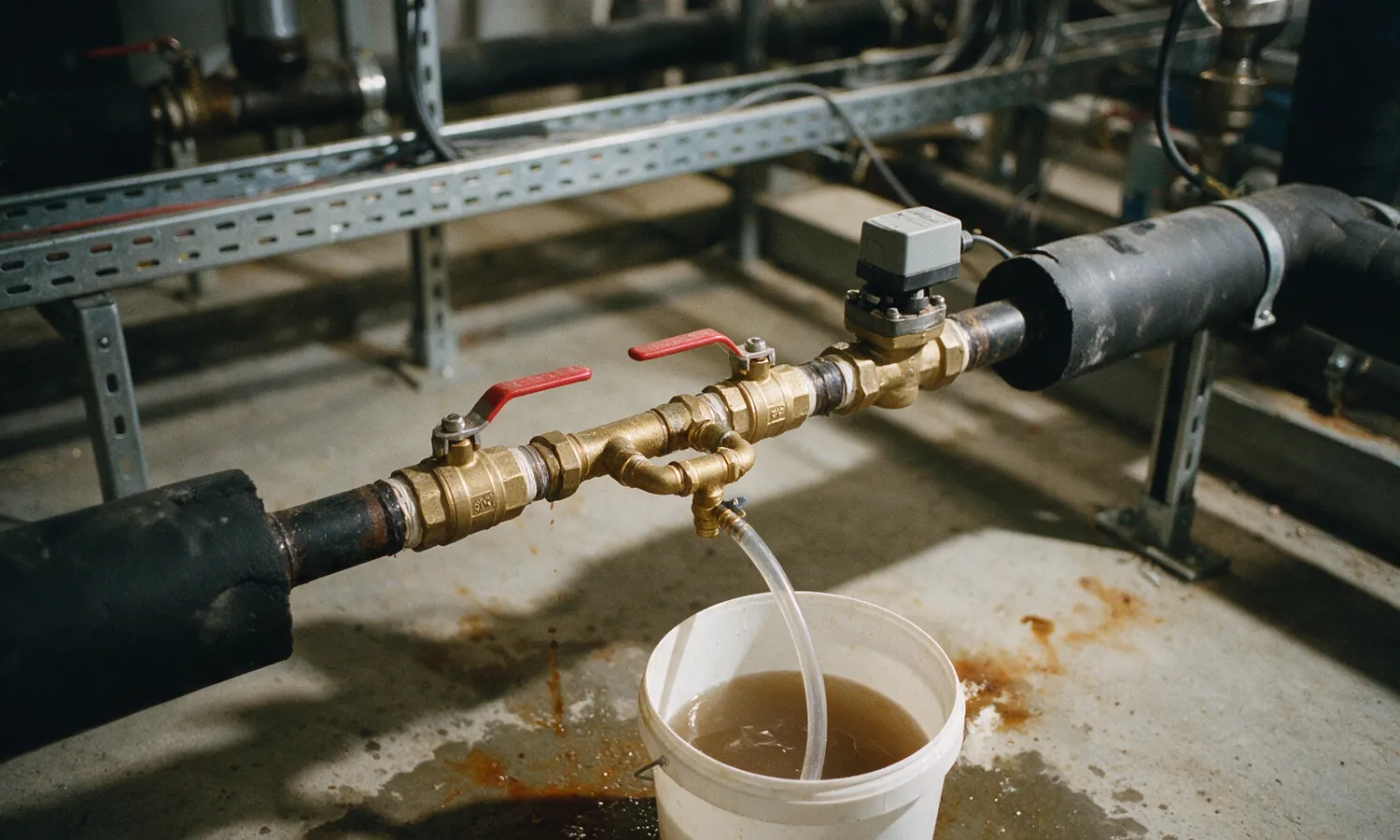
- New chilled-water pipework always holds mill scale, jointing compound and building debris, and BSRIA warns that left in, it can block strainers, control valves and small-bore heat exchangers.
- A pressure independent control valve (PICV) cannot be flushed forward, because it reacts to the higher pressure and holds its set flow. Pettinaroli also warns against flushing it backwards.
- The fix is in the pipework: a flushing by-pass across every branch that holds a PICV, and a flushing drain between the PICV and the coil.
- The mains are cleaned first with the terminals by-passed, then each coil is flushed with clean water through its drain, and only then are the by-passes closed and the PICVs set.
- A by-pass left open after flushing is one fault Pettinaroli's manual names at commissioning, so every PICV's differential pressure is measured and recorded before flow readings are taken.
On this page10 sections
01Why does a new chilled-water system need flushing at all?
A new chilled-water system needs flushing because newly fabricated pipework always carries dirt that will block the smallest passages in the loop, including the control valves at the coils. BSRIA, whose guide BG 29 covers pre-commission cleaning of pipework systems, says that mill scale, jointing compound and building debris will inevitably be found in newly fabricated heating and cooling pipework.
Left in the system in sufficient quantity, BSRIA says those contaminants make it prone to blockages at strainers, control valves and small-bore heat exchangers, and may start further corrosion and encourage microbial growth. Pre-commission cleaning, in BSRIA's definition, is the process of bringing a closed heating or cooling system to a satisfactory state for commissioning and for ongoing maintenance of water quality. The latest edition reported by Designing Buildings is BG 29/2020, amended in March 2021 as BG 29/2021, the sixth edition of a guide first published in 1991.
Because the control valves at the coils have some of the finest passages in the loop, the flushing plan is a valve decision as much as a contractor's method statement. Where these valves sit in a balanced system is covered in our guide to hydronic balancing and PICV for commercial buildings.
02Why can't the flushing water go through the PICV?
Flushing water cannot go through a PICV because the valve is built to hold a set flow whatever the pressure across it. Pettinaroli's PICV technical manual puts the first point plainly:
"PICV valves can never be forward flushed as their design is to react to increased pressure and maintain a constant flow."
Fratelli Pettinaroli, Pressure Independent Control Valves Technical Manual
Reversing the flow is no answer either. Pettinaroli's manual says reverse flushing must be avoided because it can damage a PICV's internal workings, and that the high static pressure of a multi-storey building can damage them when a PICV is back flushed. Crane Fluid Systems gives the second point: it does not recommend flushing through PICVs, because debris can block their close tolerance flow paths. How to choose a valve for a loop that is already dirty is in PICV for dirty chilled-water loops.
03Where do the flushing by-pass and the drain go?
The flushing by-pass goes across every branch that holds a PICV, and the flushing drain goes between the PICV and the terminal unit. Pettinaroli's manual gives both rules. The by-pass lets the main branch pipes be flushed and chemically cleaned without circulating dirty water and cleaning chemicals through the PICVs or the terminal units. The drain lets each terminal be flushed with clean water afterwards without that water passing through the PICV.
BSRIA's guide points the same way: Crane quotes BG 29 as recommending an additional drain point between the two-port valve and the coil connection, so that the coil can be flushed directly at full flow without the flow passing through the valve. Pettinaroli says a flushing by-pass with a three-way ball valve should be installed at every terminal unit to protect the PICV against reverse flushing when the PICV is in the return pipe.
Whether the PICV goes in the flow or the return pipe follows from the flushing plan. Pettinaroli's manual says PICVs can be mounted in either, but that the flushing regime should be considered when choosing. If the specification asks for each coil to be back flushed, from the return pipe backwards through the coil to a drain on the flow, the manual puts the PICV in the flow only, with a double three-way ball valve in the by-pass and the drain between the PICV and the coil.
| Part | Where it goes | What it lets the installer do |
|---|---|---|
| Flushing by-pass (three-way ball valve) | Across the branch, before the terminal unit | Flush and chemically clean the mains with no water through the PICV or the coil |
| Flushing drain | Between the PICV and the terminal unit | Flush the coil with clean water without passing it through the PICV |
| Double three-way ball valve | In the by-pass, with the PICV in the flow pipe | Back flush the coil when the specification asks for it |
| Strainer | On the main branch pipework feeding the terminals | Catch large debris; per-valve strainers only where the designer sees a risk of large contaminants |
Working out the flushing route for a project? Send the terminal schedule and the cleaning method on WhatsApp, +6019 750 3980.
04In what order is a chilled-water system with PICVs cleaned?
A chilled-water system with PICVs is filled and vented, then its mains are flushed and cleaned with every terminal by-passed, then each coil is flushed through its drain, and only then are the by-passes closed and the PICVs set. The outer order is that of CIBSE Commissioning Code W, whose contents run from filling and venting, and flushing and cleaning, through system checks and setting pumps to work, to balancing flow rates. CIBSE's own record shows the 2010 Code was withdrawn in June 2025 and is kept for reference only, so check which document your project specification names.
Put together from Pettinaroli's manual, the branch-level sequence is:
- Clean the main branch pipes with every terminal by-passed, so the dirty water and the cleaning chemicals never reach a PICV or a coil.
- Once the mains are clean, flush each terminal unit with clean water through its flushing drain, again without passing the water through the PICV.
- Pre-set each PICV to its design flow once the flushing works are complete, before its terminal is brought on line.
- With every by-pass closed, set the pump to its design speed and confirm the start-up pressure on the PICVs before any flow reading is taken.
Pettinaroli's commissioning checklist lists the prerequisites in the same spirit: all by-passes closed, all flushing complete, and none of the PICVs reverse flushed. BG 29 also covers how the result of the clean is checked, including laboratory test methods, so the contractor should work from the edition the specification names.
05How does the valve layout affect flushing velocity?
Pettinaroli's UK catalogue 2025 describes its terminal valve sets with a full bore drain to ensure high flushing velocity, and its manifold sets with a full bore flushing by-pass that lets the manifold be flushed at the velocities recommended in CIBSE Commissioning Code W.
One Pettinaroli PICV has a flushing mode of its own. The same catalogue says its rotary EvoPICVR (the PE83S, 1 1/4 to 2 inch), turned through 180 degrees, moves its profiled opening out of the flow path and gives a full port passage for flushing and cleaning. On a PICV without that mode, the by-pass and the drain do the job, and the manual's checklist rule that no PICV is reverse flushed still applies.
06What goes wrong after the flush?
A flushing by-pass left open after flushing is one fault Pettinaroli's manual names: it shows up later as a flow deviation at commissioning. The manual lists a flushing by-pass left open after flushing
among the causes of flow deviation, and says an increase in flow on a riser could be due to a by-pass left open.
For that reason the manual asks for the differential pressure across every PICV in the system to be measured and recorded, and the start-up pressure to be checked and achieved on every one, before flow readings are taken. Pettinaroli also suggests a Venturi flow measuring device on every terminal unit and riser, because flow measured through a variable orifice is less accurate than through a calibrated fixed orifice: plus or minus 20 per cent against plus or minus 5 per cent.
Keeping the water clean is the owner's job from then on. Pettinaroli's manual says facility managers must keep the water quality compliant for the life of the building, and names iron oxide from steel pipe corrosion as the most common and dangerous contaminant for a PICV. How to choose and service a pipeline strainer is in Y strainer or basket strainer.
07Which Pettinaroli parts are built for flushing?
Pettinaroli builds the flushing route into its prefabricated terminal kits. Its HVAC Water distribution 2024 catalogue describes its Pettinaroli Commissioning Solutions (PCS) kits for fan coils, chilled beams and air handling units as handling flushing, balancing, isolation and temperature control per terminal in one package, with no flushing through the control valve.
The same catalogue lists a flushing by-pass for pipe cleaning and dry strainer cleaning of its FilterBall among the strengths of its data centre range, and its kits for big CRAH units carry a flushing three-way ball valve and a DZR ball valve with an integrated strainer. Optimus Distributor is an authorised Pettinaroli distributor, and these kits are part of the Pettinaroli HVAC and data centre range it supplies.
The kits are covered in prefabricated valve kits for fan coils, chilled beams and AHUs and valve kits for data centre CRAH units, the whole loop in data centre chilled-water cooling, and the range on our Pettinaroli HVAC and data centre page and Pettinaroli brand page.
08What should a flushing-ready valve enquiry state?
A flushing-ready valve enquiry should state how the system will be cleaned, because the cleaning method decides where the PICV goes and which by-pass, drain and strainer sit around it. With these six lines, the valves can be matched to the flushing plan before anything is ordered:
- The terminal type and count: fan coil, chilled beam, AHU or CRAH unit.
- The design flow per unit, and the pipe and connection sizes on each leg.
- The cleaning method the specification names, and whether each coil is to be back flushed.
- Whether the PICV is to sit in the flow or the return pipe, if the design already says.
- Whether a strainer is wanted at each terminal or only on the main branch.
- Whether the system is new or existing, and anything known about the water.
09What do engineers ask us about flushing and PICVs?
Can I flush a chilled-water system through the PICVs if I remove the actuators?
Removing the actuators does not make it safe to flush through a PICV. Pettinaroli's UK catalogue says its EvoPICV works as a constant flow limiter without an actuator head, so the valve still limits the flow, and the debris still meets its close tolerance passages. Use the flushing by-pass for the mains and the flushing drain for the coil.
Should the PICV go in the flow or the return pipe?
Either works for control, so let the flushing plan decide. If the coil is to be back flushed from the return, Pettinaroli's manual puts the PICV in the flow pipe only, with a double three-way ball valve in the by-pass and the drain between the PICV and the coil.
Is a strainer at every PICV enough protection?
A strainer at every PICV is not enough on its own. Pettinaroli's manual says strainer mesh is usually too coarse for the fine particles that foul a PICV, so the protection is the flushing route plus clean water afterwards. Pettinaroli puts strainers on the main branch, and at each valve only where large debris is a risk.
How do I know the flushing by-passes were closed?
Measure and record the differential pressure across every PICV, and confirm its start-up pressure, before taking any flow reading. A riser reading above its design flow is one sign Pettinaroli's manual gives that a by-pass was left open, so check that branch's by-pass first.
What if the PICVs are already installed in a dirty existing system?
Follow the valve maker's own instructions before flushing an existing system. Isolate each PICV and flush around it.
10Sources
Read 24 October 2026. Product features are the manufacturers' own published descriptions: confirm every detail against the current datasheet for the model you are buying. BSRIA BG 29 and CIBSE Commissioning Code W are cited and summarised; no procedure, table or velocity from either is reproduced.
- Fratelli Pettinaroli, Pressure Independent Control Valves Technical Manual (flow or return mounting, strainers, flushing by-passes and drains, reverse flushing, commissioning checks, water quality, commissioning checklist).
- Fratelli Pettinaroli, UK catalogue 2025 (full bore drains and flushing by-passes on terminal and manifold valve sets; the EvoPICVR flushing mode; EvoPICV as a constant flow limiter).
- Fratelli Pettinaroli, HVAC Water distribution 2024 catalogue, printed pages 10 to 11, 31 to 32 and 45 to 46 (the manufacturer's own document, held by Optimus Distributor).
- BSRIA, BG 29 Pre-commission cleaning of pipework systems, as reported in BSRIA publishes new edition of BG29, Designing Buildings (contaminants, the purpose of pre-commission cleaning, editions, laboratory test methods).
- CIBSE, Commissioning Code W: Water distribution systems (2010), publication record and contents (withdrawn June 2025).
- Crane Fluid Systems, PICV frequently asked questions (flushing through a PICV; its extract from BSRIA BG 29 on a drain point between the valve and the coil).