 OPTIMUS DISTRIBUTOR
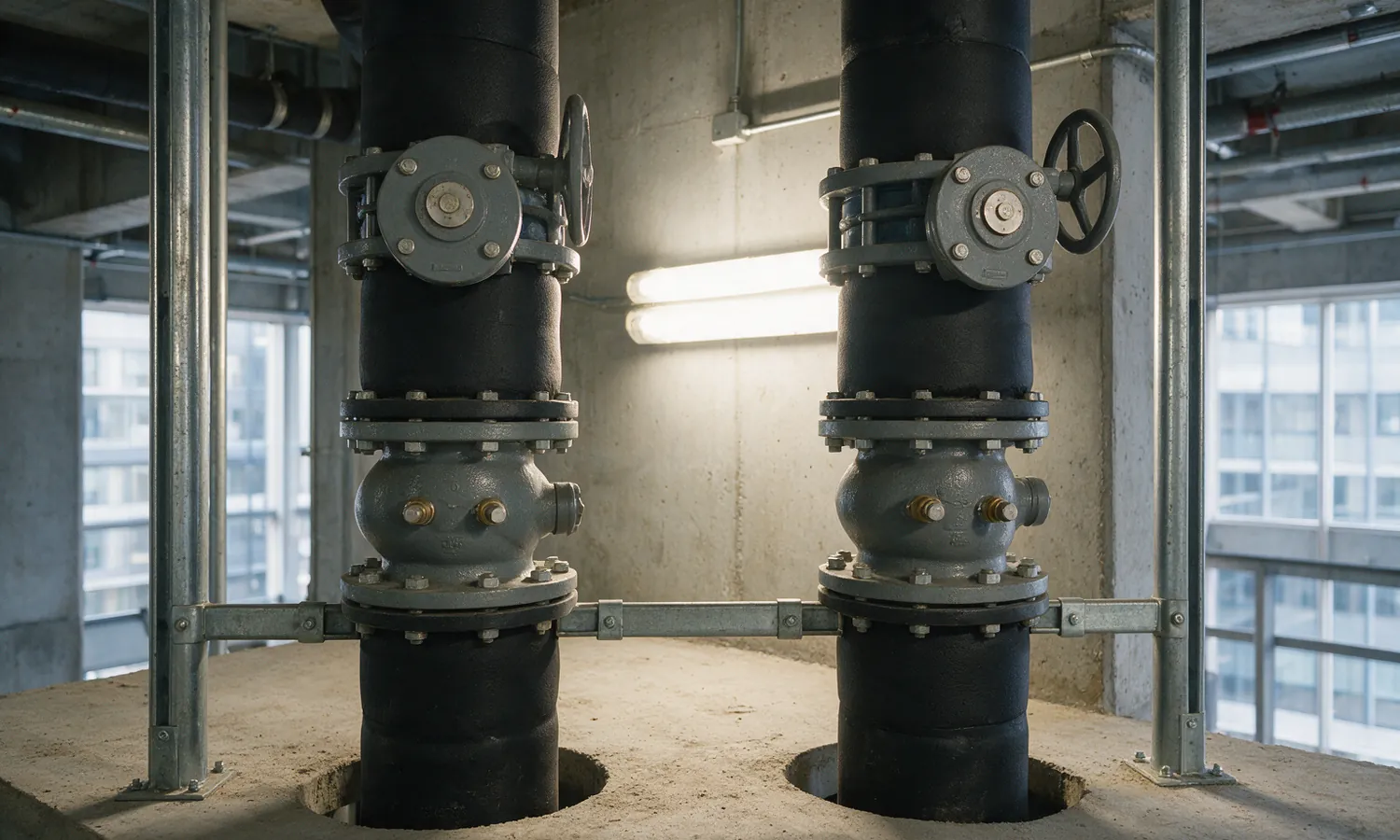
- Optimus Distributor in Subang Jaya is an authorised distributor for Pettinaroli and supplies its HVAC and data centre range across Malaysia, including Sabah and Sarawak: PICVs, balancing valves, zone and six-way valves, prefabricated valve kits, energy meters and ductile iron plant valves.
- Check the supplier's range covers the whole loop, from the plant room to each cooling unit, so one schedule is selected to one set of ratings and data.
- Check the pressure rating against the building's height: each metre of water column adds about 0.098 bar, so valves near a basement plant room in a tall tower can need more than PN16.
- For a data centre built to be maintained while it runs, check that every chiller, pump and cooling unit can be isolated, and look for strainers that can be cleaned dry, such as the FilterBall, and PICVs whose internals can be removed and cleaned, such as the Dynasty 92.
- Ask for the documents before you order: datasheets with pressure and temperature limits, BIM files, materials such as dezincification resistant brass, and the maker's quality certificates.
On this page11 sections
01Who supplies HVAC valves for data centres and office towers in Malaysia?
Optimus Distributor (M) Sdn Bhd, at Jalan Tiara 3 in Subang Jaya, supplies Pettinaroli's HVAC and data centre range as an authorised distributor, supplying across the country including Sabah and Sarawak. The range covers the terminal end of a chilled-water loop (PICVs, zone valves, six-way valves and prefabricated kits) and the plant end (butterfly, check and balancing valves, Y-strainers and flexible joints).
Fratelli Pettinaroli is an Italian maker of hydronic balancing valves, PICVs and fittings, based in San Maurizio d'Opaglio, Novara. Its HVAC catalogue has a section of its own for data centres, built around prefabricated valve kits for CRAH units, and it says its PICV range runs "from 150 l/h up to 500,000 l/h", so one maker can cover a small fan coil and a large air handler. Optimus Distributor was established in 2013 and holds ISO 9001:2015 certification for its quality management, MOF registration with the Ministry of Finance and TNB registration.
The rest of this guide is a check list for choosing an HVAC valve supplier for a data centre or an office tower, wherever you buy: what the range has to cover, how the pressure rating follows the building's height, what a data centre adds, which documents to ask for and the mistakes that cost the most.
02What should one HVAC valve supplier cover?
A supplier for a chilled-water project should cover every valve between the plant room and the cooling coils, because the valves are selected to the same flows, pressures and control signals. Buying the PICVs from one source and the balancing, isolation and metering parts from others leaves no one checking that the schedule fits together.
Where each valve goes is covered in the valves a data centre chilled-water loop needs. The table below maps the same loop to the parts of the Pettinaroli range we supply, so you can see whether one supplier covers your schedule.
| Part of the loop | What it needs | Pettinaroli line |
|---|---|---|
| Chillers and pumps | Isolation, non-return, dirt removal, vibration isolation | BF3SE and BF4SE lug and wafer butterfly valves, CK2WD dual plate wafer check valve, ST2D Y-strainer, GF1C single sphere flexible joint |
| Risers and branches | Flow measurement and balancing | SB2V static balancing valve with test port; Terminator static balancing valve with Venturi |
| Large cooling units (AHUs, big CRAH units) | Flow control that holds its setting as pressure changes | Flanged EvoPICV 94F (EN 1092-2) and 95F (ANSI), up to 500,000 l/h |
| Fan coils, chilled beams, small CRAH units | Compact PICVs, zone valves, kits | Threaded EvoPICV and Dynasty 92 PICVs; 662 and 663 zone valves; PCS prefabricated kits |
| Four-pipe terminals | Heating and cooling changeover | EvoSIX six-way valve |
| Tenant or zone metering | Energy metering | Pettinaroli energy meters (PN25) |
We don't just sell parts: we sit down with your engineers to make sure the project gets the right solution.
03Is the valve's pressure rating high enough for the building?
In a closed chilled-water system the pressure is highest at the bottom, because the water column above presses on every valve below it. Each metre of water adds about 0.098 bar. In a tall tower with the plant room in the basement, the static pressure plus the fill pressure and the pump head can pass 16 bar at the lowest floors, so the valves there need a higher rating than PN16.
The figure comes from the conversion factor itself: NIST's guide to SI units gives the conventional millimetre of water as 9.806 65 pascal, so one metre of water is about 9,807 Pa, or 0.098 bar. As Aircond Lounge explains, "pressure is always higher on lower floors than on upper floors due to static pressure", and engineers "often add the static pressure and the pump head to get the total pressure". Valves, fittings and coils are typically rated PN10, PN16, PN20 or PN25, meaning 10, 16, 20 and 25 bar, and the higher the rating, the higher the initial cost.
Worked example: a tower with its plant room in the basement
As an illustration, not a design, following Aircond Lounge's method: the highest chilled-water point in a tower is 130 m above the valves in the basement plant room. Aircond Lounge's method also notes that the highest point of the system should see a minimum pressure of 20 psi, which adds to the pressure on every valve below; NIST gives 1 psi as 6,894.757 Pa, so 20 psi is about 1.4 bar. The pump in this example makes 35 m of head.
| Pressure | Basement plant room (130 m below the top) | A mid-height floor (65 m below the top) |
|---|---|---|
| Static (water column x 0.098 bar per metre) | 12.7 bar | 6.4 bar |
| Fill pressure at the top (20 psi) | 1.4 bar | 1.4 bar |
| Pump head, at most (35 m) | 3.4 bar | 3.4 bar |
| Total | 17.5 bar | 11.2 bar |
| What the valves there need | More than PN16: PN20 or PN25 | PN16 is enough |
The mid-height figure adds the full pump head as the worst case. Aircond Lounge adds that "a safety factor must be included when deciding the pressure rating of the equipment", which is why its own example, at 19.9 bar on the lowest air handler, ends up at PN25 rather than PN20.
What the Pettinaroli ratings are
In Pettinaroli's UK catalogue 2025, the threaded Dynasty 92 and EvoPICV 91X PICVs and the Terminator balancing valve list a maximum working pressure of 25 bar, while the flanged EvoPICV 94F and the PESB1N flanged variable orifice static balancing valve list 16 bar, with EN 1092-2 PN16 flanges on the PESB1N. The ductile iron butterfly valves, static balancing valves, Y-strainers, check valves and flexible joints in the Optimus-branded Pettinaroli industrial valves flyer have ANSI Class 150 and EN 1092-2 PN16 flanges. The EvoSIX six-way valve has a nominal pressure of 16 bar, and the FilterBall ball valve with integrated strainer is rated 16 bar at 100 °C. So in the example tower the Dynasty 92, EvoPICV 91X and Terminator (25 bar) would be within their rating on every floor, and every 16-bar part (the flanged EvoPICV 94F and PESB1N, EvoSIX, FilterBall) on the mid-height floors, but the basement plant would need parts rated above 16 bar or a design that keeps them below it. Aircond Lounge notes that most chilled-water systems operate at around 10 to 12 bar, rarely above 20 bar, and that "high pressure chilled water systems usually use heat exchangers to reduce the pressure below 20 bar". Give your supplier the system pressure at the lowest valve, not one pressure for the whole building.
04What does a data centre add to the check list?
A data centre that must keep running during maintenance needs every chiller, pump and cooling unit to be isolated and worked on without stopping the cooling. Strainers that can be cleaned dry, such as the FilterBall, and PICVs whose internals can be removed and cleaned, such as the Dynasty 92, make that work easier.
The Uptime Institute's Tier classification describes a Tier III, "Concurrently Maintainable", data centre as one that "requires no shutdowns for equipment replacement and maintenance", where "each and every component needed to support the IT processing environment can be shut down and maintained without impacting IT operations". The same page says this comes from "a redundant delivery path for power and cooling" added to the redundant critical components: spare chillers, pumps and a second path keep the cooling on while one item is out.
Pettinaroli's data centre section lists what its kits are built for: low start-up pressure, pump head optimisation, a flushing by-pass for pipe cleaning, easy flow-rate setting through the PICV, dry strainer cleaning of FilterBall, integrated pressure and temperature gauges and valve test points. Its kits for big CRAH units combine an equal percentage PICV with a modulating actuator, a flushing three-way ball valve, a DZR ball valve with an integrated strainer (FilterBall) and an isolation ball valve with an integrated Venturi. For loops where dirt is a concern, the Dynasty 92 PICV is designed for heavily contaminated water, and its internals can be removed, cleaned and replaced. That choice is covered in choosing a PICV for a dirty chilled-water loop.
Ask a supplier which of these features its kits carry, because they decide how the cooling unit is serviced for the life of the building.
05Which documents should an HVAC valve supplier give you?
Before you order, ask for the datasheet of each valve with its pressure and temperature limits, the flow range and start-up pressure of each PICV, the body material, the flange standard, BIM files for the design model and the maker's quality certificates. A supplier who cannot produce them before the order will struggle to produce them at handover.
- Limits: maximum working pressure and temperature for every valve. The EvoPICV range works from -10 to 120 °C, and the FilterBall is rated 10 bar at 150 °C as well as 16 bar at 100 °C.
- Flow and start-up pressure: for each PICV, the flow range and the minimum pressure it needs to hold its flow. The Dynasty 92 needs at most 0.25 to 0.40 bar to start up, depending on size; PICV start-up pressure and pump head explains why this sets the pump.
- Materials: the brass grade matters in a closed loop that runs for decades. The Dynasty 92 PICV body is corrosion resistant brass CW602N, and the FilterBall is made of the non dezincifiable alloy CW602N; the term is explained in DZR brass valves.
- Flange standard: EN 1092-2 PN16 or ANSI Class 150, matched to the pipework and the chiller connections.
- BIM files: the data centre section of Pettinaroli's HVAC catalogue states "BIM files and technical support available".
- Quality certificates: Pettinaroli's quality system has been certified ISO 9001 by BSI since 1975, and it also holds ISO 14001 and ISO 50001.
Our guide to what an authorised distributor guarantees you explains how to check the channel the valves come through.
06Should you buy prefabricated valve kits or loose valves?
Prefabricated kits suit projects with many identical terminal units, such as fan coils, chilled beams and CRAH units, because each kit arrives with its valves assembled and tested off site. Loose valves suit plant rooms and one-off connections, where every pipe arrangement is different and is built on site.
Pettinaroli's PCS, "Pettinaroli Commissioning Solutions", are prefabricated valve assemblies for fan coils, chilled beams and air handling units. Each kit puts flushing, balancing, isolation and temperature control for one terminal unit in one package, assembled and tested off site, factory tested for minimum leakage risk, and arranged so the system is flushed without sending water through the control valve. Its data centre kits for small and medium CRAH units add EQM (equal percentage) PICVs, modulating actuators, insulation shells, flexible hoses, Venturi devices, non-return valves, unions and fittings. Our guide to prefabricated valve kits for fan coils, chilled beams and AHUs covers what off-site assembly changes on site.
07What changes for Malaysian projects now?
Malaysia's Energy Efficiency and Conservation Act 2024 came into force on 1 January 2025. It applies to large energy consumers and to specific buildings, whose energy intensity must meet prescribed standards. Rajah & Tann's summary of the guidelines puts the lines at 21,600 GJ of energy in twelve months, and office buildings of 8,000 square metres gross floor area and above.
The Energy Commission (Suruhanjaya Tenaga) explains that the Act "applies to large energy consumers, specific buildings, and energy using products". For a building subject to the Act, the person in charge must apply for and display an Energy Intensity Label, and the building's energy intensity performance "must meet prescribed standards"; if it does not, the building must undergo an energy audit and carry out an energy efficiency improvement plan. Energy consumers whose energy usage meets the specified threshold must appoint a Registered Energy Manager, develop an energy management system, submit reports and carry out regular energy audits.
Rajah & Tann Asia, summarising the Energy Commission's guidelines, gives the thresholds: an energy consumer is any person whose energy consumption over twelve consecutive months equals or exceeds 21,600 gigajoules, and the buildings covered are office buildings with a gross floor area of 8,000 square metres and above, not counting parking and circulation areas.
The Energy Commission's summary does not mention valves. On the valve side, Pettinaroli lists low start-up pressure and pump head optimisation among the strengths of its data centre range, and how each tenant's cooling is measured is covered in chilled-water energy metering.
08What mistakes do buyers make, and when does the usual advice not apply?
The costliest mistakes are choosing on price alone, over-specifying for the duty, rating the whole building to one pressure and treating the PICVs as a separate purchase from the rest of the loop. The usual advice changes for low buildings, constant-flow systems and old, dirty loops.
We see both ends of the first mistake: customers either go too cheap and face costly downtime, or over-engineer without considering what their project actually needs. In an HVAC schedule that looks like this:
- One pressure for the whole building. PN25 everywhere costs more than it needs to; PN16 everywhere can leave the basement plant under-rated. Rate by level, as in the worked example.
- PICVs bought apart from the rest of the loop. The PICVs, balancing, isolation and metering parts are selected to the same flows and pressures, as section 02 explains; split across suppliers, nobody checks that the schedule fits together.
- Mixed flange standards. EN 1092-2 PN16 and ANSI Class 150 are both offered. Decide which one the pipework uses before ordering.
- Flushing through the control valves. Flushing a new installation through the PICVs sends its dirt through them. A flushing by-pass, as in the PCS kits, keeps the flush away from the control valves; see flushing a chilled-water system for how.
When the usual answer does not apply:
- A low building. With a few storeys of water above the plant, the static pressure stays well below PN16, and the height check matters little.
- A constant-flow system. Where no coil valve modulates, static balancing valves such as the Terminator may be all the balancing the system needs; our guide to hydronic balancing and PICVs compares the two.
- An old, dirty loop. A PICV built for contaminated water, such as the Dynasty 92, has internals that can be removed and cleaned rather than the whole valve being replaced.
09What should you send a supplier for a quotation?
Send the valve schedule or the cooling-unit list with design flows, the height of the highest point above the plant room, the flange standard, the control signal, whether the site must be maintained while it runs, and when the valves are needed on site.
New customers usually want to know three things from us first: price, lead time, and whether we have the items in stock. Those answers depend on the details above. Our office in Subang Jaya is open Monday to Friday, 8.30 am to 5.00 pm, closed on weekends and public holidays.
Send these lines on WhatsApp, or see our Pettinaroli HVAC and data centre solutions and the Pettinaroli balancing and PICV page.
10Questions buyers ask about HVAC valve suppliers
Who supplies Pettinaroli PICVs in Malaysia?
Optimus Distributor in Subang Jaya, Selangor, is an authorised distributor for Pettinaroli and supplies its EvoPICV and Dynasty 92 PICVs, balancing valves and data centre valve kits across Malaysia, including Sabah and Sarawak. Its ductile iron plant valves come with EN 1092-2 PN16 or ANSI Class 150 flanges.
Is PN16 enough for a chilled-water system?
It depends on where the valve sits. Each metre of water above a valve adds about 0.098 bar, plus the fill pressure and the pump head. In a low building PN16 is usually ample; at the bottom of a tall tower the total can pass 16 bar, and those valves need PN20 or PN25.
What makes a data centre valve schedule different?
A data centre built to be maintained while it runs needs every chiller, pump and cooling unit to be isolated, with strainers that can be cleaned dry, such as the FilterBall, and PICVs whose internals can be removed and cleaned, such as the Dynasty 92. Pettinaroli's data centre kits include flushing by-passes, dry-cleaning strainers and test points.
What do prefabricated valve kits change on site?
They move the assembly and testing off site: each Pettinaroli PCS kit arrives with flushing, balancing, isolation and temperature control for one terminal unit in one package, factory tested for minimum leakage risk. They suit projects with many identical terminal units.
11Sources
Read 28 November 2026. Product figures are the manufacturer's own published statements: confirm every detail against the current datasheet for the model you are buying.
- Pettinaroli, UK catalogue 2025: working pressures of the Dynasty 92, EvoPICV 91X, EvoPICV 94F, Terminator and PESB1N. Pettinaroli, HVAC water distribution catalogue 2024, V1 March 2024, and the Pettinaroli industrial valves flyer and FilterBall leaflet (held by Optimus Distributor).
- NIST, Guide to the SI, Appendix B.9: factors for units listed by kind of quantity (millimetre of water, bar, psi).
- Aircond Lounge, Closed loop chilled water system pressure.
- Uptime Institute, Explaining the Uptime Institute's Tier Classification System.
- Suruhanjaya Tenaga, Energy Efficiency and Conservation Act (EECA) 2024.
- Rajah & Tann Asia, Insights into Malaysia's Energy Efficiency and Conservation Framework, 3 June 2025.