 OPTIMUS DISTRIBUTOR
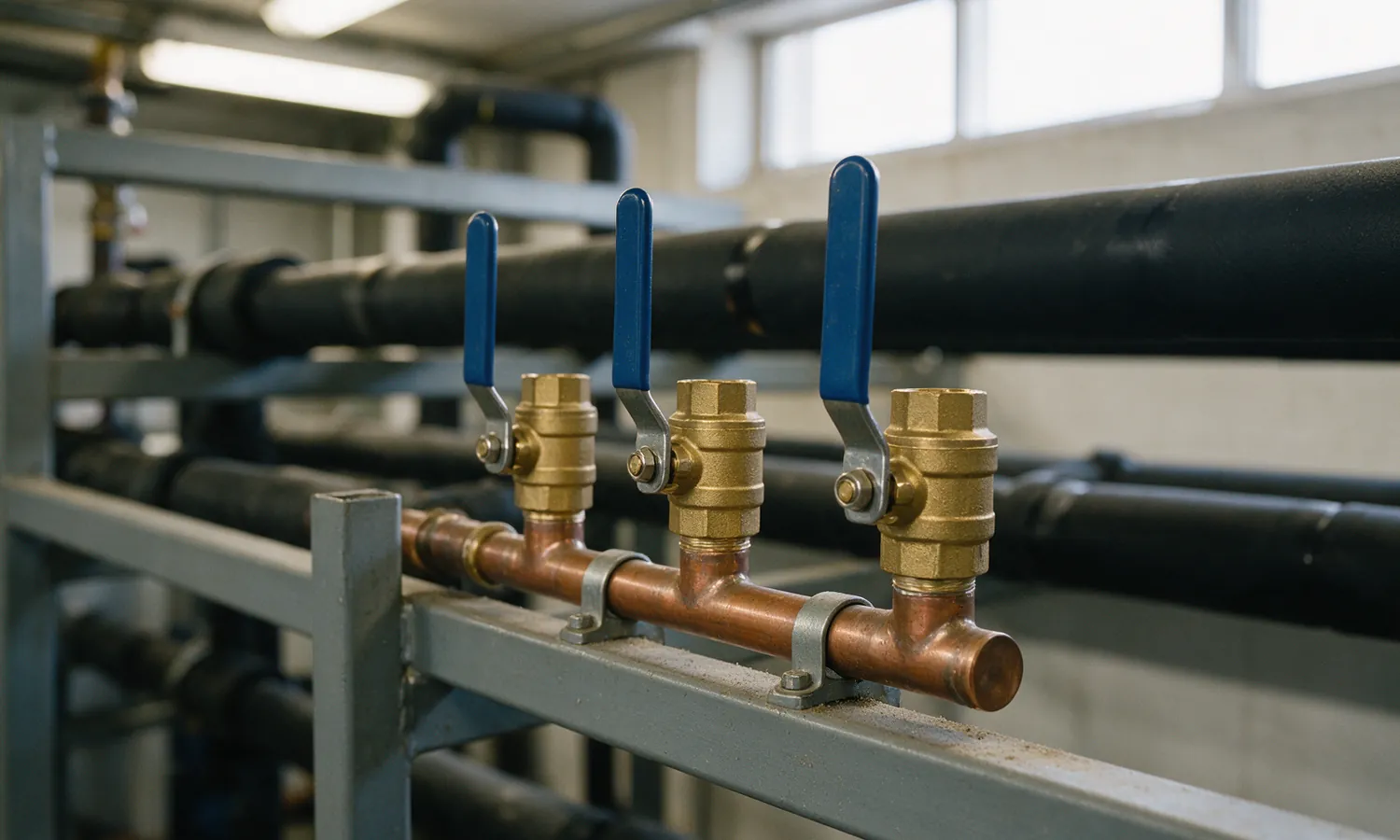
- In dezincification, zinc leaches out of brass in water and leaves a porous, copper-rich sponge with poor strength, so a valve can leak or burst under pressure.
- DZR (dezincification resistant) brass resists this, with small additions such as arsenic or tin and careful control of composition and production.
- CW602N (CuZn36Pb2As) is a European DZR grade: its datasheet lists it as "Dezincification resistant", with 0.02 to 0.15% arsenic.
- Pettinaroli's HVAC catalogue lists its FilterBall 51F and 52F series, the Dynasty PICV body and its energy meter body as CW602N brass.
- ISO 6509 is the test method for dezincification resistance: test pieces go into a copper chloride solution and are then examined under a microscope.
On this page10 sections
01What is dezincification in a brass valve?
Dezincification is the selective loss of zinc from brass. In the right water, zinc leaves the alloy and what remains is a copper-rich sponge with poor mechanical strength, so a valve body, stem or end connection can weaken from the inside.
Wikipedia's reference article on selective leaching calls it the most common example of this kind of corrosion, affecting "brass alloys containing more than 15% zinc in the presence of oxygen and moisture". The material left behind has "poor mechanical properties, and a color changed from yellow to red". In a 2025 Inspenet article on brass dezincification, Antonio Zavarce lists the visible signs as "A pinkish or reddish discoloration on the brass surface due to remaining copper", "A porous, spongy texture" and "Noticeable loss of strength, with components becoming brittle and fragile."
02Why does it matter in building water systems?
A dezincified valve loses strength, so it can leak or burst under pressure without much warning. The damage cannot be undone, which is why the brass alloy matters on valves that are meant to last for the life of a plant room or a building's water supply.
Zavarce writes that in plumbing systems these signs "may indicate that a fitting or valve is at risk of leaking or bursting, especially under pressure", and that "The risk increases in hot water circuits and stagnant sections of pipework." He adds that "dezincification is not practically reversible", and "replacement of the affected component is the safest and most cost-effective solution."
Water chemistry drives it. Wikipedia notes that dezincification "can be caused by water containing sulfur, carbon dioxide, and oxygen" and that "Stagnant or low velocity waters tend to promote dezincification." Its article on brass names "high water temperatures, chlorides present, or deviating water qualities (soft water)" as the conditions where DZR brass is used, and Zavarce lists using standard brass in soft or chlorinated water as one of the most frequent mistakes.
03What makes a brass DZR?
DZR brass is a brass whose composition and production are controlled so that zinc stays in the alloy. Small additions such as arsenic or tin suppress the zinc loss, and the maker has to keep the composition balanced and the production temperatures right, or the resistance is lost.
Wikipedia gives the countermeasure directly: "arsenic or tin can be added to brass, or gunmetal can be used instead." Its brass article gives the example of C352 brass, with about 30% zinc, 61 to 63% copper, 1.7 to 2.8% lead and 0.02 to 0.15% arsenic, and explains that "The lead and arsenic significantly suppress zinc loss." It warns that a DZR alloy "must be produced with great care, with special attention placed on a balanced composition and proper production temperatures and parameters to avoid long-term failures."
The European grade CW602N, chemical designation CuZn36Pb2As, has the same copper, lead and arsenic ranges. Its supplier datasheet lists it as "Also known as: Dezincification resistant" and names water boiler, condenser and heat exchanger components among its main uses. Wikipedia also records that DZR brass "is an alloy used to make pipe fittings for use with drinking water."
04How is dezincification resistance tested and marked?
Dezincification resistance is proven by a laboratory test, not by eye. The international method is ISO 6509, which exposes test pieces of the brass to a copper chloride solution and then examines them under a microscope for the depth of zinc loss.
ISO 6509 describes itself as "a method for the determination of the dezincification resistance of brass exposed to fresh or saline waters". The standard sets out the method, so ask for the test result on the material certificate when the service makes it matter.
On the valve itself, Wikipedia records that resistant fittings are marked "CR" (corrosion resistant) or "DZR" in the UK, and "DR" in Australia. Where no marking is shown, the alloy code on the datasheet, such as CW602N, is the reliable check.
05Which brass grades does Pettinaroli use in its HVAC valves?
Pettinaroli's HVAC water distribution catalogue lists the FilterBall 51F and 52F series, the Dynasty 92 PICV body and the ultrasonic energy meter body as CW602N brass, and the green-lever FilterBall 51FG as CW511L. We compiled the grades below from that catalogue and the G51 datasheet, so a buyer can see the alloy behind each product.
| Product | Brass grade stated | How Pettinaroli describes it |
|---|---|---|
| FilterBall 51F, 52F, 51F/1, 52F/1 (ball valve with integrated strainer) | CW602N | "made of non dezincifiable alloy CW602N" |
| FilterBall 51FG (green lever) | CW511L | "made of non dezincifiable and lead-free alloy CW511L" |
| Dynasty 92 PICV, body | CW602N | "Corrosion resistant brass CW602N" |
| Ultrasonic energy meter, meter body | CW602N | "CW602N Brass" |
| TBV thermostatic balancing valves | Not coded | "antidezincification low-lead brass" |
| G51 gas ball valve, body and ball | CW617N | "Brass CW617N (DIN 50930 part.6) CuZn40Pb2" |
The G51 row is there for contrast. It is a gas ball valve made to the EN 331 standard, and its body grade, CW617N, is one of the brasses Pettinaroli's catalogue lists as "Traditional". Wikipedia's table of brass alloys says CW617N "is not recommended for sea water use, being susceptible to dezincification." A valve made for one service is not automatically right for another.
06Where should you specify DZR brass valves?
Specify DZR brass for valves in water where dezincification is likely: domestic and drinking water, soft or chlorinated water, hot water circuits and stagnant sections of pipework. In a chilled-water or heating plant that means the small threaded brass valves at pumps, coils, meters and terminal units, especially on branches that stand idle.
- Strainers and isolation at terminal units. The FilterBall 51F and 52F are CW602N; our guide to the ball valve with integrated strainer or a separate Y-strainer covers where they go.
- Control valves. The Dynasty 92 PICV body is CW602N; see PICVs for dirty chilled-water loops.
- Metering. The ultrasonic energy meter body is CW602N; see chilled-water energy metering for tenant billing.
- Data centre cooling kits. Pettinaroli lists a DZR ball valve with integrated strainer (FilterBall) among the parts it offers for big CRAH units; see our guide to valve kits for data centre CRAH units.
Standing water is the case to watch in a closed loop: a branch left closed after flushing a chilled-water system, or a standby pump leg, is exactly the "stagnant section of pipework" where Zavarce says the risk rises. Our pillar on hydronic balancing and PICVs covers the rest of the loop.
07When is DZR brass not the answer?
DZR brass solves one problem: zinc loss in water. It does not make brass the right body for every duty.
Pettinaroli's own HVAC range shows the split: the brass FilterBall stops at 2" with threaded ends, while its butterfly valves, static balancing valves and Y-strainers for larger lines are ductile iron with flanged ends. Wikipedia also names gunmetal as an alternative to brass where dezincification is a risk. Our guide to valve body materials: WCB, stainless steel and bronze compares the other options.
08What should you check, and send us, before ordering?
Before ordering a brass valve for water service, check the alloy code on the datasheet rather than the word "brass", match it to the water the valve will sit in, and ask for the dezincification test result if the service is drinking water, soft water or hot water. A grade such as CW602N tells you more than a catalogue photo. Send these six lines and we work through the valve with your engineers:
- Valve type and size. Ball valve, strainer valve, PICV or meter, and the line size and thread.
- Service. Chilled water, heating water, domestic water or another fluid.
- Water conditions you know of. Soft water, chlorides, standing branches or high temperature.
- Alloy required. DZR, a named grade such as CW602N, or lead-free.
- Working pressure and temperature.
- Quantity and date needed on site.
Send these six lines on WhatsApp, see our Pettinaroli HVAC and data centre solutions and the Pettinaroli balancing and PICV page, or browse more guides on our insights page.
09Questions engineers ask about DZR brass valves
What does DZR stand for on a valve?
DZR stands for dezincification resistant. It means the brass has been made to resist zinc loss in water, for example with a small arsenic addition and controlled production. In the UK such fittings are marked "DZR" or "CR" (corrosion resistant), and in Australia "DR", as Wikipedia records.
Is CW602N a DZR brass?
Yes. CW602N (CuZn36Pb2As) is listed on its supplier datasheet as "Dezincification resistant", and Pettinaroli calls it "non dezincifiable" and "corrosion resistant" brass in its HVAC catalogue, using it for its FilterBall 51F and 52F valves and the Dynasty 92 PICV body.
How can you tell a brass valve has dezincified?
Look for a pinkish or reddish colour on the brass, a porous, spongy texture when the surface is scraped, and a loss of strength, the signs Inspenet's 2025 article lists. Dezincification is not practically reversible, so the article advises replacing the affected part.
Is lead-free brass the same as DZR brass?
Not by definition: lead-free describes the lead content of the brass, while DZR describes its resistance to zinc loss in water. Some grades are both, such as the CW511L that Pettinaroli calls "non dezincifiable and lead-free" on its green-lever FilterBall 51FG.
10Sources
Read 14 November 2026. Product materials are the manufacturer's own published statements: confirm every detail against the current datasheet for the model you are buying.
- Pettinaroli, HVAC water distribution catalogue 2024, V1 March 2024 (held by Optimus Distributor; the range is on Pettinaroli's HVAC catalogue pages): brass rod p4, Dynasty p10, data centre kits p46, FilterBall p72, thermostatic balancing valves p79, energy meter p86. G51 technical specifications, STE0038 R2.
- Alumeco, CW602N (CuZn36Pb2As) material datasheet, 6 May 2025.
- ISO 6509:1981, Corrosion of metals and alloys: determination of dezincification resistance of brass (public preview); scope only, nothing reproduced.
- Antonio Zavarce, Inspenet, Dezincification of brass: causes, prevention, and best practices, 1 April 2025.
- Wikipedia, Selective leaching (dezincification) and Brass.