 OPTIMUS DISTRIBUTOR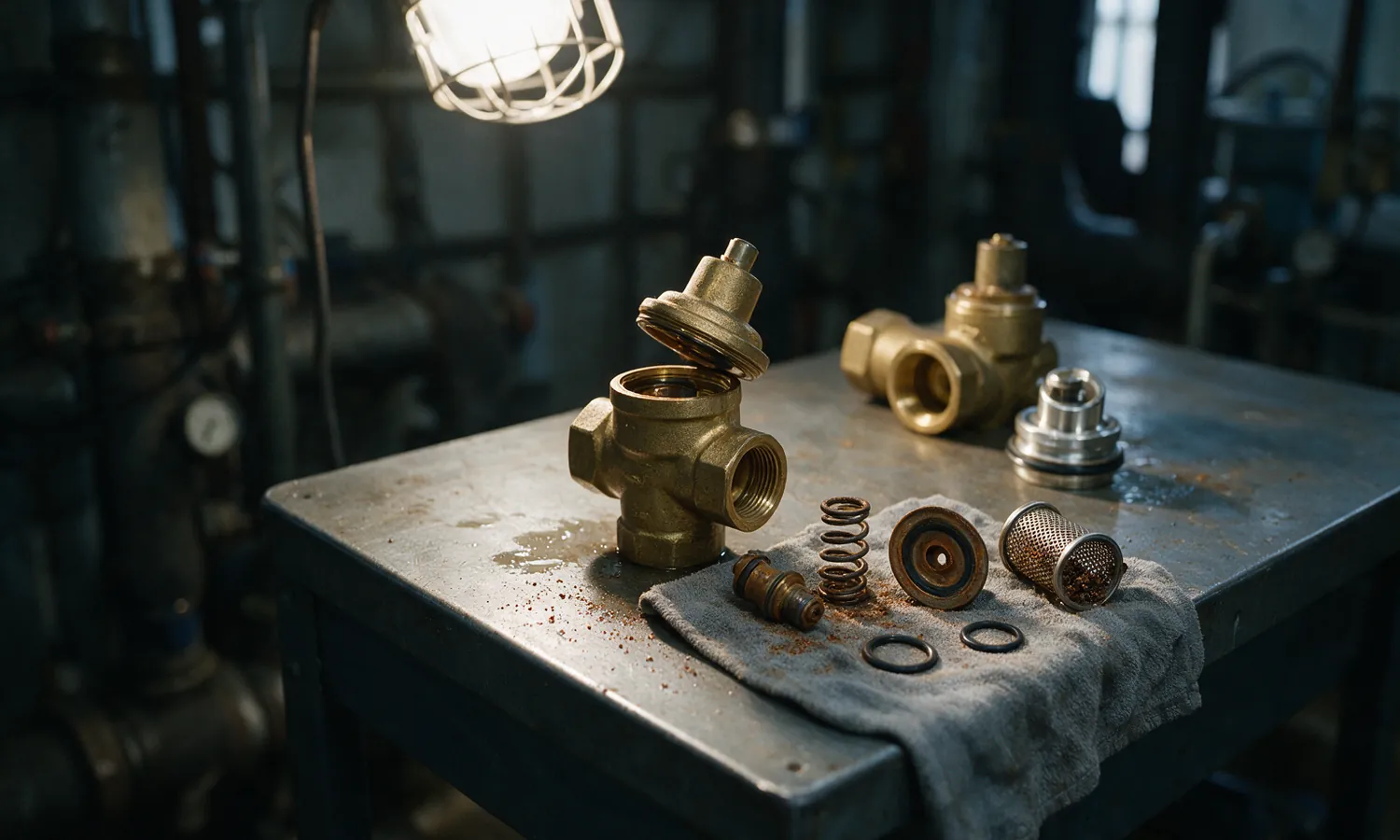
- Dirt does not usually block a PICV's flow path. It adds friction in the differential pressure regulator, and Pettinaroli names iron oxide from corroding steel pipe as the most dangerous contaminant.
- A strainer does not fix that. Pettinaroli's own guide says the mesh normally fitted is too large to trap the particles that cause the fouling.
- The test for any maker's valve: is the regulator serviceable, and was it built for dirty water. Pettinaroli life-tests the Dynasty 92 dirt-resistant diaphragm at 900 PPM of iron oxide.
- Dynasty 92 is linear, and a fan-blown coil controls best on equal percentage. On a dirty loop feeding fan coils those two pull apart, so settle it before ordering.
On this page9 sections
01Why does dirt stop a PICV on a chilled-water loop?
Dirt rarely plugs the flow path of a pressure independent control valve. It jams the differential pressure regulator, the part that holds flow steady while branch pressure moves. Pettinaroli's technical manual for its PICV range puts it plainly: regulators can be blocked or slowed down by extra friction provided by dirt, that gathers around O-Rings and internal surfaces
.
One contaminant does most of the damage. Pettinaroli's manual names Iron Oxide
as the most common and dangerous
, carried into system water by steel pipe corrosion. It tends to be fixed on surfaces
, raising friction between the regulator and its O-ring. So a PICV on a chilled-water loop can sit behind a clean strainer and still drift off its set flow: the fault is a film on a moving part, not a blockage anyone can see.
A closed chilled-water system is not immune because it is closed. What it lacks, next to a heating circuit, is the heat that drives off dissolved oxygen, so its own steel keeps making corrosion products long after handover.
Have a loop with known water problems? Send the detail on WhatsApp, +6019 750 3980 or our contact page, and our engineers will work the selection through with yours.
02Which PICV copes with contaminated water?
The test is the same whoever makes the valve: can the differential pressure regulator be taken out, cleaned and put back, and was it designed for dirty water. Because dirt acts on the regulator rather than the orifice, that pair of questions sorts the options faster than a datasheet comparison.
In the range Optimus Distributor supplies, that valve is Pettinaroli's Dynasty 92 Series, described as built to operate reliably even in systems with heavily contaminated water
, with internals that can be removed, cleaned, and replaced
and a dirt-resistant diaphragm. Its leaflet puts a number on the claim: the diaphragm is Life-tested according to propriet[ar]y test with dirty water, constantly contaminated by 900 PPM of Iron Oxide Fe2O3 (5 microns)
. Sizes run half an inch to two inches, flow 150 to 14,000 l/h, maximum start-up pressure 0.25 to 0.40 bar by size.
Pettinaroli points it first at heat interface units, where water quality can be difficult to maintain due to limited accessibility
, and says it can also go into assemblies feeding fan coils. Optimus Distributor is an authorised Pettinaroli distributor: see our Pettinaroli HVAC and data centre page and the Pettinaroli brand page.
| Range | Characteristic | Published strength | Where we would propose it |
|---|---|---|---|
| Dynasty 92 Series | Linear | Dirt-resistant diaphragm life-tested at 900 PPM iron oxide; serviceable internals | Existing or badly treated loops, and heat interface units |
| EvoPICV 91 Series | Equal percentage | Full-stroke, full-authority control; serviceable with a dedicated tool | Fan coils, chilled beams and AHUs on water that is under control |
The characteristic is not a matter of taste. Pettinaroli's guide says that for forced convection
coils, where a fan blows air across them, the best solution is an equal percentage characteristic
, while a linear one suits devices whose own output is linear, such as a plate heat exchanger. On a dirty loop feeding fan coils, the dirt-tolerant valve and the coil-matched valve are therefore not the same valve.
Three ways out, and the choice is a project decision rather than a product one. Put the water under control and specify the equal percentage EvoPICV. Accept the Dynasty's linear characteristic and shape the loop at the actuator or the BMS. Or take the factory route: Pettinaroli's data centre kits are catalogued with an equal percentage PICV. The balancing side is in hydronic balancing and PICV, the valve itself in PICV explained, the packaged version in CRAH valve kits.
03Will a strainer in front of the valve solve it?
No, not for the fouling that actually stops these valves. Pettinaroli's manual is unusually direct: strainers are not effective at removing this kind
of dirt, because the mesh size usually installed is too large to trap such tiny particles
. That fouling, it says, can only be prevented, by ensuring the quality of the heating or cooling media is of a high standard by on-going water treatment and filtration
.
Strainers still belong, for a different job: catching debris large enough to damage the valve outright. The guide says they should always be installed on the main branch pipework feeding terminals served by PICVs
, with one at each PICV where large contaminants may circulate, and notes that ball valves with an integrated strainer give smaller pressure losses and easier maintenance. Sizing the bigger ones is in our guide to choosing a pipeline strainer.
04What keeps the water clean enough for a PICV?
Two devices, because the dirt comes in two sizes. A strainer screen stops coarse debris. The fine ferrous particles that foul a regulator pass straight through it, so they are taken out magnetically or not at all. That is what on-going water treatment and filtration means in hardware.
Pettinaroli catalogues both and Optimus Distributor supplies them. The FilterBall is a ball valve with the strainer built in, corrosion-resistant brass with a stainless AISI 304 screen, cleaned by unscrewing the cap and lifting the screen out. The EvoMAGic is a magnetic dirt separator in DN20 and DN25: its magnets pull out the ferrous debris and a 28 mesh, 0.7 mm filter blocks what is left. Pettinaroli catalogues the EvoMAGic for boiler and heat pump circuits, so on a large chilled-water plant take it as the principle and size side-stream filtration with a water treatment specialist.
05What does Pettinaroli say about water that is already bad?
It says do not fit the valve until the water is dealt with. Pettinaroli's manual states: PICVs should not be installed in systems where the water quality is known to be poor
, and asks that on retro-fit and re-fit projects, works be carried out to improve the water first. That is a manufacturer setting a condition on its own product, and the condition belongs in the specification.
Where the water cannot be brought up to standard, Pettinaroli's manual recommends the latest differential pressure regulator technology, which it says works even at very high iron oxide concentrations while still asking for good water quality. The manual names no product at that point, so treat it as a specification to meet rather than a model number. For the water itself it points to BSRIA guide BG 29/2012. Later editions of BG 29, summarised by Designing Buildings, name mill scale, jointing compound and building debris as contaminants that will inevitably be found
in new pipework. Where each valve sits in the loop is in which valves a chilled-water loop needs.
06How do you keep commissioning dirt out of the valve?
By routing the dirty water around the valve instead of through it. Pettinaroli's manual asks for flushing by-passes across every branch holding PICVs, so main branch pipes can be cleaned without having to circulate dirty water and cleaning chemicals through the PICVs or terminal units
, and a flushing drain per branch so the terminal unit is then flushed with clean water.
Other makers agree. Crane Fluid Systems answers it flatly: It is not recommended to flush through PICVs
, because the valve has close tolerance flow paths
and flushing may introduce debris which could block the flow paths
. Crane quotes a BSRIA BG29 extract recommending that an additional drain point be located between the two-port valve and coil connection
, so the coil is flushed at full flow with the valve bypassed. A factory-built assembly carries that route already: see prefabricated valve kits.
07What should a dirty-loop PICV enquiry say?
An enquiry for a PICV on a dirty chilled-water loop needs six lines, and the water is the one most people leave out. Flow and differential pressure pick the valve size; the state of the water picks the range, and decides whether a separator is in scope at all. Send the six and our engineers come back with a selection rather than a question.
- Design flow per terminal unit, and how many units of each type.
- Differential pressure available at the unit, worst case and best case.
- Unit type: fan coil, chilled beam, air handling unit, heat interface unit or plate heat exchanger.
- New pipework or an existing loop, and the age and material of the pipe.
- Anything known about the water: treatment regime, water tests, any history of blocked strainers or sticking valves.
- Whether a flushing by-pass and per-unit strainer are in scope, and who cleans them.
Most enquiries open with price, lead time and stock, so say if those matter. Send them on WhatsApp, +6019 750 3980, or through our contact page.
08What do engineers ask us about PICVs on dirty loops?
Four questions come up more than any others when an engineer calls Optimus Distributor about a dirty chilled-water loop. They are about rescuing valves already installed, about sizing, about what poor water does to a commissioning record, and about spares. The answers are ours; the manufacturer's position is attributed where used.
Our existing PICVs are sticking. Can they be saved, or is it a replacement job?
Two answers decide it: whether the installed valve's internals are serviceable, as the Dynasty 92 Series are, and whether the water will be put right. Pettinaroli's guide treats on-going treatment and filtration as the only prevention for this fouling, so cleaning a regulator in water that will foul it again buys months.
Can we oversize the PICV so that dirt matters less?
Our own view is no, and it usually makes control worse. An oversized PICV works low down its stroke, where a small movement makes a large flow change. Dirt acts on the regulator, not the orifice, so a bigger body buys no tolerance. Pick the range for the water, then the size for the flow.
Does poor water change the flow tolerance we can commission to?
Poor water changes whether you keep that tolerance, not whether you reach it. A regulator slowed by friction drifts off its set flow after the commissioning sheet is signed, which is why Pettinaroli ties accurate flow across the valve's life to the newer regulator design. Plan a re-check inside the first year on any loop without a treatment regime.
What spares should we hold for PICVs on a loop with poor water?
The regulator diaphragm for the series installed, plus a spare strainer screen in each size. Pettinaroli gives the diaphragm its own catalogue line, the 092D for the 92 series and the 091D for the 81 to 83 and 91 to 93 series. We quote them separately, so a loop with known water problems can hold a spare from day one.
09Sources
Read 18 October 2026. Product descriptions, sizes, flow ranges, start-up pressures, mesh ratings and the life-test figure are the manufacturer's own published data: confirm every figure against the current datasheet for the model you are buying. Pettinaroli's PICV technical manual is quoted in short attributed extracts and otherwise summarised; no table, figure or acceptance value is reproduced from it. BSRIA BG 29 is named and summarised from the published descriptions below, with nothing reproduced from the guide itself.
- Fratelli Pettinaroli, PICV range (Dynasty 92 Series and EvoPICV 91 Series: contaminated water, serviceable internals, dirt-resistant diaphragm, characteristic, sizes, flow and start-up pressure).
- Fratelli Pettinaroli, Dynasty 92 Series leaflet (the 900 PPM iron oxide life test, size and flow table, maximum start-up pressure).
- Fratelli Pettinaroli, Pressure Independent Control Valves Technical Manual, version 2 (water quality and iron oxide, strainers, flushing by-passes and drains, control characteristic).
- Fratelli Pettinaroli, UK catalogue 2025, printed pages 55 to 60 (FilterBall construction and cleaning; EvoMAGic magnetic dirt separator, DN20 and DN25, 28 mesh 0.7 mm).
- Fratelli Pettinaroli, HVAC accessories catalogue (the 091D and 092D differential pressure regulator diaphragm lines).
- Crane Fluid Systems, PICV frequently asked questions (flushing through a PICV, and the BSRIA BG29 extract on an additional drain point).
- BSRIA BG 29 on pre-commission cleaning, as summarised by Designing Buildings.
- Fratelli Pettinaroli, HVAC Water distribution 2024 catalogue, printed pages 8, 10, 11, 45 and 46 (the manufacturer's own document, held by Optimus Distributor; not published online).