 OPTIMUS DISTRIBUTOR
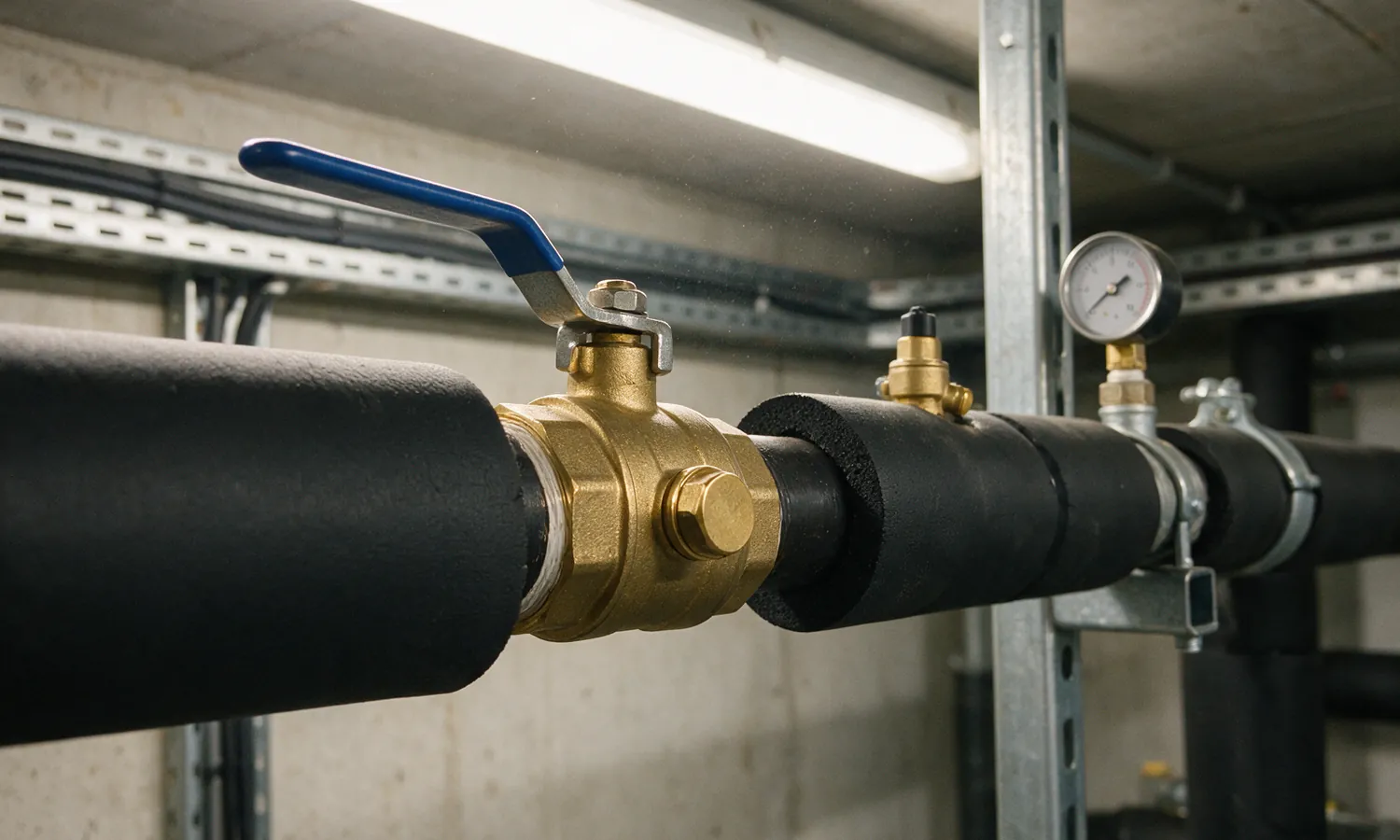
- A ball valve with an integrated strainer is one on-off valve with a removable mesh strainer inside its body, so one fitting both isolates the line and catches dirt.
- It replaces the usual pair of a ball valve and a Y-strainer on small threaded lines: one body, fewer joints and less space.
- Pettinaroli's leaflet gives its 1" FilterBall a Kv of 14.5 m³/h against 7.0 m³/h for a 1" Y-strainer, so it passes more than twice the flow for the same pressure loss.
- The FilterBall range runs from 1/2" to 2" in brass alloy CW602N with threaded ends, rated 16 bar at 100 °C and 10 bar at 150 °C with its standard FM28 strainer.
- Larger or flanged lines still need a separate strainer; Pettinaroli's ductile iron Y-strainer for HVAC runs from 2" to 24".
On this page11 sections
01What is a ball valve with an integrated strainer?
A ball valve with an integrated strainer is an on-off ball valve that carries a removable cylindrical mesh strainer inside its body, so a single fitting shuts off the line and filters the water passing through it. Pettinaroli calls its version the FilterBall and describes it as "an on-off ball valve containing an interchangeable cylindrical strainer which is easy to inspect and remove for normal maintenance operations."
The leaflet sums up the idea in one line: a single valve has two functions, the sealing of the ball valve and the filtering of the fluid. The strainer sits under a screwed cap, held by a bronze clip, so it comes out without taking the valve off the pipe.
02How is it different from a ball valve plus a Y-strainer?
The usual way to protect a coil, pump or meter is two fittings in a row: an isolating ball valve and a Y-strainer. The integrated valve does both jobs in one body. Pettinaroli names the gains in cost, installation and space, and adds that "the FILTERBALL valve means much smaller load losses, which virtually coincide with those of the filter only."
In practice that means one body to buy and fit instead of two, fewer threaded joints that could leak, and a shorter run of pipe at the terminal unit. That matters most where space is tight, such as in a ceiling void at a fan coil or inside a cooling unit's pipe connections.
| Point | Ball valve plus Y-strainer | Ball valve with integrated strainer |
|---|---|---|
| Fittings in the line | Two | One |
| Kv at 1" (Pettinaroli's example) | Y-strainer alone: 7.0 m³/h | FilterBall: 14.5 m³/h |
| Flanged option in Pettinaroli's HVAC range | Ductile iron Y-strainer ST2D: 2" to 24", flanged | FilterBall: 1/2" to 2", threaded |
| Typical use | Lines over 2" and flanged lines | Branches up to 2": pumps, control valves, meters |
03Why does the lower pressure drop matter?
Every fitting in a chilled-water branch takes some of the pump's pressure, and a strainer is one of them. Spirax Sarco notes that "in pumped water or viscous fluid systems, the pressure drop can be significant", so a valve that strains with less loss leaves more pressure for the coil and its control valve.
The figure that shows this is the flow coefficient, Kv. Spirax Sarco advises that "Strainers should have flow capacities quoted in terms of a capacity index or Kvs value". A higher Kv means more water through the same size fitting for the same loss. Pettinaroli's leaflet states that the FilterBall "compared with a Y standard strainer allows more than a double flow, assuming same load losses", and gives the 1" example: FilterBall Kv (1 bar) 14.5 m³/h, Y-strainer Kv (1 bar) 7.0 m³/h.
Two points keep that comparison honest. It is the manufacturer's own figure for its own valve against "a Y standard strainer", not a test of any particular competing strainer. And the leaflet does not say how dirty the screen was: as any strainer fills with dirt, its loss rises, which is why the cleaning method in section 06 matters as much as the Kv.
04Where does it go in a building's water system?
A ball valve with an integrated strainer goes in front of anything that dirt would damage or block: circulation pumps, control valves, check valves, heat exchangers, condensers and meters. It isolates that part for maintenance and keeps debris out of it, on any branch up to the 2" top of Pettinaroli's range. Pettinaroli's leaflet lists nine main uses, among them:
- before the circulation pumps in heating and air conditioning systems;
- before the control valves, "to protect their operation";
- before the check valves, "to protect their sealing characteristics";
- before the heat exchanger and the condenser, to protect them from particles carried in the water;
- at the entrance of each zone fitted with a meter, and on the water inlet of each apartment, to protect the meter and taps.
In chilled-water work, the control valve is often the case that matters most, because a PICV or a zone valve regulates the flow to a coil. Pettinaroli also lists a DZR ball valve with integrated strainer (FilterBall) among the parts of its valve kits for big data centre cooling units, and its prefabricated valve kits for fan coils and AHUs bring the terminal-unit valves together in the same way. Our guide to valve kits for data centre CRAH units shows the rest of that kit.
05Which strainer mesh should you choose?
Start with the standard FM28 screen, with a 0.7 mm (700 µm) filtering capacity, and go finer only when the equipment downstream needs it, because a finer screen catches more and clogs sooner. A finer mesh also adds pressure drop, so the choice is a balance between protection and flow. Pettinaroli fits its FilterBall valves with the FM28 stainless steel AISI 304 strainer as standard and lists four finer screens for the 51F, 52F, 51FS, 52FS and 56F/2:
| Screen | Mesh | Filtering capacity | Casing |
|---|---|---|---|
| FM28 (standard) | 28 | 700 µm (0.7 mm) | Simple |
| FM40 | 40 | 300 µm (0.3 mm) | Simple |
| FM60 | 60 | 230 µm (0.23 mm) | Double |
| FM80 | 80 | 180 µm (0.18 mm) | Double |
| FM100 | 100 | 150 µm (0.15 mm) | Double |
Mesh is the number of openings per linear inch of screen, as Spirax Sarco's strainer tutorial explains, so a higher mesh number means smaller holes. The same tutorial notes the trade-off: "The greater the free area (and the coarser the screen), the higher the flow capacity and ultimately the lower the pressure drop across the strainer." A finer screen also fills faster, so plan for more frequent cleaning if you choose one.
06How is the strainer cleaned?
A FilterBall strainer is cleaned in one of three ways, depending on the version: by taking the screen out under the cap, by flushing it to a drain with the system's own water, or by a back flush turn of the handle. Only the first means opening the cap; the other two clean the screen with the cap in place.
- Take the screen out (51F and 52F). Unscrew the cap and remove the strainer block ring, take out the strainer, remove the collected impurities, and refit the parts.
- Flush it with the system water (51FS and 52FS). Close the valve, connect the drain outlet to a drain and open the small shutter beside the lever: the system's own water cleans the trapped impurities off the steel strainer.
- Back flush (56F/2). From the closed position, turn the handle a further 22 degrees clockwise; the flow is diverted to clean the strainer through the drain outlet.
The flushing versions suit places where opening the cap is awkward, such as a valve inside a cooling unit or high in a ceiling void. The self-cleaning and back flush versions do not come in every size, so check the size against the version. Whichever you choose, clean the screens after the first weeks of running, when construction debris is still moving through the pipes. Our guide to flushing a chilled-water system covers that stage.
07When is a separate strainer still the better choice?
A separate strainer is still the right part on lines over 2", on flanged lines, on lines carrying a lot of debris, and on duties beyond the FilterBall's pressure and temperature rating. The FilterBall range stops at 2" with threaded brass ends, so mains, chiller headers and larger pump lines need their own strainer.
- Size and ends. For flanged HVAC lines, Optimus's Pettinaroli industrial valves flyer lists the ST2D and ST2DA ductile iron Y-strainers with test port and a stainless screen, from 2" to 24", flanged to ANSI class 150 or EN 1092-2 PN16.
- Flow and dirt load. Spirax Sarco notes that, size for size, a basket strainer has a lower pressure drop than a Y-type because of its greater free straining area, which makes it "the preferred type for liquid applications", and that it also holds more dirt. The tutorial is written for steam systems, but the strainer points apply to water lines too.
- Pressure and temperature. The FilterBall is rated 16 bar at 100 °C and 10 bar at 150 °C (non shock). Duties outside that need another part.
Our guide to Y-strainers and basket strainers compares those two for larger lines.
08What does Pettinaroli's FilterBall range include?
Pettinaroli's FilterBall range includes versions with a lever or a butterfly handle, and versions that are cleaned by hand, flushed with the system water or back flushed, all with the FM28 strainer as standard. The body is corrosion resistant brass alloy CW602N with threaded ends. The stem has triple safety (two O-rings and a PTFE ring) and is fitted from inside, the joint between body and end connection is double tightened, and the ball is solid and chromium plated.
- 51F: blue steel lever. 51FG: green reversible steel lever.
- 52F: blue butterfly handle. 52FROS: red butterfly handle.
- 51FS and 52FS: the automatic cleaning device, flushed to a drain; the 51FS has a reversible handle, the 52FS a butterfly handle.
- 56F/2: the back flush version.
Optimus Distributor supplies Pettinaroli's HVAC range, and the FilterBall 51F is one of the Pettinaroli products in our own company profile. See our Pettinaroli HVAC and data centre solutions and the Pettinaroli balancing and PICV page for the rest of the range.
09What should you check, and send us, before ordering?
Check the line and the job first, then the valve: size and thread, the service, what it protects, the mesh and the working conditions settle most orders. Send these six lines and we work through it with your engineers:
- Line size and thread. 1/2" to 2" for the FilterBall; larger lines need a separate strainer.
- Service. Chilled water, heating water or domestic water.
- What it protects. A pump, a control valve or PICV, a coil, a heat exchanger or a meter.
- Strainer mesh. The standard FM28 (0.7 mm) or a finer screen, if the equipment maker asks for one.
- Working pressure and temperature. Against the 16 bar at 100 °C and 10 bar at 150 °C rating.
- Quantity and date needed on site, and which cleaning version suits the access.
Send these six lines on WhatsApp, or browse more guides on our insights page.
10Questions engineers ask about ball valves with integrated strainers
What does a strainer ball valve do?
A strainer ball valve, also called a filter ball valve, does two jobs in one body: it shuts off the line like any ball valve, and its built-in screen catches dirt like a strainer. A Y-strainer only strains and has no shut-off of its own, which is why it is usually fitted together with a separate isolating ball valve.
Does a FilterBall replace the strainer in front of a PICV?
It can, on a branch up to 2". Pettinaroli lists the FilterBall for use before control valves and puts one in its valve kits for big data centre cooling units. Confirm the PICV maker's screen requirement and the line size first; our guide to PICVs for dirty chilled-water loops covers the valve side.
How often should the strainer be cleaned?
There is no fixed interval, because it depends on how dirty the water is. Check the screen after commissioning and the first weeks of running, when the most debris is moving, then on the building's maintenance plan. Check it sooner if a finer screen is fitted, since a finer screen fills faster.
Can I fit a finer screen later?
Yes. The strainer is interchangeable, and Pettinaroli lists FM40, FM60, FM80 and FM100 screens for the 51F, 52F, 51FS, 52FS and 56F/2 valves alongside the standard FM28, down to 150 µm. Remember that a finer screen adds pressure drop and needs cleaning more often.
11Sources
Read 11 November 2026. Product features and ratings are the manufacturer's own published statements: confirm every detail against the current datasheet for the model you are buying.
- Pettinaroli, FILTERBALL leaflet, V3.2 (client document held by Optimus Distributor), and the Pettinaroli filtering range (FilterBall series).
- Pettinaroli, HVAC water distribution catalogue 2024, V1 March 2024 (client document held by Optimus Distributor): data centre kits p46.
- Pettinaroli Industrial Valves flyer (client document held by Optimus Distributor): ST2D and ST2DA Y-strainers.
- Spirax Sarco, Strainers (strainer types, pressure drop, Kvs, mesh and free area; written for steam systems).
- Wikipedia, Flow coefficient (Kv and pressure drop).