 OPTIMUS DISTRIBUTOR
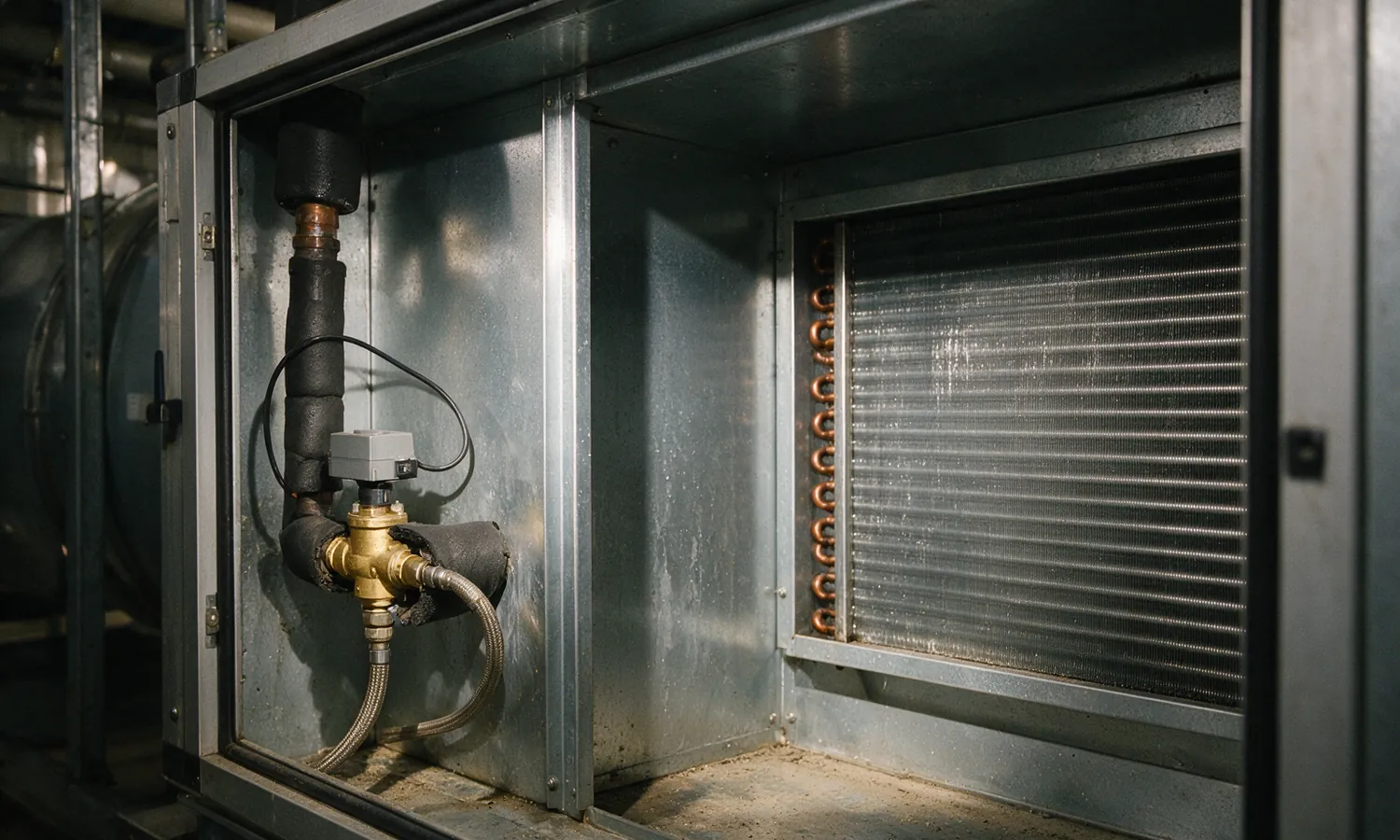
- A cooling coil with a fan blowing air across it controls best on an equal percentage characteristic: its output rises steeply at low flow, then flattens.
- A PICV's authority close to 1 steadies its curve against system pressure changes. It does not turn a linear valve into the right one for a coil.
- A linear PICV fits water-to-water duty such as a plate heat exchanger, and chilled water loops that are not paired with a coil.
- An actuator can reshape a linear PICV towards equal percentage, but only if its characterising action is matched to that valve and its flow setting.
- Pettinaroli's EvoPICV is equal percentage and full stroke; its Dynasty 92 is linear, and its data centre kits for CRAH units name equal percentage PICVs.
On this page10 sections
01What is a control valve's characteristic?
A control valve's characteristic is the relationship between how far the valve is open and how much water it passes. Pettinaroli's PICV technical manual describes it as a feature of the design of either the valve itself, or the valve and actuator combination
, and names three common shapes: on/off (quick acting), linear and equal percentage.
A linear valve passes flow in proportion to its opening: half open, half flow. An equal percentage valve adds the same percentage of the current flow for each equal step of opening, so it changes flow slowly near closed and quickly near open. Siemens notes that most commercial HVAC modulating valves are globe or characterised ball valves with an equal percentage characteristic, used to offset the coil's own curve. Where PICVs sit in a balanced system is covered in our guide to hydronic balancing and PICV for commercial buildings.
02Why does a cooling coil want an equal percentage PICV?
A fan-blown cooling coil wants an equal percentage PICV because the coil's output is not proportional to its water flow. Pettinaroli's manual explains that for these coils the heating or cooling output gradually stabilises as water flow increases until a point is reached where the output becomes unresponsive to further increases
. The first part of the flow does most of the cooling, and the same holds for a fan-blown heating coil.
Chris Parsloe, summarising BSRIA guide BG 51/2014 in Modern Building Services, says the same of fan coils, active chilled beams and air handling units:
"... a large reduction in flow rate is required to achieve a small reduction in heat transfer. Hence, for these applications, a linear characteristic is not ideal. Instead an equal-percentage characteristic is best."
Chris Parsloe, consultant to BSRIA, Modern Building Services, 1 October 2014
Pettinaroli's manual works the case of a controller asking for half the thermal output: a linear valve passes half the design flow, an equal percentage valve about 15 per cent. The surplus water a linear valve passes at part load is what engineers see as low delta T. Separately, the manual warns that inaccurate valve control makes the room temperature hunt, repeatedly overshooting and undershooting its set point.
The coil curve is a guide, not a law. FlowCon points out that the textbook coil curve is a theoretical representation or symbol, rather than an actual curve
, and that real coils do not mirror an equal percentage valve exactly. FlowCon's rule of thumb is that equal percentage control is markedly more accurate at low load, roughly 0 to 50 per cent of rated valve capacity, while linear valves are generally preferred for higher loads and control ranges.
03Where is a linear PICV the right choice?
A linear PICV is the right choice where the device's own output is close to proportional to flow, which is water-to-water duty rather than water-to-air. Pettinaroli's manual names the plate heat exchanger as the example, and says a linear PICV's ability to open quickly while still holding pressure control suits a heat exchanger that must raise its secondary water temperature fast.
- Plate heat exchangers and other water-to-water duty.
- Chilled water loops not paired with a coil. The US National Institutes of Health uses equal percentage valves on its hydronic coils and a linear characteristic on valves that control building chilled water loops not paired with a coil.
- Dirty or doubtful water, with care. Pettinaroli's Dynasty 92 is a linear PICV built to keep working in heavily contaminated water. On a coil it needs a matched characterising actuator, and because its presetting reduces the control stroke, that actuator must suit the setting. The trade is set out in PICV for dirty chilled-water loops.
04Does a PICV's full authority make the characteristic matter less?
No. A PICV's authority close to 1 keeps the valve's curve steady when system pressure changes, but it does not change which curve the valve has. Authority is how much of the circuit's pressure drop the control element takes. Pettinaroli's manual puts a PICV's authority close to 1, against authorities as low as 0.2 for conventional 2 port valves, which it calls common but far from ideal.
A linear PICV with near-perfect authority is still a linear valve. Pettinaroli's manual is direct on this: a linear characteristic valve with perfect authority is not as good as an equal percentage valve
. The manual adds that, depending on the design, a PICV's authority and so its curve can still shift as the valve's flow setting is changed. Full authority is the reason to choose a PICV; the characteristic decides which PICV. How a PICV holds flow is covered in PICV explained.
Choosing between characteristics for a project? Send the terminal schedule on WhatsApp, +6019 750 3980. Optimus Distributor is an authorised Pettinaroli distributor; Pettinaroli's PICV ranges are on our Pettinaroli balancing and PICV page.
05Can an actuator turn a linear PICV into an equal percentage one?
An actuator can often reshape a linear PICV towards equal percentage, but only when its characterising action is matched to the valve it sits on. Pettinaroli's manual says electro-mechanical actuators fitted to linear PICVs can generate an equal percentage characteristic, and warns that the result may be right at only one flow pre-setting. A wrong actuator can also spoil a valve that is equal percentage by design, for example when its stroke does not match the valve's.
Specifications say this in writing. One Danfoss PICV specification requires actuators for equal percentage coils to be field set to Equal Percentage characteristics
, or to carry an adjustable alpha characteristic matched to the coil's. Pettinaroli's UK catalogue lists modulating actuators whose input signal, action direction, characteristic and stroke length can be configured in the field, and its HVAC catalogue describes the Dynasty 92 as linear, with an equal percentage characteristic available through the actuator.
A linear PICV plus a characterising actuator is a matched pair, so in our view it should be specified and bought together, never the valve alone. Where the choice is between a mechanical and an electronic PICV, read mechanical PICV vs electronic PICV.
06Does a full stroke or stroke limited PICV change the answer?
A full stroke or stroke limited design decides how much the characteristic matters, because it decides whether the flow setting eats into the control stroke. In a full stroke PICV the flow setting and the control element are separate, so the actuator always has the whole stroke. Siemens makes the same point about its own range: flow limiting kept independent of the control valve leaves full stroke for control.
In a stroke limited PICV, one part does both jobs. Pettinaroli's manual says a stroke limited linear valve set to 50 per cent of its maximum flow loses 50 per cent of its control stroke, while an equal percentage valve set the same way loses only around 18 per cent. The manual calls an intrinsic equal percentage characteristic essential for stroke limited valves, and says lift and lay types need an actuator that compensates for the lost stroke. Pettinaroli's own ranges show both designs: it describes the EvoPICV as full stroke, full authority
, and the Dynasty 92 as having internal presetting with stroke reduction of the control valve.
| Question | Equal percentage PICV | Linear PICV |
|---|---|---|
| Best terminal | Fan coils, AHUs, active chilled beams, CRAH units | Plate heat exchangers; chilled water loops not paired with a coil |
| On a fan-blown coil | Coil output follows the signal | Overflow and low delta T at part load unless the actuator reshapes it |
| If the flow setting limits the stroke | Around 18 per cent of stroke lost at a 50 per cent setting | 50 per cent of stroke lost at a 50 per cent setting |
07Which Pettinaroli PICVs are equal percentage and which are linear?
Pettinaroli's EvoPICV ranges are equal percentage and its Dynasty 92 is linear. Its HVAC catalogue lists the threaded EvoPICV 91 and 93 series with an equal percentage characteristic, and rotary EvoPICV versions with an equal percentage characteristic for rotary actuators. The UK catalogue says the EvoPICV is equal percentage at a mechanical level. The Dynasty 92, its PICV for heavily contaminated water, is linear, with equal percentage available through the actuator.
A data centre CRAH unit is a large fan-blown chilled-water coil, so it takes an equal percentage PICV. Pettinaroli's HVAC catalogue lists an EQM (equal percentage) PICV with modulating actuators in its kits for small and medium CRAH units, and an equal percentage PICV with modulating actuators, a flushing 3-way ball valve and a ball valve with an integrated FilterBall strainer in its kits for big ones. Its UK catalogue also offers prefabricated commissioning kits built both ways: one round an equal percentage rotary PICV, one round the linear, dirt-resistant Dynasty.
The full parts list for a cooling unit is in valve kits for data centre CRAH units, the rest of the loop in data centre chilled-water cooling: which valves the loop needs, and the range on our Pettinaroli HVAC and data centre page.
08What should a PICV enquiry state?
A PICV enquiry should state the terminal, the design flow, the differential pressure available and the controls, because those four settle the characteristic and the valve body.
- The terminal type and count: fan coil, AHU, CRAH unit or plate heat exchanger.
- The design flow per unit in l/h, and the differential pressure available at the worst and best circuit.
- The control signal (0-10 V, 2-10 V or 3 point) and the BMS make, so the actuator can be matched.
- The characteristic the controls specification asks for, if it names one, and the coil maker's output data if you have it.
- Whether the loop is new or existing, and anything known about the water.
09What do engineers ask us about PICV characteristics?
Is equal percentage always right for a chilled-water coil?
Equal percentage is the default for a fan-blown chilled-water coil, and Pettinaroli calls it the best solution for forced convection coils. Real coils vary, so where the coil maker publishes output against water flow, read it. On a dirty loop, a dirt-tolerant linear PICV with a matched characterising actuator can be the better trade.
Can a BMS setting change a PICV's characteristic?
A configurable actuator can reshape a PICV's stroke, so a setting can change the characteristic the coil sees. It is still a change to the valve and actuator pair, so set it once, record it at commissioning and check it at the coil.
Does an equal percentage PICV need a special actuator?
The actuator's stroke, force and signal still have to match the valve, which is why Pettinaroli's UK catalogue states which EvoPICV sizes an actuator's stroke suits as supplied.
We already have linear PICVs on fan coils. Must they come out?
Linear PICVs on fan coils need not come out by default. If the space temperature is stable, leave them. If the room hunts or the delta T collapses at part load, our view is that a matched characterising actuator is the cheaper first test before any valve swap.
10Sources
Read 21 October 2026. Product descriptions and characteristics are the manufacturers' own published data: confirm every figure against the current datasheet for the model you are buying. Pettinaroli's manual and catalogues are quoted in short attributed extracts and otherwise summarised; no chart or table is reproduced from them.
- Fratelli Pettinaroli, Pressure Independent Control Valves Technical Manual (valve characteristic, forced and natural convection coils, plate heat exchangers, authority, actuator selection, full stroke and stroke limited valves).
- Fratelli Pettinaroli, UK catalogue 2025, printed pages 14, 15, 20, 23, 64 and 92 (prefabricated commissioning kits, Dynasty linear characteristic and stroke reduction, EvoPICV full stroke equal percentage characteristic, configurable actuators).
- Fratelli Pettinaroli, HVAC Water distribution 2024 catalogue, printed pages 10, 13 to 19 and 46 (the manufacturer's own document, held by Optimus Distributor).
- Chris Parsloe, Controlling influences, Modern Building Services, 1 October 2014 (BSRIA BG 51/2014 on characteristics for water-to-air and water-to-water heat transfer).
- FlowCon International, Importance of Control Curves in PICVs, updated May 2024 (theoretical and real coil curves; where equal percentage and linear are each more accurate).
- Siemens, EngineeringAdvantage newsletter, Pressure Independent Control Valves, April 2017 (equal percentage valves offsetting the coil curve; flow limiting independent of the control valve).
- US National Institutes of Health, Design Considerations for Modulating Hydronic Control Valves, September 2024 (equal percentage for coils, linear for loop valves not paired with a coil).
- Danfoss, PICV and balancing valve specification (actuators matched to the coil characteristic).