 OPTIMUS DISTRIBUTOR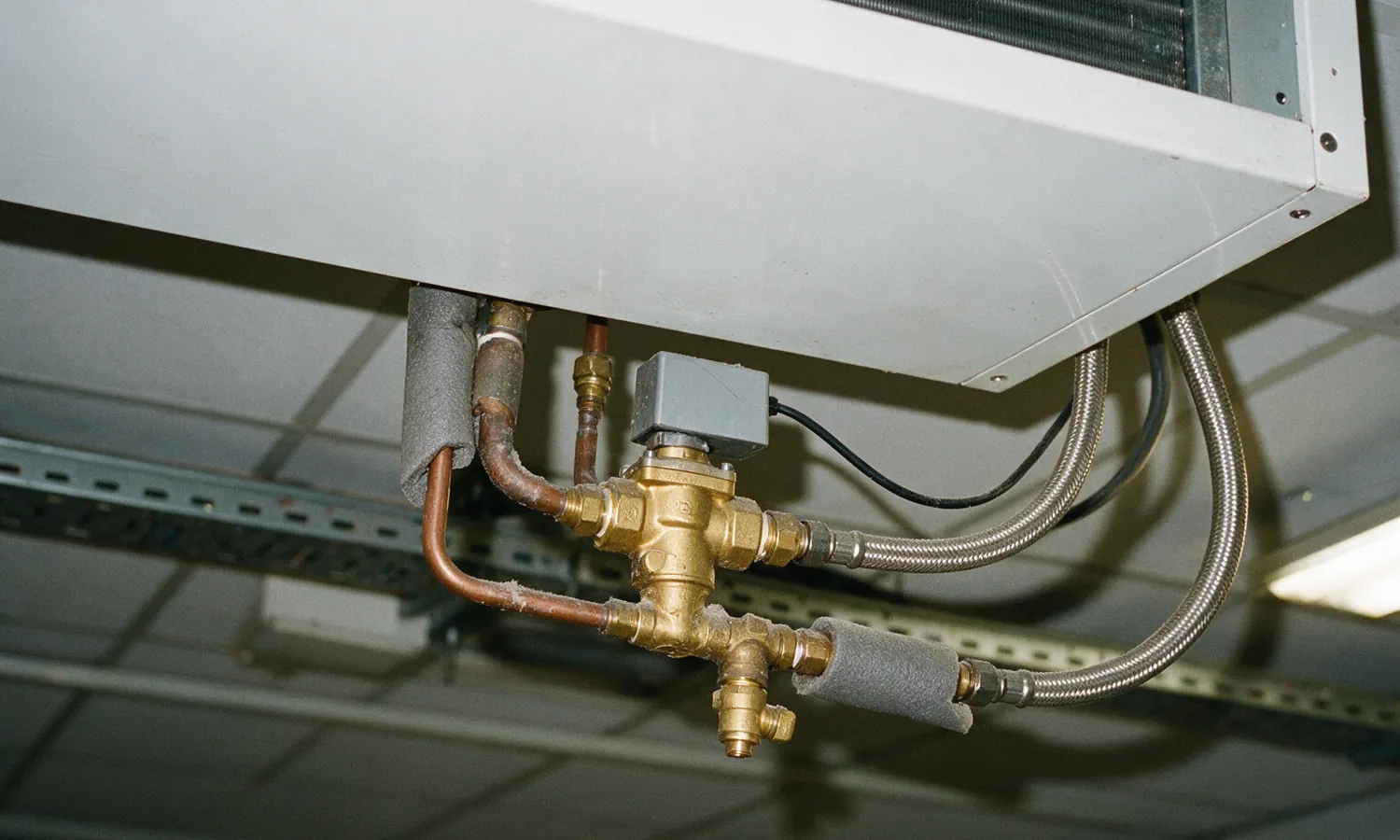
- A six-way valve is one body with one actuator doing the work of two three-way valves, so one coil can be fed by the chilled circuit or the hot one.
- Pettinaroli's EvoSIX turns through 90 degrees in three parts: 0 to 32 degrees for one side, a dead zone from 32 to 58 with both shut, then 58 to 90 for the other.
- The EvoSIX is a changeover and control valve, not a balancing valve: its Kv is fixed by the discs fitted, so a balancing valve or PICV still holds the flow. Separately, it is rated to 2 bar differential pressure.
- The range is DN15 and DN20, Kv 0.25 to 4.0. It is a terminal unit valve and nothing larger.
- Malaysian commercial buildings normally have no hot water circuit at the terminal units, and a reheat coil is a separate-valve job, so the six-way case here is narrow.
On this page8 sections
01What does a six-way valve do at a fan coil or chilled beam?
A six-way valve lets one coil be fed by either the chilled water circuit or the hot water circuit, under one actuator and one control signal. Dadanco, which builds chilled beams, describes the type as essentially two three way valves in a single valve body with a common actuator
: six ports, four facing the building's flow and return pipes and the other pair running to the coil.
Pettinaroli builds the type as the EvoSIX, its 63 series, a Six-way ballvalve for HVAC 4 pipes applications to automatically carry out the winter-summer changeover or, if needed, the control of radiant ceilings, fan coils and chilled beams
. The EvoSIX ball turns through 90 degrees in three parts: 0 to 32 degrees for the first side, a dead zone from 32 to 58 degrees with neither side open, then 58 to 90 degrees for the second. The dead zone keeps the two circuits apart between duties, and because one ball serves both sides, a 6-way valve gives its coil one duty at a time.
02When does a six-way valve earn its place?
A six-way valve earns its place when one coil in the terminal unit has to do both duties. It is a 4-pipe arrangement at the riser and a two-tail one at the unit: both circuits reach the valve, and one coil hangs off it. The fan coils, chilled beams and radiant ceilings it suits are those bought with a single coil rather than two.
On a chilled beam the gain is in the coil, not only the valve count. Dadanco notes that in a four-pipe chilled beam approximately 75% of the tubes used will be circuited for cooling only
; with a six-way valve the chilled beam is now able to utilize all of the tubes of its coil and produce a higher capacity
, giving the flexibility of a true 4-pipe system with the performance of a 2-pipe system, at a lower first cost than a 4-pipe system
.
Working out which arrangement your terminal units need? Send the schedule on WhatsApp, +6019 750 3980. Optimus Distributor is an authorised Pettinaroli distributor, and the terminal unit and data centre kits are set out on our Pettinaroli HVAC and data centre page.
03When are two separate control valves the better choice?
Two separate control valves are the better choice when the terminal unit has a coil for each duty, when both duties may be wanted at once, or when the branch needs pressure independent control. A six-way valve trades those three for one body and one signal.
| What matters | One six-way valve | Two separate control valves |
|---|---|---|
| Above the ceiling | One body, one actuator, one signal, so fewer joints to make, insulate and leak | Two valves, two actuators, two signals, and the pipework to join them |
| The coil | One coil serves both duties, so all of it is available to each | A coil per duty, each sized for its own job |
| Heating and cooling together | No: the ball crosses a dead zone between sides | Yes, which is what reheat needs |
| Flow control | The EvoSIX sets Kv by its discs and does not hold flow against pressure changes, so a balancing valve or PICV goes on the branch; the valve itself is rated to 2 bar differential | Each valve can be a PICV, so the branch is pressure independent with no extra bodies |
| The water | The circuits share the terminal pipework, and Dadanco warns the loops mix over time, so both need the same treatment | The two circuits stay apart |
| Size | DN15 and DN20 only, Kv 0.25 to 4.0 | No practical ceiling: sized to the coil |
| If the actuator fails | Both duties stop: one actuator holds every position | One duty stops, the other runs on |
Pressure independence is a datasheet question, not a rule about the type: other makers build six-way valves with pressure independent control inside the same body, reported in the valve trade press since 2021, while the EvoSIX does not hold flow by itself. Read the datasheet of whatever six-way valve is offered before deleting the balancing valve from the branch. Pettinaroli keeps the two jobs in one package instead: its Energy Saver Switch Plus, a prefabricated metering and billing kit for centralised systems, holds a double Dynasty pressure independent valve, an EvoSIX with its actuator, an energy meter and a temperature probe valve. That style of supply is covered in prefabricated valve kits, and where the water is poor, read choosing a PICV for a dirty chilled-water loop first.
04Does a Malaysian building need changeover at the terminal?
Most Malaysian commercial buildings do not, and this is the question to settle before anyone prices a six-way valve. A building here normally has no hot water circuit at the terminal units, so there is no second duty to change over to. Two mistakes cost our customers money from opposite directions: going too cheap and facing downtime, or over-engineering beyond what the project actually needs.
Where heat does appear at a terminal in a tropical building it is usually there for humidity, and that case is not a six-way job. Dezfouli and colleagues measured a fan coil unit in a Malaysian seminar room in 2015: the room held 24.3 degrees C but 77.1 per cent relative humidity, and they concluded that it could not dehumidify enough and that reheating is needed once the cooling coil is enlarged. Reheat means cooling and heating the same air at once, which a changeover valve cannot do, so a reheat coil is a separate-valve job. That is one room, not a survey, but it is the shape of the problem in hotel rooms, wards, laboratories and archive stores.
In a cooling-only building the money belongs in flow control: see what a PICV does and hydronic balancing and PICV for commercial buildings.
05How do you specify an EvoSIX: Kv, ends and actuator?
The Kv of an EvoSIX is chosen per side, after the valve arrives, by changing a disc. Pettinaroli ships it at maximum Kv on both sides with four pairs of interchangeable discs in the box, the Kv written inside every disc: one product with 25 different kv configurations
. The two duties rarely want the same flow, because heating and cooling run at different design temperature differences.
| Decide | What the EvoSIX range allows | Why it matters |
|---|---|---|
| Size and end connection | DN15 and DN20, plus a high-flow DN20; ends sphero conical, threaded G, flat end, or Euroconos | Decided by the tails already on the unit, and hardest to change once the ceiling is closed |
| Kv on each side | DN15 from 1.25 down to 0.25; DN20 from 2.8 down to 0.7; high-flow DN20 at 4.0 or 2.5 | The two sides are rarely the same disc |
| Actuator and signal | M63, 24 V, proportional 0-10 V or two and three point, 8 Nm, running time 120 or 60 seconds | A sequence written for a modulating signal will not run on two-point control |
| Insulation | Insulating case available for DN15 and DN20 | A chilled water valve in an unconditioned void sweats onto the tile below |
| Pressure and temperature | 16 bar nominal, water -10 to 120 degrees C, 2 bar maximum differential | A tall riser breaks the differential pressure limit first: check the worst branch |
Settle the control strategy with the BMS contractor before the valve is ordered, and settle the failure case with it. Pettinaroli lists no spring return for the M63, so on a loss of power the ball stays where it stood: if the branch has to be shut in that state, the isolating valves or the control strategy have to do it.
06What should the enquiry say?
An enquiry for terminal unit valves needs six lines, and the second line settles the rest of them. Whether the unit has one coil or two decides whether this is a six-way valve job or a pair of control valves, and it sets the sizing with it.
- Terminal unit type and how many of each: fan coil, chilled beam, radiant ceiling.
- One coil doing both duties, or a separate heating coil in the unit.
- Design flow and design delta T, cooling and heating.
- Differential pressure available at the unit, worst and best case.
- The control signal from the BMS, and the supply voltage at the valve.
- End connection wanted, and whether insulating cases are in scope.
Price, lead time and stock are what most enquiries open with, so say if those matter. Send them on WhatsApp, +6019 750 3980, or through our contact page. The whole Pettinaroli line we carry, hydronic and industrial, is on the Pettinaroli brand page.
07What do engineers ask us about six-way valves?
Four questions decide most changeover enquiries that reach Optimus Distributor: whether an existing terminal unit can be converted, whether the dead zone can stand in for isolation, whether to buy six-way valves for heating that is not built yet, and what else still belongs on the branch. The answers below are ours, with the manufacturer's position attributed where it is used.
Can a six-way valve be retrofitted to a terminal unit that already has two control valves?
Only if the unit has one coil. A unit with a dedicated cooling coil and a dedicated heating coil has two circuits inside the casing, and no valve outside it changes that. Send a photograph of the tails and the data plate before anyone prices a swap.
Does the dead zone count as isolation for maintenance?
No, and it should never be scheduled as one. The dead zone is a control position held by a powered actuator, so it is only as reliable as the signal and the power. Keep the isolating ball valves on the branch, in reach with a tile out.
We are cooling only today but heating may be added later. Should we buy six-way valves now?
Our own view is no, in most cases. The hot water circuit and its plant are the larger half of that decision, and until they exist a six-way valve is a control valve with an unused side. Leave the branch space, and buy for the duty you have.
Does the branch still need a strainer if we fit a six-way valve?
Yes. A ball with discs down to Kv 0.25 passes small ports, and nothing in a changeover valve traps debris. Pettinaroli's answer at the unit is its FilterBall, a ball valve with the strainer built in, so isolation and straining take one fitting.
08Sources
Read 18 October 2026. Product descriptions, sizes, Kv values, operating angles, pressure and temperature limits and actuator data are the manufacturer's own published data: confirm every figure against the current datasheet for the model you are buying. Pettinaroli's catalogues are quoted in short attributed extracts and otherwise summarised; no table is reproduced from them.
- Fratelli Pettinaroli, UK catalogue 2025, printed pages 43 to 45 (EvoSIX description, the interchangeable disc kit and the 25 Kv configurations, sizes and Kv values, end connections, operating angles, nominal and differential pressure, water temperature).
- Fratelli Pettinaroli, Six-way valves, EvoSIX (the 63 series listing, the M63 actuator with proportional 0-10 V or two and three point control, and the insulating case).
- Fratelli Pettinaroli, HVAC Water distribution 2024 catalogue, printed pages 61 to 64 and 84 (the insulating case in DN15 and DN20; M63 actuator supply voltage, torque and running times; the Energy Saver Switch Plus kit). The manufacturer's own document, held by Optimus Distributor and not published online; available on request.
- Dadanco, Benefits of using a 6-way valve, 20 December 2017 (two three-way valves in one body, the share of chilled beam coil tubes circuited for cooling only, first cost, and the warning that the two loops mix over time).
- Valve World Americas, Belimo launch 6-way pressure-independent control valve, 9 July 2021 (that six-way valves with pressure independent control exist, for chilled beams, radiant ceiling panels and four-pipe fan coil units).
- M. M. S. Dezfouli and colleagues, Ability of Conventional Air Condition System to Produce Suitable Supply Air in Hot and Humid Region, conference paper, 2015, Universiti Kuala Lumpur institutional repository (one seminar room measured at 24.3 degrees C and 77.1 per cent relative humidity, and the conclusion that reheating is needed).