 OPTIMUS DISTRIBUTOR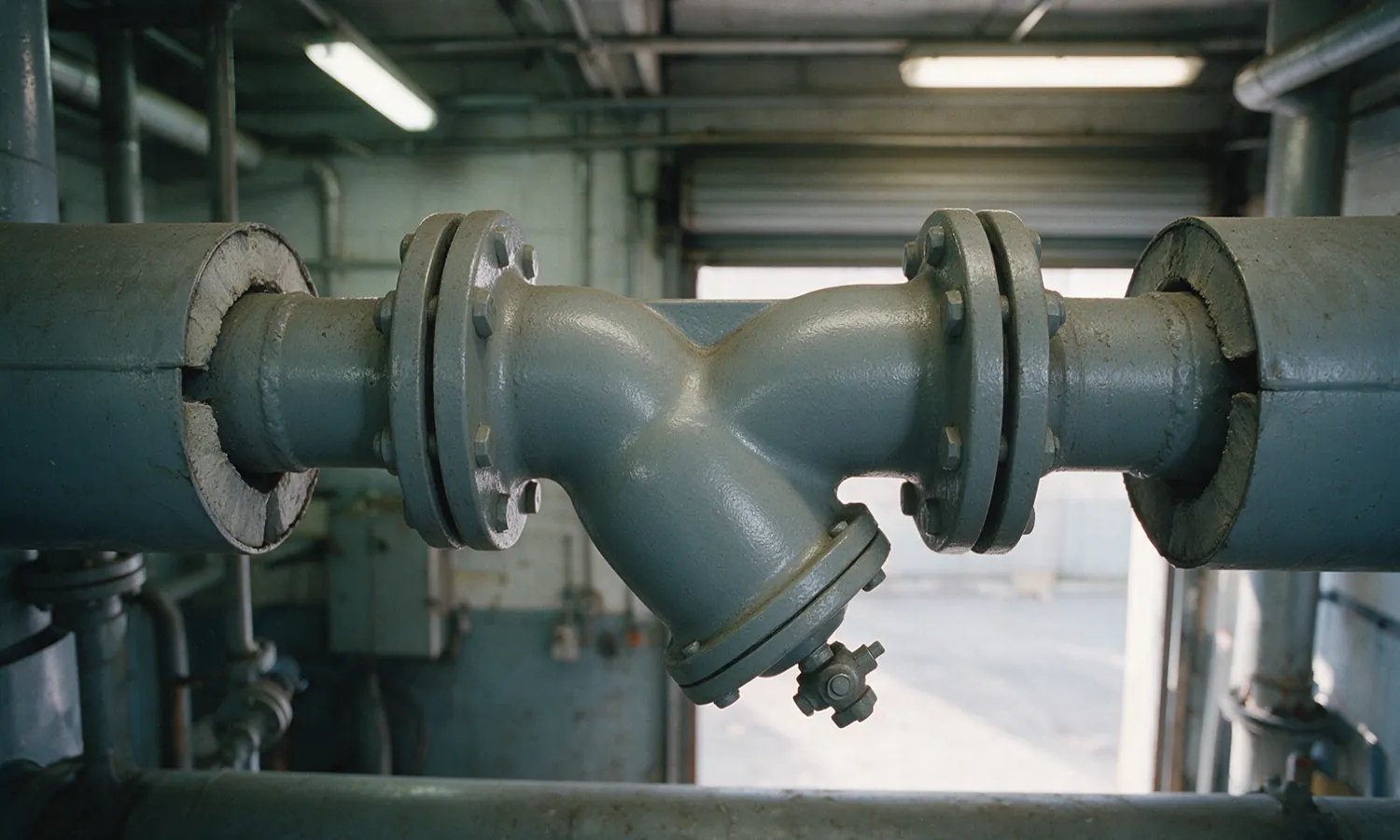
- A Y-strainer is the usual choice on steam and high-pressure lines with a light debris load.
- Size for size, a basket strainer holds more dirt and drops less pressure than a Y-strainer, says Spirax Sarco.
- Eaton's screen data puts 100 mesh at 140 microns and 200 mesh at 74 microns.
- Caleffi advises cleaning a hydronic Y-strainer at about 5 to 6 psi (0.35 to 0.4 bar) of pressure drop, never past about 10 psi (0.7 bar).
01What is the difference between a Y-strainer and a basket strainer?
A Y-strainer and a basket strainer both stop pipe debris reaching sensitive equipment, but their bodies differ. The Y-strainer, also called a wye strainer, carries its screen in a short leg angled off the pipe. The basket strainer drops a larger screen into a vertical pot. That body shape decides dirt capacity, pressure drop, pressure rating and orientation.
The Spirax Sarco strainer tutorial compares the two size for size. The Y-strainer holds less dirt, so it needs cleaning more often. The basket offers more free screen area, so its pressure drop is lower. A Y-strainer and a basket strainer are each better at a particular duty.
| Factor | Y-strainer | Basket strainer |
|---|---|---|
| Body | Compact cylinder with an angled screen leg | Larger vertical pot with a lift-out basket |
| Cost and weight | Low cost, compact and light (Watts) | Larger body; needs lifting headroom and a base support |
| Dirt-holding capacity | Lower, so cleaning comes round sooner | Higher, so runs between cleans are longer |
| Pressure drop, size for size | Higher | Lower, from the larger free screen area |
| Pressure duty | Strong compact body suits high-pressure steam | Check the rating; usually chosen for liquid duty |
| Orientation | Horizontal, or vertical with the flow running downward | Horizontal lines only |
| Cleaning | Remove the cap, or blow down through a valve on the cap | Lift out the basket; a duplex cleans on line |
| Best duties | Steam, high pressure, light debris, tight spaces | Liquid lines, heavy debris, larger steam mains, continuous service |
02When is a Y-strainer the right choice?
A Y-strainer is the right choice where space is tight and the debris load is light. Steam and high-pressure lines favour the Y pattern, and it serves gas lines as well. On steam, the Y-strainer is the default rather than one option among several.
Spirax Sarco calls the Y-type almost universal in steam service. The same guide notes that Y-strainers rated up to 400 bar g are not unusual. A strainer is a pressure part, so check its pressure and temperature rating against the line's worst case.
Spirax Sarco singles out rusty lines and newly commissioned plant as the hard cases on steam. A blowdown valve on the strainer cap lets line pressure flush the screen while the plant runs. Specify the blowdown valve with the strainer on any steam line that will see start-up debris.
Which way should a Y-strainer face on a steam line?
On horizontal steam or gas lines, lay the Y-strainer's pocket on its side, in the horizontal plane. On liquid lines, Spirax Sarco points the pocket straight down, so debris stays put when flow drops. A downward pocket on steam collects water, and droplets carried over can cause erosion and upset heat transfer.
Some makers' instructions show the leg down on every horizontal line. The Watts strainer guide and the Islip installation instructions both do. On steam, check the instructions for the model you are fitting.
Can a Y-strainer be installed in a vertical pipe?
A Y-strainer suits a vertical pipe only when the flow runs downward into the pocket. With upward flow the pocket would open downward, and anything caught would drop back into the line. Watts lists a strainer fitted backwards, upside down or flow-up among its things to avoid. Never fit a Y-strainer in a vertical line with upward flow.
03When is a basket strainer the right choice?
A basket strainer is the right choice on liquid lines that carry a heavy debris load. Its larger screen holds more dirt and costs less pressure drop than a Y of the same size. Where pumps move dirty water all day, the basket earns its bigger footprint.
Spirax Sarco notes basket strainers suit horizontal lines only, and heavy ones need support under the base. On steam, a basket gathers condensate, so steam-service baskets usually carry a drain that can take a trap. Before choosing a basket, check for a horizontal run, lifting headroom and a support point.
Where the line cannot stop, specify a duplex basket strainer. Two baskets sit in parallel, so operators clean one while the other carries the flow. For continuous service, a duplex basket is the usual answer.
In their words“Duplex basket-type strainers are suitable for continuous flow applications where the process cannot be shut down for cleaning.”
Cameron Rapoport (Watts) and Brian Blalock (Mueller Steam Specialty, a Watts brand), The Who, the What, and the Wye
04What mesh size should a strainer screen have?
The right mesh size is the coarsest screen that still protects the equipment downstream. Start from what the trap, valve, pump or meter can tolerate, and work back to an opening size. A screen finer than the duty needs only adds cleaning and pressure drop.
Spirax Sarco puts typical perforated-plate holes at 0.8 mm to 3.2 mm, which suits general pipe debris. Woven wire mesh goes far finer, and Spirax Sarco cites holes as small as 0.07 mm. Perforated plate handles the bulk debris in a line. Mesh catches the finer particles that would pass through the plate.
Mesh is counted in wires per inch, and wire size sets both hole and open area. Eaton's screen data puts 20 mesh at 864 microns, 100 mesh at 140 and 200 mesh at 74. Its open area figures run about 46%, 30% and 34% at those same counts. Ask for the opening in microns and the open area, not the mesh number alone.
What mesh suits a Y-strainer on steam?
On steam Y-strainers, Eaton suggests a Dutch weave such as 30 x 160. Its denser weave holds small particles and tolerates far higher pressure drop before bursting. Confirm the weave with the strainer maker against the trap or valve it protects.
FCX Performance defines open area ratio as the screen's free area divided by the pipe's cross-sectional area. Free area is the screen surface multiplied by its percentage open area. A higher open area ratio buys running time between cleans. A 4:1 strainer half clogged still has twice the pipe's area open.
05Where should a strainer be installed?
A strainer should be installed directly upstream of the equipment it protects. That means ahead of pressure reducing valves, control valves, steam traps, pumps and flow meters. Leave room to pull the screen or basket, and orient the body for the fluid. A strainer fitted downstream of the equipment protects nothing at all.
In their words“A strainer should be fitted upstream of every steam trap, flowmeter and control valve.”
Spirax Sarco, Learn about steam: Strainers
Debris under the seat can stop a PRV holding its set pressure. Our guide to sizing a pressure reducing valve puts the strainer first in the station. In a reducing station, the strainer always comes before the PRV.
Watts describes the Y-strainer as a common choice for pump protection. Debris under a check valve disc stops it seating, as our water hammer guide explains. On a pump suction, size the strainer generously, because a blinding screen starves the pump.
On hydronic terminal units, the strainer can sit inside the isolation valve itself. Optimus Distributor is an authorised distributor for Pettinaroli, whose FilterBall 51F has one built in. Range details and sizing notes are on our Pettinaroli page. One fitting at each fan-coil connection means fewer joints and no strainer dropped from the order.
06When does a strainer need cleaning?
A strainer needs cleaning when its pressure drop climbs well above the clean reading taken at design flow. Caleffi advises cleaning a hydronic Y-strainer at about 5 to 6 psi, roughly 0.35 to 0.4 bar. It also says never to let the drop pass about 10 psi, roughly 0.7 bar. Pressure gauges either side of a strainer turn the cleaning decision into a number.
Clean pressure drop depends heavily on the fluid the strainer carries. Spirax Sarco works an example: a DN40 strainer passing 500 kg/h of 8 bar g saturated steam. Spirax Sarco puts that drop at just over 0.5%. Spirax Sarco warns that strainer pressure drop can be significant in pumped water or viscous liquids.
Size a liquid strainer from the maker's Kv or Cv, then record its clean differential pressure. Islip Flow Controls suggests timing how long that clean pressure drop takes to double. Use the doubling time to set the schedule, and Caleffi's figures as the ceiling on hydronic lines.
07How to choose a pipeline strainer: a 7-point checklist
To choose a pipeline strainer, start from the equipment it protects and work outward. The particle size that equipment tolerates sets the screen, and the fluid and debris load set the body. It is the same duty-first logic as our guide to choosing the right industrial valve. Run these seven checks before a strainer goes on the order.
- Name the equipment it protects. Ask that maker what particle size its trim can pass.
- Choose the coarsest screen that stops that particle. Perforated plate for general debris, mesh only where needed.
- Match the body to the duty. Y for steam, high pressure and light debris; basket for heavy liquid duty; duplex where the line cannot stop.
- Check open area ratio and clean pressure drop. Use the maker's Kv or Cv for the screen actually fitted.
- Confirm rating, material and end connections. Read our comparison of valve body materials, then confirm against the current edition of the governing standard and your purchase order.
- Specify the accessories now. A blowdown valve on steam Y-strainers, a drain on steam baskets, gauge tappings and a spare screen.
- Plan the start-up. A new line usually needs a temporary strainer and a planned date to remove it.
Optimus Distributor supplies across Malaysia, including Sabah and Sarawak, from Subang Jaya, Selangor. It is an authorised distributor for KITZ, which makes valves, fittings and industrial filters. Browse the Strainer category on our products page. Send us your checklist answers, and we sit down with your engineers to settle the strainer.
08Questions buyers ask about pipeline strainers
Do new pipelines need a temporary strainer?
Most new lines benefit from one during commissioning. A temporary cone, basket or plate strainer sits between flanges and catches construction debris. Fit a spool piece so the strainer comes out easily afterwards. With a mesh liner, flow must meet the mesh first, backed by the perforated plate.
Can a basket strainer be installed in a vertical pipe?
No, a basket strainer needs a horizontal line. Its basket hangs in a vertical pot under the cover, which only works upright. Where only a vertical run is available, use a Y-strainer with the flow running downward.
What is the difference between a strainer and a filter?
A strainer removes visible debris with a perforated or mesh screen that is cleaned and reused. A filter removes much finer particles, for duties such as clean steam. On steam, a filter typically uses a sintered stainless steel element. Filters cost more pressure drop and block quickly, so fit a strainer upstream to protect them.
09Sources
- Spirax Sarco: Learn about steam, Strainers
- Watts: The Who, the What, and the Wye, everything you need to know about strainers
- Eaton: Technical information, standard cast pipeline strainers, basket and screen data (copy hosted by Hipco)
- Caleffi: How do I know when a y-strainer needs to be cleaned out?
- FCX Performance: Open area ratios and how they affect strainer performance
- Islip Flow Controls: Installation and maintenance instructions for IFC fabricated strainers