 OPTIMUS DISTRIBUTOR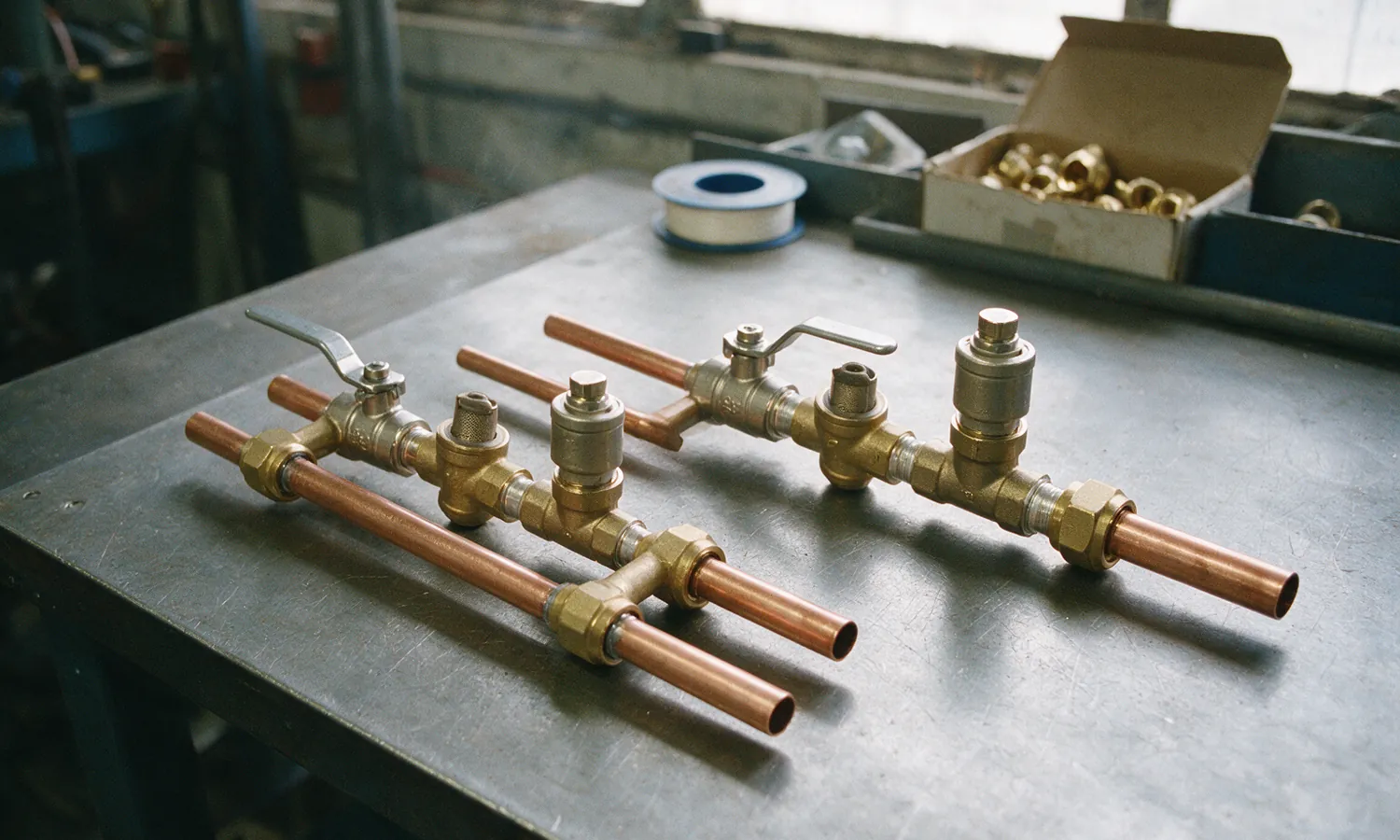
- A prefabricated valve kit is one package: a flushing by-pass, a pressure independent control valve and a ball valve with the strainer built in, joined and factory tested.
- Off-site assembly does not change the hydraulics. It changes where the joints are made, who tests them, and when the choices are locked.
- Pettinaroli identifies its PCS kits by the centre to centre spacing of the two legs, from 40 mm on the compact X4 assembly to 279 mm on the XT2790, each built around a named valve series.
- The insulating case, the flow measurement device and the spares are catalogue lines of their own, so name on the enquiry what has to come with the kit.
On this page9 sections
01What is a prefabricated valve kit?
A prefabricated valve kit is one factory-built assembly that connects a terminal unit to the chilled-water or heating pipework. The valves that isolate, strain and control the coil sit on one set of legs, joined and tested before the kit reaches site. It arrives ready to connect rather than as loose fittings to be built up in a ceiling void.
Pettinaroli groups them under the name PCS, for Pettinaroli Commissioning Solutions, and lists them in its own catalogue as preassembled valve kits. What that listing puts in most kits is short:
- a flushing by-pass, so the pipework can be cleaned without the water going through the control valve;
- a pressure independent control valve, named per kit: EvoPICV 91 or 93 Series, Dynasty 92, or the 83 Series;
- a FilterBall, which is a ball valve with the strainer built into it;
- on individual kits, a drain-off valve (the XT704), threaded connections (the XT1303) or a Venturi for reading flow (the XT716).
Everything else is ordered beside it. Pettinaroli's own HVAC catalogue describes this range as pre-fabricated valve assemblies for fan coils, chilled beams and air handling units, assembled and tested off site. Optimus Distributor is an authorised distributor for Pettinaroli and supplies it: the overview is on our Pettinaroli HVAC and data centre page, and the brand page is Pettinaroli hydronic balancing and PICV.
Have a terminal schedule already? Send it to us on WhatsApp, +6019 750 3980, or use our contact page, and our engineers will go through it with yours.
02What does off-site assembly actually change?
Off-site assembly changes three things, and none of them is the hydraulic selection. It moves where the joints are made, it moves where the assembly is tested, and it brings the specifying decisions forward to the order. The valve controlling the coil is the same valve either way.
The first is joints. Writing in Modern Building Services in June 2015, Oliver Jones of Marflow Hydronics described prefabricated valve sets as pre-assembled and pre-tested units that are fully prepared for installation
, with fewer joints so the leak potential is drastically reduced
. Fewer joints made at height, in sequence with other trades, is most of the argument.
The second is the testing. Danfoss, launching its own factory-built flushing by-pass assembly for larger plant in 2017, said that unit was factory built and supplied pressure tested to the Pressure Equipment Directive standard
in sizes DN15 to DN150, and that it saves time on site and eliminates the need for hot works
. That is one manufacturer describing one product under a European instrument, so take it as the question to ask rather than the answer: Pettinaroli's catalogue says its kits are factory tested for minimum leakage risk, and the test pressure and certificate for a given model are worth asking for by name.
The third is the decisions, and that one is our own reading from quoting these kits rather than a published finding: a kit cannot be altered on site, so choices an installer used to make in the field are made on the order instead.
03What gets locked in when the kit is built?
Five things are settled when the kit is ordered: the spacing between the legs, the valve family, the insulating case, the flow measurement device and the spares that go with it. The first two are properties of the kit model; the other three are catalogue lines of their own. That is why a kit enquiry is a short list of numbers rather than a product name.
Spacing is the one people miss. Pettinaroli's PCS listing identifies kits by the centre to centre distance between the two legs: the XT600 family at 60 and 40 mm, XT700 at 70 mm, XT800 at 80 mm, out to the XT2790 at 279 mm. Flow picks the valve. The coil connection picks the kit.
| Decision | Fixed by | If it is settled late |
|---|---|---|
| Centre to centre spacing | The kit model itself | The kit misses the coil connections and pipework is reworked |
| Control valve family | Named per kit: EvoPICV 91 and 93 Series, Dynasty 92, or the 83 Series | The wrong characteristic, or too little tolerance of dirty water |
| Insulating case | Separate cooling and heating items, such as 091ICV against 091IHV | Condensation on cold metal above a finished ceiling |
| Flow measurement | A Venturi on the kits that carry one, otherwise the separate V90 device, read with the MDPS2 manometer | No reading at the unit, so no commissioning record |
| Spares | Catalogued separately: 091SETP maintenance kit, 091D and 092D diaphragms | A part ordered from the factory while the unit is down |
Pettinaroli catalogues the insulating cases, the V90 Venturi device, the 091SETP maintenance kit and the by-pass valve for each kit series as separate accessories, which is why they belong on the enquiry rather than being assumed.
04Do a fan coil, a chilled beam and an AHU need the same kit?
A fan coil unit, a chilled beam and an air handling unit do not need the same kit. All three need the same four jobs done at the coil, flushing, isolation, strain and control, but on legs of different size and spacing. Pettinaroli's listed PCS kits run from 40 mm on the compact X4 assembly to 279 mm on the XT2790. The listing does not map a kit family to a unit type, and it does not need to: the coil connection sets the kit, not the name of the unit above it.
| Terminal unit | What decides the kit | What to settle before ordering |
|---|---|---|
| Fan coil | Small, repeated connections at a tight spacing | The spacing of the two tails, the handing of the kit, and whether the actuator is on the order |
| Chilled beam | A very small design flow | Whether that flow can be read at the unit at all |
| Air handling unit | One large connection | Valve body size, and whether a drain-off and test points are wanted |
Handing is a catalogue attribute, not a detail: the X4 assembly is listed as right-handed, so state the handing on the order.
Measurement is the other thing to settle early. Modern Building Services reported in 2012 that commissioning engineers meet ultra-low flows (<0.015 l/s)
that are too low to measure accurately and consistently with standard flow-measurement devices
, which makes compliance with CIBSE Commissioning Code W difficult. That article is about low-flow hydronic systems in general, and our own reason for raising it here is that a chilled beam, or a small fan coil, is where a flow that small turns up: if the design flow is near that figure, the measurement method belongs in the enquiry.
What the control valve itself is doing is in PICV explained, the balancing side is in hydronic balancing and PICV for commercial buildings, and the data hall version is in valve kits for data centre CRAH units.
05Why is the flushing by-pass the point of the kit?
The by-pass exists so pipework can be cleaned before commissioning without the dirty water passing through the control valve. Pettinaroli describes the PCS range as giving flushing without the water being flushed through the control valve. It is the part of a kit that earns its place before handover rather than during service.
What is at risk sits inside the control valve. Pettinaroli catalogues a differential pressure regulator diaphragm as a spare part for these valve series, and the kit's FilterBall is a ball valve with a strainer built into it.
Pre-commission cleaning is set out in the United Kingdom in BSRIA guide BG 29, which names mill scale, jointing compound and building debris among the contaminants that will inevitably be found in new pipework. The British and European documents named on this page are context for the practice: your own project specification governs. Our guide to choosing a pipeline strainer covers the larger strainers elsewhere in a plant room.
06What does a prefabricated kit not fix?
A prefabricated kit does not fix bad design data. A kit built to the wrong design flow, or to a differential pressure the branch never offers, is a wrong selection assembled neatly and tested properly. Prefabrication shortens the argument about workmanship. It does nothing about the schedule the kit was built from.
A kit also does not decide the water. On a refurbishment, where nobody can say what is in an existing loop, the valve family matters more than the packaging: Pettinaroli catalogues the Dynasty 92 Series as a PICV for heavily contaminated water, with internals that can be removed, cleaned and replaced and a dirt-resistant diaphragm, in sizes from half an inch to two inches and with a maximum start-up pressure of 0.25 to 0.40 bar depending on size. Our comparison of mechanical against electronic PICV covers the control side.
07What should a kit enquiry say?
Send the schedule rather than a product code. A kit is picked by the flow at the unit, the differential pressure the branch can give it and the spacing of the two connections, and usually only the first is on a drawing. Six lines are enough for our engineers to work a selection through with yours.
- Design flow per terminal unit, and how many units of each type.
- Differential pressure available at the unit, worst case and best case.
- Terminal unit type: fan coil, chilled beam, air handling unit or other.
- Coil connection size, and the centre to centre spacing of the two connections.
- New pipework or an existing loop, and anything known about the water.
- What comes with it: actuator and signal type, cooling insulating case, drain-off, flow measurement, spares.
New customers usually ask about price, lead time and stock, so tell us if those matter. Send the six lines on WhatsApp, +6019 750 3980, or through our contact page.
08Questions engineers ask us
Can prefabricated valve kits be used on a refurbishment, or only in a new building?
Prefabricated kits are used on both. In our experience refurbishment needs two extra answers first: the centre to centre spacing of the connections already in the ceiling, and the condition of the water in the existing loop. Where nobody can describe the water, the serviceable Dynasty 92 Series internals are the reason to look at that range.
Is a kit worth it on a job with only a few terminal units?
Our own view is that the savings prefabrication is sold on are repetition savings, so a handful of units gives up most of them. What stays on a small job is the factory-tested assembly, the by-pass arrangement and the correct insulating case. Ask us for both prices.
Does the kit arrive with the actuator fitted?
Not always. Pettinaroli's public PCS listings for ordinary HVAC terminal units name the control valve series and no actuator, while its data centre kits are catalogued with modulating actuators, so the actuator is a separate line unless the quotation says otherwise. Name the actuator and its signal type on the enquiry rather than assuming it is in the kit. A constant volume circuit may need none at all.
Can we specify a kit without naming a manufacturer's model?
Yes, and performance wording travels better than a model number. State the design flow, the available differential pressure, the connection size and spacing, and the characteristic wanted from the control valve, then require the assembly to be supplied with isolation, a strainer, a flushing by-pass that avoids the control valve, a flow measurement device and a cooling insulating case.
09Sources
Read 16 October 2026. Product names, spacings, series numbers and accessory codes are catalogue data from Fratelli Pettinaroli's own public pages and from its HVAC catalogue (printed pages 10 to 11, 31 to 32 and 46), which Optimus Distributor holds as the manufacturer's document: confirm every figure against the current datasheet for the model you are buying. The 2015 and 2017 trade-press items quoted above are suppliers describing their own products. BSRIA BG 29 and CIBSE Commissioning Code W are named and summarised from the published descriptions below, with no table, clause or acceptance value reproduced from either.
- Fratelli Pettinaroli, Hydronic kits PCS catalogue listing (kit families, centre to centre spacings, valve series).
- Fratelli Pettinaroli, HVAC accessories catalogue listing (by-pass valves, insulating cases, Venturi device, maintenance kit, diaphragms).
- Fratelli Pettinaroli, PICV range (Dynasty 92 Series: contaminated water, serviceable internals, dirt-resistant diaphragm).
- Fratelli Pettinaroli, HVAC Water distribution 2024 catalogue, printed pages 31 and 32 (the manufacturer's own document, held by Optimus Distributor).
- Oliver Jones, Marflow Hydronics, The perks of prefabrication, Modern Building Services, 3 June 2015.
- Danfoss develops valve assemblies for larger plant, Modern Building Services, 3 May 2017.
- Measuring ultra-low flows for commissioning, Modern Building Services, 2 February 2012 (CIBSE Commissioning Code W, ultra-low flow rates).
- BSRIA BG 29 on pre-commission cleaning, as summarised by Designing Buildings.