 OPTIMUS DISTRIBUTOR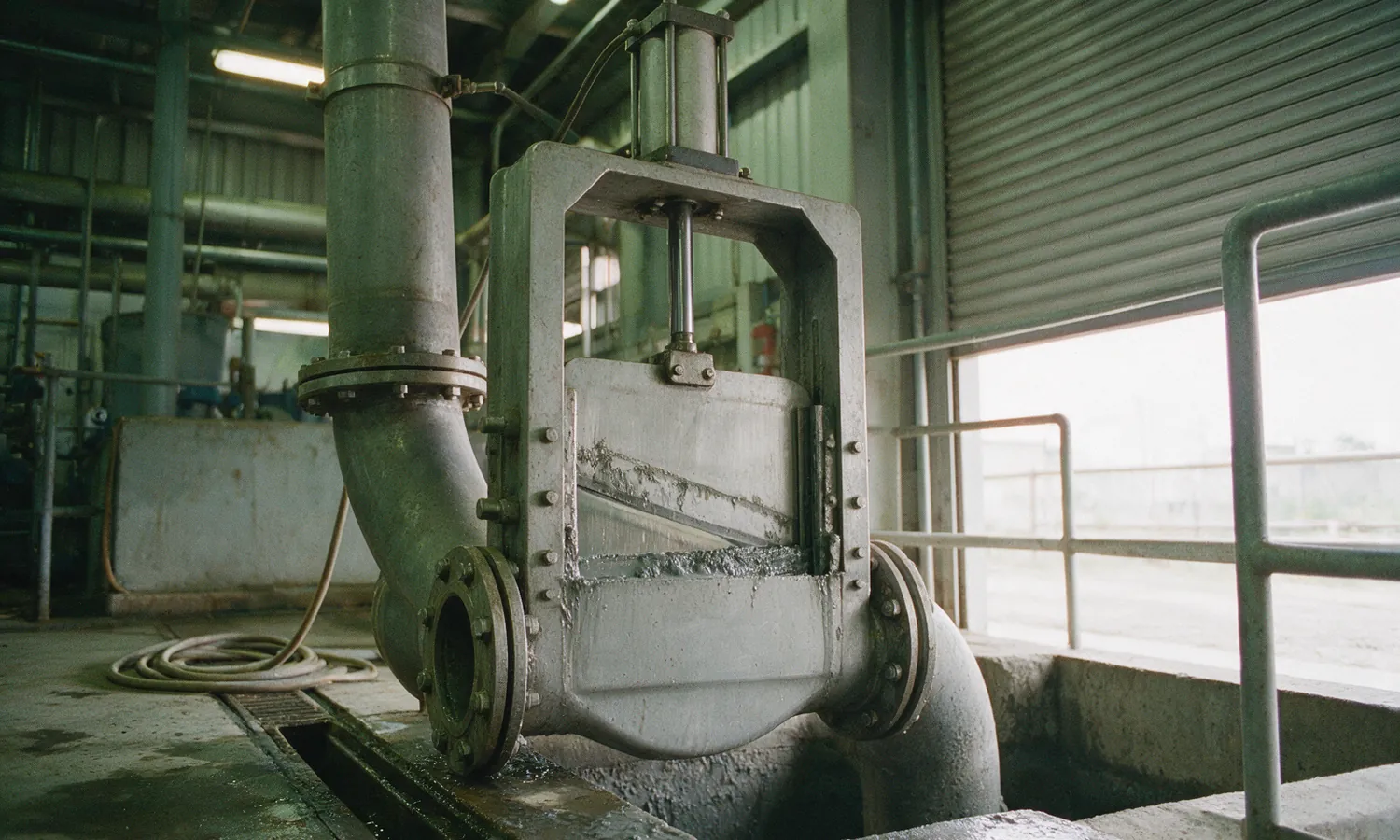
- A slurry, sludge, pulp or powder line usually needs a knife gate valve. A clean line that has to hold pressure and temperature usually needs a conventional gate valve.
- A knife gate valve closes with a thin bevelled plate in a short bonnetless body. A gate valve closes with a wedge inside a bolted bonnet.
- MSS SP-81, MSS SP-135 and AWWA C520 each cover knife gate valves, and no one of them covers every design. A line that says only "knife gate valve" has not said which.
- MSS SP-81 is the narrowest: bonnetless, flanged ends, stainless steel or stainless-steel-lined body, NPS 2 (DN 50) through NPS 36 (DN 900), per its own scope statement.
- Shut-off depends on the seat and the direction, not on the valve family. Both belong on the enquiry, because neither can be recovered from a size and a class.
01What is the difference between a knife gate valve and a gate valve?
A knife gate valve closes with a single thin plate with a bevelled edge, running in a short body with no bonnet over it. A conventional gate valve closes with a thicker wedge or parallel disc, guided inside a pressure-containing bonnet bolted to the body. A knife gate is built to cut through what is in the line; a gate valve is built to seal a clean line and hold pressure.
That one difference drives everything else. The thin plate shears through fibre, sludge and settled solids instead of trapping them, and the bonnetless body leaves no cavity above the seat for solids to pack into. The price is the pressure and temperature the valve can take, and usually the tightness of the shut-off.
Neither valve is the better valve. Fitting a knife gate to a clean high pressure line and fitting a wedge gate valve to a pulp line are the same mistake in opposite directions. Optimus Distributor's sales desk sees the same two mistakes: a buyer goes too cheap and meets costly downtime, or over-engineers without asking what the project actually needs. Where the choice is between gate, globe and ball on a clean line, start with our guide to choosing an isolation valve.
| Point | Knife gate valve | Conventional gate valve |
|---|---|---|
| Closure | A thin plate with a bevelled edge | A wedge or parallel disc |
| Body | Bonnetless in MSS SP-81; bonneted designs exist under AWWA C520 | Bolted bonnet in API Standard 600 |
| Face to face | Short, wafer or flanged | Longer than a wafer or flanged knife gate body |
| Suits | Fibre, sludge, powder, settling slurry, tank isolation | Clean liquid and gas, higher pressure and temperature |
| Documents to name | MSS SP-81, MSS SP-135, AWWA C520 | API Standard 600, MSS SP-42, ASME B16.34 |
02Which standard does a knife gate valve actually follow?
No single standard covers every knife gate valve, and that is the first thing to settle. MSS SP-81, MSS SP-135 and AWWA C520 cover them from three directions, and each excludes what the others include. A line that reads only "knife gate valve" has told the supplier the shape of the valve and almost nothing else.
| Document | What its published scope covers | Name it when |
|---|---|---|
| MSS SP-81-2021 | Bonnetless knife gate valves with flanged ends, stainless steel or stainless-steel-lined, NPS 2 (DN 50) to NPS 36 (DN 900) | The valve is a stainless bonnetless flanged one in that size band |
| MSS SP-135-2021 | Construction of wafer and flange type knife gate valves from ASME Code materials, meeting the applicable gate valve requirements of ASME B16.34 | The knife gate has to sit on a rated line rather than a gravity one |
| AWWA C520-19 | Bonneted and bonnetless, cast and fabricated steel, stainless steel and ductile iron bodies, resilient or metal seats, for water, wastewater and reclaimed water | The duty is water, wastewater or reclaimed water |
MSS SP-81 is the narrow one. The catalogue record for MSS SP-81-2021, published by the Manufacturers Standardization Society and titled Stainless-Steel or Stainless-Steel-Lined, Bonnetless, Knife Gate Valves with Flanged Ends, states that the Standard Practice "covers all stainless-steel or stainless-steel-lined, cast, or fabricated bonnetless, knife gate valves with flanged ends from size NPS 2 (DN 50) through NPS 36 (DN 900)". A ductile iron body or a bonneted design is outside it.
MSS SP-135 is the pressure one. The record for MSS SP-135-2021, High Pressure Knife Gate Valves, says it "covers the construction requirements for wafer- and flange-type knife gate valves made from ASME Code materials and meeting the applicable gate valve requirements of ASME B16.34".
AWWA C520 is the water one, and it is the broadest. The record for AWWA C520-19, published by the American Water Works Association and titled Knife Gate Valves, Sizes 2 In. (50 mm) Through 96 In. (2,400 mm), covers knife gate valves "with resilient or metal seats" in bonneted and bonnetless, cast and fabricated steel, stainless steel and ductile iron bodies, including tapping valves, for water, wastewater and reclaimed water systems. Its published scope also sets a service window by pH and temperature, and sets minimum design pressure ratings separately for the smaller and the larger nominal size bands.
A specification that cites MSS SP-81 and then asks for a bonneted knife gate valve has asked for something that document does not cover. The same happens with a ductile iron body under SP-81. Name the document that matches the valve you want, and say which edition. These three records are the publishers' catalogue records as held by the standards distributor Nimonik; buy the standards themselves from MSS and AWWA.
03Which valve does a slurry or sludge line need?
A knife gate valve belongs on the line when what flows through it would ruin a seating face. Solids, fibre and settling material collect in a bonnet cavity or wedge against a seat; a thin plate passes through them instead. A knife gate valve earns its place where the closure has to cut through the medium rather than seal against a clean face.
The manufacturer DeZURIK describes its own knife gate valves as used "in isolation/on-off applications to handle a wide variety of media including liquids, paper stock, slurries, chemicals, and dry materials", and offers a metal cutting pattern whose "serrated seat ring, hardened gate and oversized guides combine to provide shearing capability to cut, crush and clear wires, staples and glass". That is the duty in one sentence: the valve is specified for what it has to pass through.
- Fibrous and pulpy flow. Paper stock bridges across a wedge and holds it open. A thin plate parts the fibre instead.
- Settling slurry and sludge. Solids that drop out of suspension fill a bonnet cavity and stop the valve closing at all. A bonnetless body has no cavity.
- Powders and granular solids. Silo and hopper isolation is a knife gate duty for the same reason, and the short face to face suits the short spool pieces those lines use.
- Tank, hopper and chute isolation. Where the duty is open or shut at low pressure and the fitting length is tight, the compact body decides it rather than the rating.
- Large bore, low pressure water and wastewater. This is AWWA C520 territory, where the water document specifies the valve rather than a refinery one.
Those duties sit in the sectors Optimus Distributor supplies from Subang Jaya, Selangor: palm oil refinery and oleochemical, paper, water works, power and general industry, across Malaysia including Sabah and Sarawak. Our own knife gate valve category lists eight items. A knife gate valve is usually bought for the medium, not for the pressure, which is why the first question on an enquiry is what is in the line.
04When is a conventional gate valve still the right answer?
A conventional gate valve is still the right answer when the line is clean and the duty is rated. A bolted bonnet gate valve is the pressure-containing isolation valve of record for steam, clean water, oil, gas and process liquids, and it is backed by the standards a project specification is most likely to name.
The catalogue record for API Std 600, now in its 14th edition, covers steel gate valves with flanged and butt-welding ends and bolted bonnets. For corrosion resistant alloy valves, the record for MSS SP-42-2013, Corrosion-Resistant Gate, Globe, Angle, and Check Valves with Flanged and Butt Weld Ends (Classes 150, 300, & 600), says it "covers Classes 150, 300 and 600 corrosion resistant alloy gate, globe, angle and check valves with flanged and butt weld ends which are constructed of pressure containing parts, including materials that conform to ASME B16.34". The pressure-temperature rating itself comes from ASME B16.34, listed by ASME's own catalogue in its 2025 edition.
A conventional gate valve also gives you a bonnet, and a bonnet is maintainable. Stem packing can be renewed through it and the internals reached without cutting the valve out, which is why a line that will be opened for maintenance is rarely a knife gate line. How the body metal is chosen is covered in our guide to valve body materials.
05What does bonnetless mean for sealing, actuation and maintenance?
Bonnetless means the knife gate passes out of the body through a packing gland rather than into an enclosed bonnet. That is what makes the valve short, light and tolerant of solids, and it is also what limits it. A bonnetless knife gate valve has no pressure-containing cover over the gate, so the gland is the only thing between the line and the outside at the top of the valve.
- The seat decides the shut-off. AWWA C520's published scope separates valves with "resilient or metal seats". A resilient seat and a metal seat are different promises, and the seat is what a shut-off requirement actually rests on.
- Direction is a design question. Many knife gate patterns seat against flow from one side only; DeZURIK offers a bi-directional pattern whose "premium bi-directional perimeter seat provides both direct and reverse shutoff", which tells you the single-direction case is the one to rule out. If the line can be pressurised from either side, say so on the enquiry.
- The gland is a maintenance item. It is reachable without removing the valve, which helps, but it is also the part wearing while the plate cuts through solids.
- Actuation is part of the specification, not an afterthought. A rising stem with a handwheel suits an occasional duty; a pneumatic cylinder or an electric actuator suits a frequent one, and the yoke on a knife gate is built for it. Mounting and sizing are covered on our valve actuators and automation page.
Cost follows the same logic rather than contradicting it. A knife gate valve has a short body, less metal and a lower rating than a bolted bonnet gate valve of the same bore, so on a large low pressure line it is usually the cheaper purchase; on a rated line it is the wrong purchase at any price. That is the argument in why the cheapest valve usually costs the most. Where upstream protection is the real answer to solids in a line, a strainer may belong in front of the valve instead, and the two families are compared in Y-strainer against basket strainer.
06What should an enquiry for a knife gate valve say?
An enquiry should say enough for the supplier to pick a document before picking a product. Six lines settle a knife gate valve enquiry, and they are the same six whatever the brand:
- The medium, and what solids are in it.
- The size and the end connection.
- The pressure and the temperature at the valve.
- The standard and edition the project names.
- The seat type and the shut-off the duty needs.
- Whether the line can be pressurised from both sides.
Two of those six are the ones most often left out: the standard, because the specification itself left it out, and the direction, because it is assumed. Both change which valve is correct, and neither can be recovered from a size and a class.
Where the duty sits in the wider sequence is set out in our pillar guide, choosing the right industrial valve, duty first and budget second. The refinery and oleochemical plants where these lines are most common are described on our palm oil refinery and oleochemical page, and the duct-side relative of this valve, the guillotine damper, is on our industrial dampers page.
07Questions buyers ask about knife gate valves
Four questions come up on almost every knife gate enquiry: whether the valve can throttle, how it is rated, what to do when the specification and the drawing disagree, and whether it can replace a gate valve already in the line. The answers below are the short versions.
Can a knife gate valve be used for throttling?
Treat a knife gate valve as an isolation valve unless the maker's data sheet says otherwise for that model. It closes a line by driving a thin plate across the bore, and holding the plate part way across puts the whole flow across one edge of it. Some patterns are offered with a perforated or profiled gate for control duty, which is a product feature to confirm with the manufacturer.
Is a knife gate valve rated like a gate valve?
Not necessarily, and the standard named is what tells you. MSS SP-135 covers knife gate valves meeting the applicable gate valve requirements of ASME B16.34, the rating framework a rated line expects. MSS SP-81 and AWWA C520 cover knife gate valves on their own terms, and AWWA C520 sets minimum design pressure ratings separately for the smaller and the larger nominal size bands.
Our specification says MSS SP-81 but the drawing shows a bonnet. Which wins?
Raise it before the order, because the two cannot both be satisfied. MSS SP-81's scope covers bonnetless knife gate valves with flanged ends in stainless steel or stainless-steel-lined bodies, so a bonneted design sits outside the document the specification names. AWWA C520 covers bonneted as well as bonnetless knife gate valves, so on a water or wastewater duty that is usually the document the drawing had in mind.
Can a knife gate valve replace a gate valve in the same pipe run?
Rarely as a straight swap. The face to face dimension differs, the pressure and temperature rating is usually lower, and the shut-off and direction behaviour may not match. Send us the line conditions and the details of the valve already fitted, and the change can be checked on paper before anything is cut.
08Sources
Read 10 October 2026. The five standards entries below are publisher catalogue records held by the standards distributor Nimonik, except ASME B16.34, which is ASME's own page. This page names each standard and summarises what its catalogue record says. It reproduces no table, clause or other text from any standard, and it states no test pressure, duration or acceptance value. Buy the current editions from MSS, AWWA, API and ASME for the requirements themselves, confirm every line against the valve maker's own data sheet, and your purchase order governs.
- MSS SP-81-2021, Stainless-Steel or Stainless-Steel-Lined, Bonnetless, Knife Gate Valves with Flanged Ends (published by MSS, issued January 2021)
- MSS SP-135-2021, High Pressure Knife Gate Valves (published by MSS, issued January 2021)
- AWWA C520-19, Knife Gate Valves, Sizes 2 In. (50 mm) Through 96 In. (2,400 mm) (published by AWWA, issued January 2019)
- API Std 600, 14th edition, steel gate valves with flanged and butt-welding ends and bolted bonnets (published by API)
- MSS SP-42-2013, Corrosion-Resistant Gate, Globe, Angle, and Check Valves with Flanged and Butt Weld Ends (Classes 150, 300, & 600) (published by MSS, issued January 2013)
- ASME B16.34, Valves: Flanged, Threaded, and Welding End (ASME's own catalogue page, edition listed as B16.34-2025)
- DeZURIK, Knife Gate Valves (the manufacturer's own published product literature, for the service media, the metal cutting pattern and the bi-directional seat). DeZURIK is named here as a source only and is not a line Optimus Distributor supplies.