 OPTIMUS DISTRIBUTOR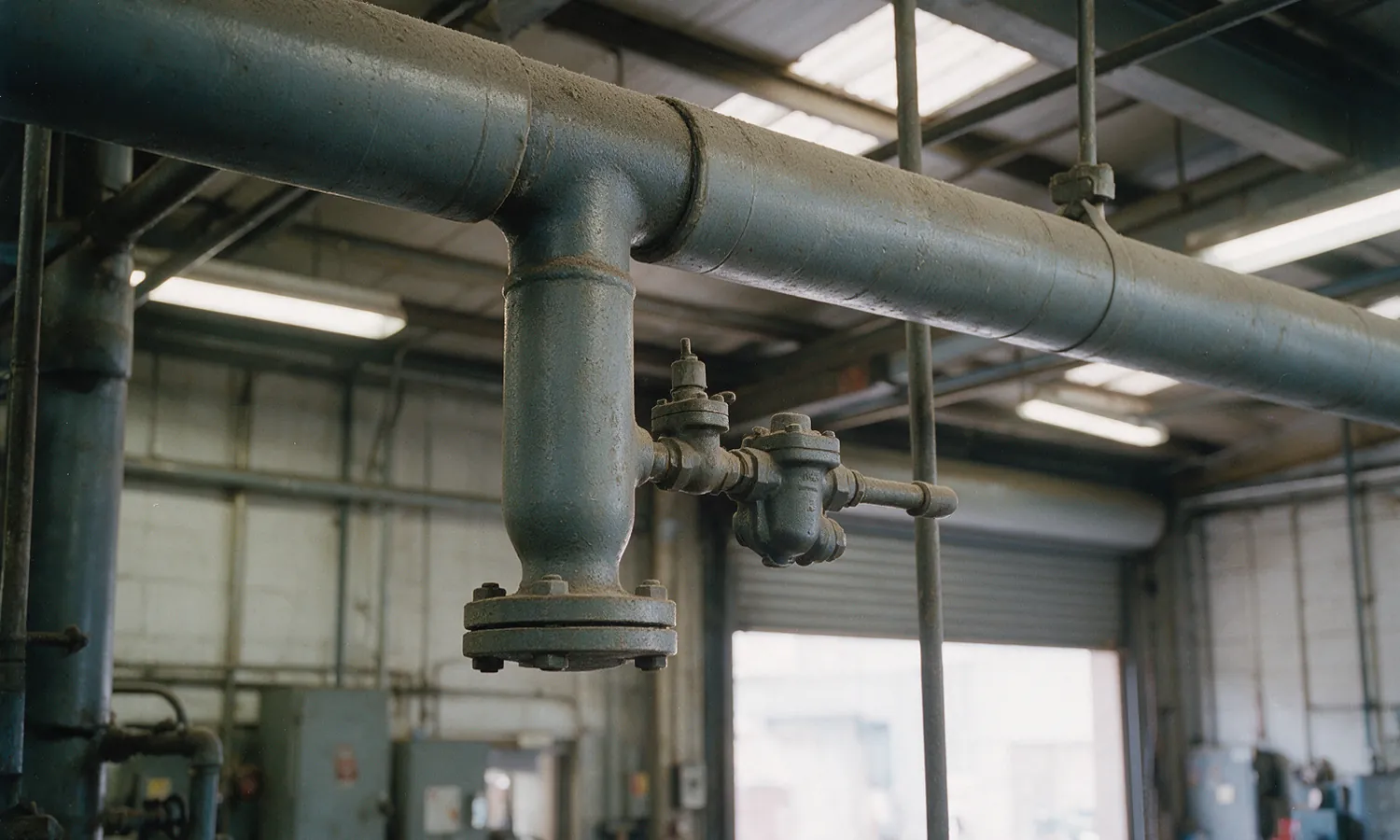
- A steam trap must discharge condensate, vent air and non-condensable gases, and stay shut to live steam.
- Temperature-controlled process equipment needs a float and thermostatic trap; drip legs suit a disc or inverted bucket.
- Size a trap on condensate load, safety factor and differential pressure; TLV's minimums for its own traps run from 1.5 (float) to 3 to 5 (bimetallic).
- When a control valve drops steam space pressure to or below back pressure, condensate stalls; a pump-trap is the usual cure.
- Unmaintained for 3 to 5 years, 15% to 30% of steam traps may have failed, says the US Department of Energy.
01What does a steam trap have to do?
A steam trap has three jobs at the same time. It must discharge condensate as it forms, vent air and non-condensable gases, and hold steam. TLV's explainer on steam traps cites the ANSI/FCI definition: a self-contained valve that drains condensate automatically yet stays steam-tight. Every selection decision comes down to which of those jobs the duty makes hardest.
Condensate left in a steam space blankets the heating surface and slows heat transfer. In a main, it becomes the slug described in our guide to water hammer.
Armstrong's condensate drainage guidelines say that, under certain conditions, 0.5% air by volume can cut efficiency by up to 50%. A trap that holds steam but cannot vent air is doing only two of its three jobs.
02What are the main types of steam trap, and what does each suit?
Steam traps fall into three families, which TLV's guide to trap types separates by density, velocity and temperature. Float and thermostatic traps, a mechanical type, suit process equipment whose load and steam pressure change. Spirax Sarco suits thermodynamic disc traps to steam main drip legs, where loads are small. Thermostatic traps suit non-critical tracing, where sub-cooling the condensate is useful.
Float and thermostatic traps discharge condensate the moment it arrives. Spirax Sarco's guide to mechanical traps rates this pattern the nearest thing to an ideal trap. Inverted bucket traps tolerate high pressure and water hammer, but their small bucket vent clears air slowly.
Thermodynamic disc traps need a real pressure difference to work. Spirax Sarco's guide to thermodynamic traps gives a typical minimum inlet pressure of 0.25 bar g. A disc trap tolerates back pressure up to 80% of its inlet pressure. Spirax Sarco says a cold, wet and windy site can make a disc trap cycle too often; an insulating cover slows it.
Thermostatic traps open only once condensate cools below steam temperature. Balanced pressure traps open fully at start-up, so they vent air well. Spirax Sarco's guide to thermostatic traps says bimetallic traps need a cooling leg, typically 1 to 3 m long. A thermostatic trap's sub-cooling is a benefit on tracing and a fault on a heat exchanger.
03Which steam trap suits each application?
Each plant duty has a usual first-choice trap: drip legs take a disc or inverted bucket trap. Non-critical tracing takes a thermostatic trap, and critical tracing a disc or float trap. Temperature-controlled heat exchangers and jacketed vessels take a float and thermostatic trap, with a pump-trap where stall occurs. The table covers common duties in Malaysian palm oil, oleochemical and food and beverage plants.
Selecting a steam trap for an application takes five steps:
- Name the duty. Say what the trap drains, and whether the load is steady or modulating.
- Pick the family. Match the duty to continuous discharge, sub-cooling or water hammer tolerance.
- Check for stall. On temperature-controlled equipment, check the differential at minimum load first.
- Size on load. Multiply the calculated condensate load by the maker's safety factor, at the lowest working differential.
- Confirm the orifice and body. The orifice must open at the highest differential. Then check connection, rating and material.
| Application | Usual first choice | Why | Watch-out |
|---|---|---|---|
| Steam main drip legs | Thermodynamic disc; inverted bucket as the alternative | Small running loads; both shrug off water hammer | Use a proper drain pocket, not a small bottom tapping |
| Non-critical tracing | Thermostatic: balanced pressure or bimetallic | Sub-cooling puts condensate heat into the product | One trap per tracer line, never one trap for several |
| Critical or high-temperature tracing | Thermodynamic disc or float | Little or no sub-cooling, so no cold length of tracer | A sub-cooling trap backs condensate up the tracer |
| Heat exchangers under temperature control | Float and thermostatic; pump-trap where stall occurs | Continuous discharge as load and steam pressure swing | Check for stall at minimum load first |
| Jacketed vessels and pans | Float and thermostatic, plus an air vent opposite the steam inlet | Heavy start-up load and a lot of air to clear | Tilting pans always steam-lock; specify a steam lock release |
| Tank heating coils and process vats | Float and thermostatic; disc or balanced pressure acceptable | All three suit; a disc trap is less affected by corrosive liquor from a leaking coil | A rising outlet needs a U seal and a small-bore lift pipe |
The table draws on Spirax Sarco's tutorials on process equipment and steam mains, tanks and vats. The tracing rows also draw on TLV; the one-trap-per-tracer rule is Armstrong's. Makers disagree on mains: Spirax Sarco favours disc traps, Armstrong's guidelines buckets, TLV's mains notes float traps.
Spirax Sarco's selection considerations suggest draining mains every 30 to 50 metres. Give each unit its own trap: on a shared trap, the highest pressure unit holds back the others' condensate.
The same logic runs through choosing an industrial valve by duty first, budget second. Our palm oil refinery and oleochemical page maps these duties.
Yoshitake was founded in Nagoya, Japan, in 1937. Yoshitake makes regulating valves, pressure reducing valves (PRVs) and steam traps. Optimus Distributor is an authorised Yoshitake distributor. See the Yoshitake steam trap and PRV range.
04How do you size a steam trap without oversizing it?
A steam trap is sized on three numbers: condensate load, a safety factor and the differential pressure. Pipe size is not one of them, as our guide to sizing a pressure reducing valve also argues. TLV's four-step method picks the trap type, then the model, then applies the maker's safety factor. The final pick goes to the lowest life cycle cost, not the lowest price.
TLV's page on safety factors sets minimums for its own traps: 1.5 for float and 3 to 5 for bimetallic. TLV puts its bucket, disc and X-element thermostatic traps at 2. Armstrong's guidelines put the general range at 1.5 to 10. Intermittent disc and bucket traps need more margin than continuous float traps.
Armstrong warns that a needlessly oversized trap wears out faster and loses more steam when it fails. Spirax Sarco's disc trap guide warns that an oversized disc trap cycles longer and wears faster.
Armstrong's guidelines define the maximum differential as supply pressure, or PRV outlet pressure, minus return line pressure. A float or bucket trap facing more differential than its orifice is rated for stays shut. Spirax Sarco's guide to mechanical traps makes that point.
Armstrong puts the back pressure from lift at about 1 psi per 2 ft, roughly 0.1 bar per metre. That holds for condensate alone; flash steam can cut it to nothing.
05What is stall, and when is a pump-trap needed?
Stall is the slowing or stopping of condensate flow from a heat exchanger. Spirax Sarco's stall tutorial places it where steam space pressure equals or drops below the trap's total back pressure. Stall strikes temperature-controlled equipment at part load, as the control valve throttles steam pressure down. No trap can discharge condensate against a negative differential.
Exchangers come in fixed sizes, often with spare area. Extra area means lower operating steam pressure, which leaves less pressure to push condensate out. Spirax Sarco's stall tutorial lists symptoms including a cold trap, a hunting valve, unsteady outlet temperature and water hammer.
In palm oil and oleochemical plants, check every temperature-controlled product heater, tank coil and air heater for stall. Lift after a controlled exchanger is a warning sign. Spirax Sarco's selection notes warn of a tendency to water hammer there, whichever trap is fitted.
In their words“Merely replacing the trap does not prevent the occurrence of Stall because it will not resolve the negative pressure differential that occurs across the trap.”
TLV, What is Stall?
The cure is to restore the differential, not to swap the trap. Where stall is likely, Spirax Sarco's guide to preventing stall calls a pump-trap generally the most effective answer. For open drainage, a vacuum breaker plus a float trap 0.5 to 1 m below the outlet also works.
06How do steam traps fail, and how often should you test them?
Steam traps fail in two directions, and both cost money. A trap that fails open blows live steam into the condensate return. A trap that fails shut, or blocks, backs condensate into the equipment it serves. Neither failure can be confirmed without testing the trap.
The US Department of Energy (DOE) steam tip sheet is blunt. In systems left unmaintained for 3 to 5 years, 15% to 30% of traps may have failed. A regular programme should hold leaking traps below 5% of the population.
The DOE tip sheet sets the test interval by pressure. Test traps at 150 psig (about 10 bar g) and above weekly to monthly. Test from 30 to 150 psig (about 2 to 10 bar g) monthly to quarterly. Test below 30 psig once a year.
The tip sheet's example is a trap stuck open at 150 psig with a 1/8 inch orifice. It loses an estimated 75.8 lb (about 34 kg) of steam an hour. Running all year, that one trap with a 1/8 inch orifice wastes roughly 300 tonnes of steam.
How do you test a steam trap?
The DOE tip sheet names four basic test methods: temperature, sound, visual and electronic. Spirax Sarco's testing guide cautions that steam and condensate can sit at the same temperature. Temperature alone is not a reliable test.
TLV's note on live and flash steam warns that a visible discharge cloud is often harmless flash steam. Live steam is invisible just past the outlet and leaves faster. A survey in four steps avoids the common wrong calls:
- List every trap with its duty. Tag, application, type, size, pressure and discharge point.
- Test with two methods. Pair temperature with ultrasound or a sight glass.
- Find the cause before replacing. Repeat failures usually point at layout, water hammer or dirt, not the trap.
- Service the strainer too. Pipe scale and dirt hold traps open or block them. Our guide to choosing a Y or basket strainer covers screen sizing.
A survey ends in a list: traps to replace, traps to repair, strainers to clean. Bring that list to us: we sit down with your engineers and match each replacement to its duty.
07Questions buyers ask about steam trap selection
Is a thermodynamic trap suitable for a heat exchanger?
Usually not on a temperature-controlled exchanger. A disc trap needs a real pressure difference to cycle, and modulating control can remove it at part load. A float and thermostatic trap suits most exchangers, with a pump-trap where stall is expected.
How often should steam traps be tested?
Test by pressure and by how critical the duty is. The US Department of Energy suggests weekly to monthly checks from 150 psig, about 10 bar g. It suggests monthly to quarterly from 30 to 150 psig, about 2 to 10 bar g. Below 30 psig, it suggests once a year. Critical process traps justify online monitoring.
What information is needed to select a steam trap?
Send what the trap drains and its start-up and running condensate load. Add the inlet steam pressure and the back pressure or lift after the trap. Connection, orientation and body material complete the brief.
08Sources
- US Department of Energy: Inspect and Repair Steam Traps, Steam Tip Sheet #1
- TLV: What is a Steam Trap?
- TLV: Applications of Different Types of Steam Traps
- TLV: Steam Trap Selection: How Application Affects Selection
- TLV: Steam Trap Selection: Safety Factor and Life Cycle Cost
- TLV: Installation Tips for Steam Traps on Steam Mains
- TLV: What is Stall?
- TLV: Is My Trap Leaking Live Steam?
- Spirax Sarco: Mechanical Steam Traps
- Spirax Sarco: Thermodynamic Steam Traps
- Spirax Sarco: Thermostatic Steam Traps
- Spirax Sarco: Considerations for Selecting Steam Traps
- Spirax Sarco: Selecting Steam Traps, Process Equipment
- Spirax Sarco: Selecting Steam Traps, Steam Mains, Tanks and Vats, Pressure Reducing Valves
- Spirax Sarco: Heat Exchangers and Stall
- Spirax Sarco: Practical Methods of Preventing Stall
- Spirax Sarco: Testing and Maintenance of Steam Traps
- Armstrong International: Steam Conservation Guidelines for Condensate Drainage (copy hosted by Affiliated Steam)