 OPTIMUS DISTRIBUTOR
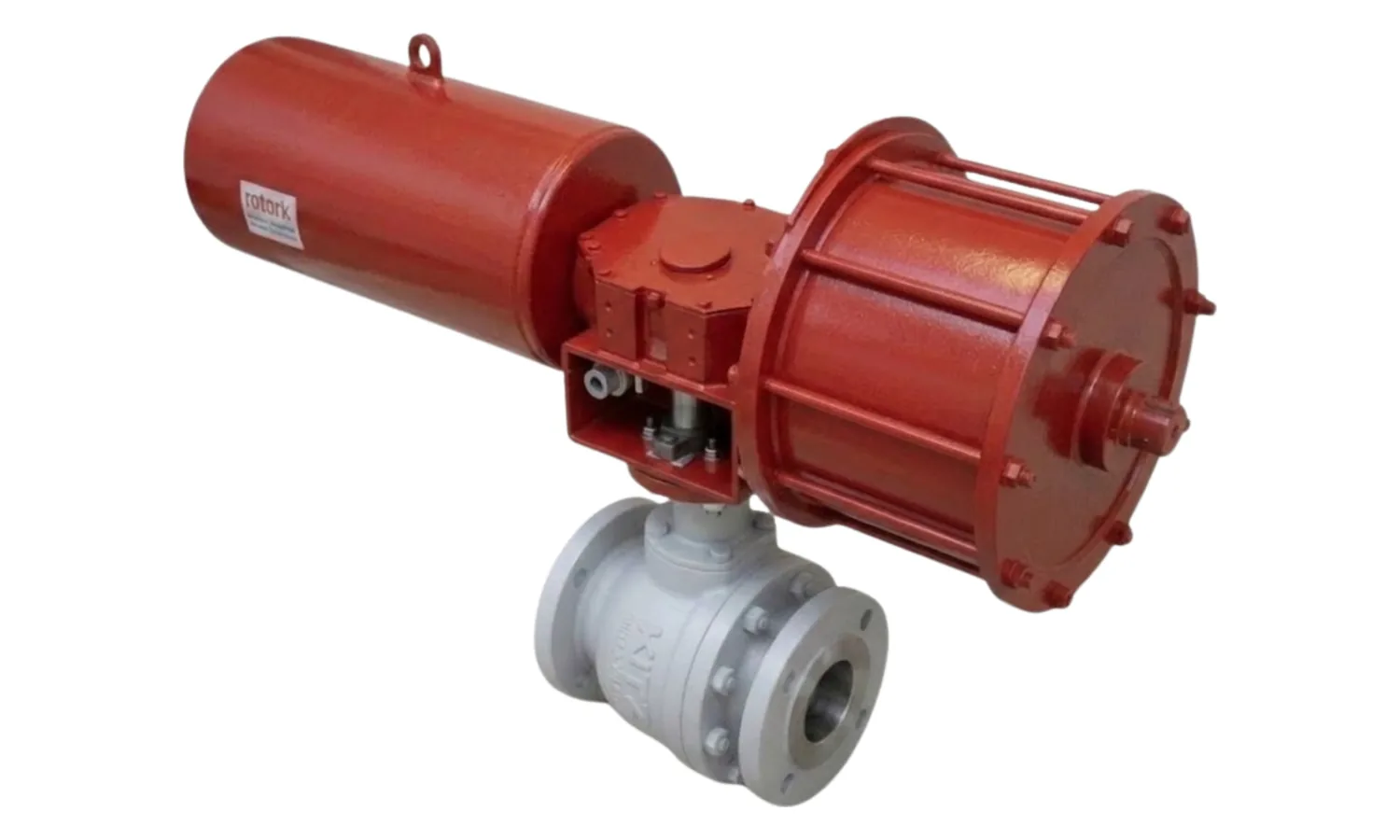
- The KITZ pneumatically actuated LTCS ball valve is a full bore floating ball valve, 8 inch (DN 200) and ASME Class 300, with a body cast in ASTM A352 LCC, a low-temperature carbon steel.
- The KITZ actuated LTCS ball valve's Rotork GP scotch-yoke actuator is single-acting and spring-to-close: instrument air opens the valve, and the spring shuts it when the air goes.
- On the KITZ actuated LTCS ball valve, a trip makes the solenoid valve (SOV) vent the actuator so the spring shuts the ball; the filter regulator feeds the actuator clean air at a steady pressure.
- The LCC body is impact tested to -46 °C under ASTM A352, but KITZ rates its standard SCTDZ seats from -29 °C and Rotork its standard GP from -30 °C, so confirm the valve's own minimum design temperature.
- Optimus Distributor's listing names NACE MR0175, the materials standard for oil and gas production where hydrogen sulfide is present.
On this page11 sections
01What is the KITZ pneumatically actuated LTCS ball valve?
The KITZ pneumatically actuated LTCS ball valve is an automated valve that opens on air and shuts on a spring. It is a KITZ full bore floating ball valve, figure 300SCTDZXCLM-FS, in 8 inch (DN 200) ASME Class 300 with raised face flanges. A Rotork GP-085S pneumatic scotch-yoke actuator turns it, with a control panel, a solenoid valve (SOV), a filter regulator and tubing.
Optimus Distributor, in Subang Jaya, Malaysia, was appointed authorised distributor for KITZ valves in 2019 and lists this build. Check the full figure, 300SCTDZXCLM-FS, against the KITZ datasheet for the order.
| Part | On this valve | What it does |
|---|---|---|
| Valve type | Floating ball, full bore | Line pressure presses the ball onto the outlet seat; the bore matches the pipe |
| Size and rating | 8" (DN 200), ASME Class 300, raised face flanged | The class sets the pressure the valve may hold at each temperature |
| Body and cap | ASTM A352 Gr. LCC | Carbon steel casting made for low-temperature service |
| Ball | ASTM A182 F316 / A351 CF8M | Type 316 stainless steel |
| Stem | ASTM A182 F51 / UNS S31803 | 2205 duplex stainless steel |
| Seats | HYPATITE PTFE | KITZ's own modified PTFE ball seat |
| Packing and gasket | Flexible graphite | Stem and body seals |
| Requirement | NACE MR0175 | Materials for oil and gas production with hydrogen sulfide |
| Actuator | Rotork GP-085S, pneumatic scotch-yoke, single-acting, fail-close | Air opens the valve, the spring closes it |
| Accessories | Control panel, SOV, filter regulator, tubing | Trip the valve, and feed it clean air at a set pressure |
02How does a floating ball valve shut off the line?
A floating ball valve shuts off because line pressure pushes the ball onto the outlet seat. The ball sits between two soft seats, one on the inlet side and one on the outlet, and when the valve closes the pressure presses it against the outlet seat. KITZ describes it on its ball valve page:
"When closing, the ball is pushed against the fluid pressure, and the ball acts as a sealing force against the secondary side sheet [seat]."
KITZ Corporation, Ball Valves
A quarter turn, 90°, takes a ball valve from fully open to fully shut, which KITZ says is why ball valves suit automation. The full bore means the hole through the ball matches the pipe, which KITZ notes gives small fluid resistance.
SCTDZ in the figure number is a KITZ series name, given on KITZ's ball seat page. KITZ's TDZ series page describes split-body, full bore, flanged floating ball valves built to ISO 17292 and API 608, with an ISO 5211 top mount for the actuator. The seats are HYPATITE PTFE, a modified PTFE ball seat KITZ developed, which KITZ says resists compression and creep better than other PTFE materials. How a ball valve compares with gate and globe patterns is in gate, globe or ball: choosing the right isolation valve.
03How does the actuator close the valve by itself?
The actuator closes the valve with a spring. The Rotork GP is a pneumatic scotch-yoke actuator, which Rotork builds to give ball, butterfly and plug valves a rotary, quarter-turn movement. On this single-acting, spring-to-close unit, instrument air drives the piston to open the valve and holds it open. When the air goes, the spring turns the ball back to shut.
"A spring-return, single-acting actuator provides an inherent fail mode for the valve assembly."
Emerson, Control Valve Handbook, sixth edition
Emerson's handbook gives the usual way to reach the safe state in an emergency: remove the air pressure to the actuator and let the spring position the valve. For the KITZ actuated LTCS ball valve, that safe state is closed.
Rotork's GP range flyer adds two details that matter on site:
- Rotork can build a spring-return GP to fail in either direction, so spring-to-close is part of this build, not a given. The spring module can only come off the centre body after all its force is released.
- The actuator has its own cold limit: -30 °C for a standard GP, with -40 °C and -60 °C builds. Match it to the coldest the actuator itself will see.
How an actuator and its fail action are chosen together is covered on our valve actuators and automation page.
04What do the solenoid valve and filter regulator do?
The solenoid valve is the trip, and the filter regulator keeps the air clean and steady. Emerson's handbook describes an SOV as an on/off electro-magnetic valve worked by a discrete signal from the control system, with a three-way SOV used on spring-return actuators. ControlAir says air filter regulators remove solid and liquid contaminants and keep the pressure to valves steady.
What happens on a trip, step by step:
- In service, clean instrument air from the filter regulator holds the valve open against the spring.
- The control or shutdown system sends a trip, which the SOV acts on.
- The SOV vents the air from the actuator, which Emerson describes as letting the valve move to its no-air, fail state.
- The spring drives the scotch yoke back and turns the ball a quarter turn to shut.
- If the instrument air itself fails, the end is the same: no air, so the spring shuts the valve.
Whether the SOV trips when its coil is switched off or on (de-energise to trip or energise to trip) is set by the panel design, so check it on the panel drawing with the coil voltage and the hazardous area rating. The listing names no limit switch. Emerson's handbook says a limit switch gives the control system a discrete open or close signal at a set valve position. Ask for one if the shutdown logic needs proof the valve has closed.
Quoting a shutdown valve? Send the panel drawing or the cause and effect chart with the enquiry on WhatsApp, +6019 750 3980.
05Why is the body LTCS, and how cold can the valve go?
LTCS means low-temperature carbon steel, and this body is ASTM A352 grade LCC, a casting grade intended primarily for low-temperature service. ASTM gives -46 °C (-50 °F) as LCC's usual minimum testing temperature, the lowest at which the material ordinarily has to meet the standard's impact requirements. The valve's own minimum design temperature is also set by its seats, bonnet and actuator: confirm it on the datasheet for figure 300SCTDZXCLM-FS.
Emerson's handbook gives LCC the same composition as WCC cast carbon steel, and lists it from -45 °C, its own rounding of the same -50 °F. How carbon steel, stainless steel and bronze bodies compare is in valve body materials compared.
The body is not the whole valve. KITZ rates the standard HYPATITE seats on its SCTDZ series from -29 °C, lower only with an extended bonnet and special low temperature materials. Its low temperature page lists -46 °C for the carbon steel TDZ series. A standard Rotork GP is rated to -30 °C.
06What does NACE MR0175 mean on this valve?
NACE MR0175 is the materials standard for oil and gas production where hydrogen sulfide (H2S) is present. Emerson's handbook says NACE issued it in 1975 to guide the choice of materials that resist failure in H2S-containing oil and gas production environments. Since late 2003 it has been the joint document NACE MR0175/ISO 15156. Optimus Distributor's listing names it as the requirement for this valve's materials.
NACE MR0175 on a listing is not a blanket sour service rating. TWI says it now falls to the end user to judge what is acceptable for their own service, so the line's H2S conditions belong in the enquiry. Refineries use a different document: Emerson's handbook describes NACE MR0103 as the refining industry's version, since reissued as MR0103/ISO 17945.
On the order, ask for the material certificates and a statement naming the document and edition the materials meet.
07Where does ASME Class 300 sit?
ASME Class 300 is the pressure class above Class 150, and its allowed working pressure changes with material and temperature. Emerson's handbook table for WCC cast valves to ASME B16.34-2013 gives Class 300 51.7 bar from -29 to 38 °C, against 19.8 bar for Class 150. That table covers WCC, not LCC, so check the LCC figures in ASME B16.34 at the design temperature.
08Which applications and industries suit this valve?
The KITZ actuated LTCS ball valve suits lines that must shut by themselves: emergency shutdown and isolation duty, in low-temperature service within the valve's rated limit, and H2S service within the limits of its materials. Emerson's handbook names ball valves among the final elements a safety instrumented system uses for emergency shutdown (ESD), to take the process to a safe state.
| Industry or duty | What in the build suits it | What to check |
|---|---|---|
| Emergency shutdown and isolation | Spring-to-close actuator with an SOV trip | Trip logic and position feedback |
| Oil and gas production with H2S | Materials to NACE MR0175 | H2S conditions and the edition named |
| Petroleum and petrochemical plant | The TDZ series, made by KITZ to ISO 17292 and API 608 | That figure 300SCTDZXCLM-FS is a TDZ-series valve, on the KITZ datasheet |
| Low-temperature lines | LCC body impact tested to -46 °C | Seats, bonnet and actuator rated as low |
KITZ says its TDZ series meets ISO 17292 and API 608 for the petroleum, petrochemical and allied industries. Oil and gas and petrochemical are among the industries Optimus Distributor serves. More is on our oil, gas and petrochemical valves page, and on matching a valve to its duty in choosing the right industrial valve.
09What should an enquiry for this valve state?
An enquiry for an actuated ball valve should state the service and what the valve must do when air or power fails. Emerson's handbook lists the action desired on air failure, the instrument air supply available, the instrument signal, the body material, and the end connections and rating among the information a valve maker needs. For this build, add the cold and sour conditions:
- The fluid, its H2S content if any, and whether NACE MR0175, or MR0103 for a refinery, applies. For refinery service, ask for MR0103 / ISO 17945 materials.
- The minimum and maximum design temperatures, and the coldest ambient on site.
- The design pressure and the class.
- Size, bore and ends.
- The action on air failure, and the instrument air pressure available.
- The SOV coil voltage, its trip logic, the hazardous area rating, and any limit switch.
- The documents needed: material certificates, the NACE statement, test and fire test certificates.
We sit down with your engineers to make sure the valve fits the job. Send these lines on WhatsApp, +6019 750 3980, or see the KITZ valves page for the wider range.
10What do engineers ask about this valve?
Does the valve close if the instrument air fails?
Yes. The KITZ actuated LTCS ball valve is single-acting and spring-to-close, so losing the instrument air removes the only force holding it open and the spring turns the ball shut, with no power or signal needed. A double-acting actuator would need extra accessories, such as pneumatic trip valves or lock-up systems, to reach a set position.
Can the KITZ actuated LTCS ball valve throttle flow?
No, it is built to open and shut. Rotork offers the GP range for on/off or modulating duty, but the valve's solenoid valve (SOV) only fills or vents the actuator. Emerson also notes that a full-port ball must turn 15 to 20 degrees from wide open before it absorbs significant energy, so for control duty choose a valve made for it.
Can the KITZ actuated LTCS ball valve be opened by hand when the air is off?
Only if a manual override is fitted. Rotork offers GP override options, including open or enclosed jackscrews and hydraulic overrides. The listing for this valve does not name one, so ask for an override in the enquiry if the site needs to work the valve by hand during start-up, maintenance or an air outage.
Is the KITZ actuated LTCS ball valve fire safe?
The listing does not state a fire test certificate for figure 300SCTDZXCLM-FS. KITZ says API 607 and ISO 10497 fire test certification is available for its TDZ series, so ask for the certificate that covers this exact figure and size. Our guide to fire-safe ball valves explains what the two tests prove.
Does NACE MR0175 cover every sour service?
No. NACE MR0175 is written for oil and gas production, and the end user judges what is acceptable for each service. Refinery service uses a different document, NACE MR0103 / ISO 17945. Send the H2S conditions, and the document and edition the project names, with the enquiry.
How is a shutdown valve proved between shutdowns?
By testing it in service. Emerson's handbook says safety valves sit still in normal operation and are prone to sticking. It describes partial stroke testing: the valve moves a portion of its travel and back, which exercises its mechanical parts with minimal disruption to the process. Ask whether the shutdown system needs it, because it shapes the panel.
11Sources
Read 27 October 2026. The build is as Optimus Distributor lists it; confirm every line against the datasheet for the order. ASME B16.34, ASTM A352 and NACE MR0175 are cited and summarised, not reproduced.
- KITZ Corporation, Ball Valves, Floating type ball valves (TDZ series), Ball seats and Ball valves for low temperature services.
- Rotork, GP/GH range flyer (PUB011-043-00, issue 05/26).
- Emerson, Control Valve Handbook, sixth edition, 2023 (fail modes, solenoid valves, limit switches, partial stroke testing, materials, NACE MR0175, ASME B16.34 ratings, safety instrumented systems).
- ASTM International, ASTM A352/A352M-21, scope and grade temperatures.
- ControlAir, Air filter regulators.
- TWI, What has happened to the MR0175 standard?
- Optimus Distributor, its product listing for the KITZ pneumatically actuated LTCS ball valve, and its KITZ appointment of 2019.